Build a real online business from the ground up—business models, positioning, audience clarity, the PPP framework, and the core skills that make everything else work.
Bottom line: You don’t need a dozen expensive subscriptions to build a successful online business. After years of running Internet Marketing Muscle, I’ve learned that a small, reliable toolkit beats a bloated software stack every time. These are the top 10 internet marketing tools for 2026 (and beyond) I use most often, along with free or open-source alternatives that can save you money without sacrificing results.
Note that these internet marketing tools are used IN my business. They are NOT my business. I use them because they help me Publish. Promote. Profit.
My Top 10 Internet Marketing Tools for 2026 (Plus the Best Free Alternatives) 5
Table of Contents (Top 10 Internet Marketing Tools for 2026)
Whether you’re just getting started or looking to simplify your workflow, these are the tools I’d recommend.
Most people don’t think much about their web browser, but it’s one of the most important tools in my business.
Microsoft Edge has become my browser of choice because it’s fast, stable, and packed with productivity features. Vertical tabs, sleeping tabs, Collections, built-in AI features, and excellent PDF support make research and content creation much easier.
When you’re writing articles, researching competitors, or juggling dozens of tabs, those little improvements add up.
Why I use it
Fast performance
Excellent memory management
Vertical tabs
Collections for research
Built-in AI features
Great PDF tools
Free alternative
Mozilla Firefox is an excellent open-source browser with outstanding privacy features and thousands of extensions.
ChatGPT has become my everyday marketing assistant.
No, it doesn’t write my business for me. It helps me think faster and do more good things.
I use it to brainstorm article ideas, organize outlines, summarize research, improve headlines, rewrite awkward paragraphs, and generate FAQs. It eliminates blank-page syndrome and speeds up nearly every part of the writing process.
One of the biggest productivity hacks I ever discovered was using an RSS reader.
Instead of visiting dozens of websites every morning, the news comes to me.
Inoreader collects updates from SEO blogs, AI websites, affiliate marketing resources, YouTube channels, industry publications, and news sites into one organized dashboard.
Your email list is the most valuable asset you can build online.
Search rankings change. Social media algorithms change. Your email subscribers are yours.
I’ve used AWeber for years because it keeps email marketing simple. I use it to welcome new subscribers, deliver lead magnets, announce new articles, and stay connected with readers.
Notepad++ may be the least glamorous tool on this list…
…but it’s one of the ones I use the most.
Whenever I need to edit HTML, CSS, JavaScript, Markdown, robots.txt, or plain text, Notepad++ launches instantly and gets out of my way.
Every marketer should have a quality text editor.
This is mine.
Why I use it
HTML editing
CSS
JavaScript
Markdown
Configuration files
Quick notes
Free alternatives
Notepad++ is already free.
Other excellent options include:
Visual Studio Code
VSCodium
Geany
Honorable Mentions
A few tools narrowly missed my Top 10 but are still part of my regular workflow.
Rank Math SEO
My preferred SEO plugin for WordPress. It handles schema, XML sitemaps, redirects, metadata, and much of the technical SEO that keeps a site healthy.
Google Search Console
If you’re serious about SEO, Search Console is essential. It tells you how Google sees your website, what keywords you’re ranking for, and what needs attention.
Google Analytics
Analytics shows what visitors actually do on your website instead of what you think they do.
Google Trends
Perfect for spotting seasonal topics and emerging search trends before they become competitive.
Claude
I often use Claude as a second opinion when rewriting or refining content. Different AI models approach writing differently, and that’s a strength.
Publer
A simple way to schedule content across multiple social media platforms without logging into each one individually.
Pexels & Pixabay
Excellent sources for free, high-quality images that help bring blog posts and social media content to life.
NanaZip
Think of NanaZip as a modern version of 7-Zip. It uses the same trusted compression engine with a cleaner Windows 11 interface, making it ideal for extracting downloads, creating archives, and managing backups.
You Don’t Need Expensive Software
One thing you’ll notice is that almost every paid tool on this list has a capable free or open-source alternative.
That’s intentional.
When I started online, I couldn’t justify expensive monthly subscriptions. I learned to get results with free tools first and upgraded only when a paid version genuinely saved time or helped generate more income.
Too many marketers collect software instead of building systems.
Don’t fall into that trap.
Master a small set of reliable tools. Build good habits. Create valuable content consistently. The software should support your business—not become your business.
That’s the philosophy behind Internet Marketing Muscle, and it’s served me well for years.
The biggest lesson I’ve learned is to avoid random acts of marketing. Tools should support your workflow, not become your workflow.
What Are Your Favorite Marketing Tools?
Every marketer develops a toolkit over time, and no two are exactly alike.
I’d love to hear what’s in yours.
What software do you use every day? Is there a hidden gem you think more marketers should know about?
Leave a comment below and let me know.
Build Your Welcome Sequence in Minutes with AI
Why start from a blank page when AI can do the heavy lifting? Our AI Hand Tools give you access to professionally crafted prompts and workflows that help you write high-converting welcome emails, subject lines, lead magnets, sales copy, and more—without the guesswork.
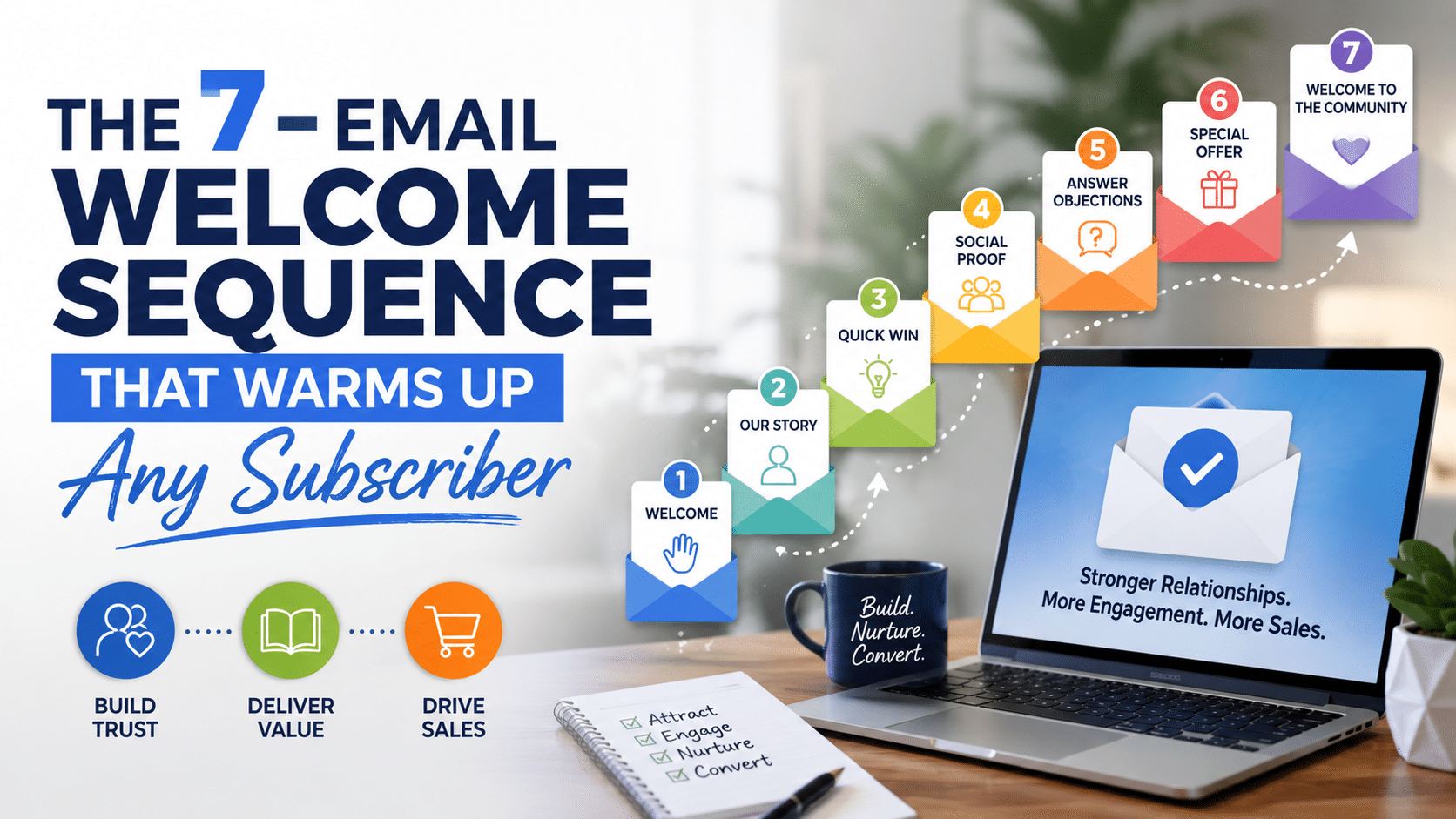
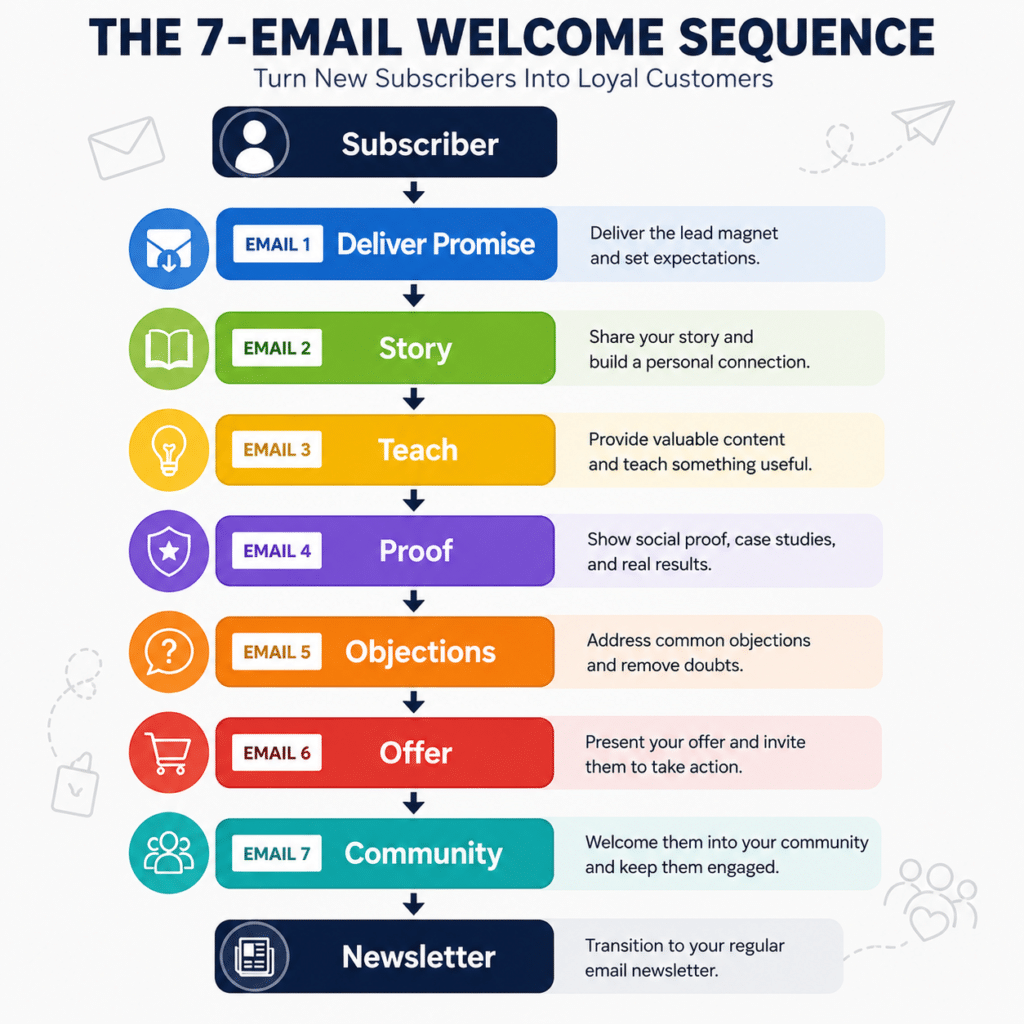
The first seven emails you send after someone joins your email list will have a greater impact on your long-term revenue than almost any other email campaign. A well-designed welcome sequence introduces your brand, builds trust, delivers value, answers objections, and naturally guides subscribers toward becoming paying customers.
Instead of sending a single “thanks for subscribing” email, businesses that use a structured 7-email welcome sequence consistently see higher open rates, better engagement, stronger customer relationships, and more conversions. Whether you’re a coach, consultant, affiliate marketer, ecommerce store, agency, or SaaS business, this framework can become one of your highest-performing marketing assets.
What Is a Welcome Email Sequence?
A welcome email sequence is an automated series of emails sent immediately after someone subscribes to your email list. Rather than leaving new subscribers wondering what comes next, the sequence intentionally moves them through a journey—from curious prospect to informed buyer.
A successful welcome sequence should:
Deliver the promised lead magnet or incentive immediately
Introduce your brand and build credibility
Educate subscribers with practical advice
Demonstrate expertise through real-world examples
Overcome common buying objections
Present a relevant offer
Transition subscribers into your regular email newsletter
If you’re just beginning your email marketing journey, start with the Email Marketing Hub. It provides a comprehensive collection of resources covering list building, automation, copywriting, segmentation, and email strategy.
Why Welcome Email Sequences Matter
Many marketers spend hundreds or thousands of dollars acquiring leads, only to neglect the period when subscribers are most engaged.
The first 48 hours after someone subscribes represent your best opportunity to:
Make a memorable first impression
Establish authority
Demonstrate value
Encourage replies and engagement
Generate your first sale
Research consistently shows that welcome emails outperform standard marketing emails because subscribers are expecting to hear from you. They recognize your brand, remember why they signed up, and are actively looking for the value you promised.
When you capitalize on that attention, your entire email marketing system performs better.
The Psychology Behind a High-Converting Welcome Sequence
Successful welcome sequences don’t rely on clever copy alone. They leverage several well-established psychological principles that influence decision-making.
When you give valuable information without asking for anything in return, subscribers naturally become more receptive to future recommendations.
This is why educational content should come before sales emails.
Consistency
Once subscribers take small actions—such as downloading a guide, replying to an email, or reading a blog post—they become more likely to continue engaging with your brand.
Each email should encourage one simple action.
Authority
People trust experts.
Sharing case studies, practical advice, customer success stories, and your own experience positions you as a trusted authority rather than another marketer trying to make a sale.
Social Proof
Testimonials, reviews, and success stories reduce uncertainty.
When subscribers see others achieving positive results, they become more confident that your solution can help them as well.
Familiarity
The more consistently someone encounters your brand in a positive context, the more comfortable they become purchasing from you.
A welcome sequence accelerates that familiarity.
Before You Build Your Sequence
Before writing your first email, answer these questions:
Who is subscribing?
Why did they join your list?
What problem are they trying to solve?
What transformation are they looking for?
What product or service should naturally come next?
Everything in your welcome sequence should move subscribers toward that desired outcome.
Finally, invite them to reply with their biggest challenge.
This last step dramatically improves engagement while providing valuable market research.
Email #2: Tell Your Story
People connect with stories.
They don’t connect with sales pitches.
Instead of talking about your products, explain:
Why you started your business
The struggles you experienced
The breakthrough you discovered
How you help others today
Your story should make subscribers think:
“This person understands exactly what I’m going through.”
Don’t try to impress readers.
Aim to become relatable.
Email #3: Teach Something Useful
By now you’ve earned enough trust to start teaching.
This email should solve one specific problem.
Examples include:
Three mistakes beginners make
Five simple tips
One overlooked strategy
A quick tutorial
A useful checklist
Subscribers should finish reading with a practical takeaway they can implement immediately.
Small wins create momentum.
Large walls of information create overwhelm.
Focus on one lesson.
Email #4: Show Proof
Anyone can claim they’re an expert.
Few can prove it.
This email is where testimonials, case studies, screenshots, reviews, and success stories become invaluable.
Include:
Customer wins
Before-and-after examples
Revenue increases
Time savings
Performance improvements
For example:
“After implementing our welcome sequence, one client increased first-time customer conversions by 37% in less than 60 days.”
Stories outperform statistics because readers imagine themselves achieving similar results.
Email #5: Handle Common Objections Before They Become Roadblocks
By the fifth email, your subscribers know who you are, understand what you teach, and have received genuine value. Yet many still won’t take the next step—not because they aren’t interested, but because unanswered questions create hesitation.
This email is designed to eliminate friction.
Instead of pushing harder with sales copy, address the concerns that naturally arise before someone invests in your product or service.
Common Objections to Address
“Will this work for someone like me?”
“I don’t have enough time.”
“I’m just getting started.”
“I’ve tried similar solutions before.”
“I can’t afford to make another mistake.”
“How long before I see results?”
“Is this too complicated?”
When you proactively answer these questions, subscribers feel understood. They no longer have to wonder if your solution is right for them—you’ve already shown them.
Subject Line Ideas
Still on the Fence?
Let’s Answer Your Biggest Questions
Before You Decide…
Wondering If This Will Work?
Email Structure
Start with empathy.
Acknowledge that it’s normal to have questions before making a decision.
Address your three to five biggest objections.
Use simple, conversational language.
Support your answers with proof.
Reference testimonials, case studies, or your own experience.
Close with reassurance.
Invite readers to reply if they have additional questions.
Example
One of the questions I hear most often is, “What if I’m just getting started?”
The truth is, beginners often see the biggest improvements because they’re building good habits from day one. You don’t need a massive audience—you need the right system.
Notice how this approach educates rather than pressures.
Email #6: Make the First Offer
Now it’s time to invite subscribers to become customers.
Notice the wording:
Invite—not pressure.
A welcome sequence isn’t about squeezing every dollar out of a new subscriber. It’s about offering the logical next step after you’ve demonstrated your expertise.
What Makes a Great First Offer?
The best introductory offer solves the next obvious problem.
For example:
A course
A coaching program
A software trial
A membership
A consulting package
A digital download
A paid workshop
Avoid overwhelming readers with multiple choices.
One offer.
One call-to-action.
One outcome.
Subject Line Ideas
Ready for the Next Step?
Here’s How We Can Work Together
Let’s Take This Further
Your Next Move Starts Here
Framework
Problem
Restate the challenge your audience faces.
Solution
Introduce your product or service.
Benefits
Explain what they’ll gain.
Social Proof
Include testimonials or measurable results.
Call to Action
Make it easy to take the next step.
Optional Bonus
Adding a limited-time bonus can increase conversions without resorting to aggressive scarcity.
Examples include:
Bonus templates
Extra training
Private Q&A session
Additional downloads
Extended support
The emphasis should remain on value rather than urgency.
Email #7: Welcome Them Into Your Community
Not everyone buys immediately.
That’s perfectly normal.
The purpose of your final welcome email is to keep subscribers engaged regardless of whether they’ve purchased.
Think of this email as the bridge between your onboarding sequence and your ongoing newsletter.
Include
A thank you
Your mission
Community resources
Your most popular content
Ways to stay connected
Invite subscribers to:
Follow you on social media
Join your community
Listen to your podcast
Watch your videos
Read your best articles
Reply whenever they have questions
Your goal is simple:
Remain top of mind.
Subject Line Ideas
Welcome to the Community
Let’s Stay Connected
You’re Officially Part of the Family
Here’s What’s Next
Suggested Timing for the 7-Email Welcome Sequence
Timing matters almost as much as content.
Here’s a schedule that works well across most industries.
Day
Email
Goal
Day 0
Welcome
Deliver the promised resource
Day 1
Your Story
Build trust
Day 3
Educational Lesson
Demonstrate expertise
Day 5
Social Proof
Build credibility
Day 7
Overcome Objections
Remove buying barriers
Day 10
First Offer
Generate conversions
Day 14
Community Invitation
Encourage long-term engagement
Avoid sending every email on consecutive days. Giving subscribers time to consume and apply your content makes the sequence feel more natural.
Welcome Email Templates You Can Customize
Email 1 Template
Subject: Welcome! Here’s Your Free Guide
Hi {{First Name}},
Thanks for joining!
As promised, here’s your download:
[Download Link]
Over the next two weeks I’ll send you practical strategies that will help you:
Improve your results
Avoid common mistakes
Reach your goals faster
I’d love to know:
Simply reply and tell me your biggest challenge.
Talk soon,
Your Name
Email 2 Template
Tell your story.
Explain why you started.
Describe the turning point.
Share what changed.
Invite readers to continue the journey with you.
Email 3 Template
Teach one lesson.
Keep it practical.
End with one action item readers can implement immediately.
Email 4 Template
Share a customer success story.
Include measurable results whenever possible.
Show the transformation—not just the outcome.
Email 5 Template
Answer the questions you hear most often.
Be honest.
If your solution isn’t right for everyone, say so.
Authenticity builds trust.
Email 6 Template
Present your offer.
Explain who it’s for.
Describe the benefits.
Provide one clear button or link.
Email 7 Template
Thank subscribers.
Share your best resources.
Encourage continued engagement.
Transition them into your regular newsletter.
Accessibility Tip: Use meaningful link text, sufficient color contrast, descriptive alt text for images, and a logical heading structure so your emails remain accessible to all readers. The accessibility resources from WebAIM are an excellent reference.
How to Automate Your Welcome Sequence
The beauty of a welcome sequence is that you build it once and let automation do the work.
While automation saves time, make sure your emails comply with the FTC’s CAN-SPAM Act by including accurate sender information, a physical mailing address, and a clear unsubscribe option.
Most modern email marketing platforms make this straightforward.
The remaining emails are sent according to your schedule.
If they purchase, move them to a customer sequence.
If they don’t purchase, transition them into your regular newsletter.
As your business grows, you can create separate welcome sequences for different lead magnets, audience segments, or product lines, ensuring every subscriber receives the most relevant content.
If you’re building your entire marketing ecosystem from the ground up, the Start Here guide is an excellent roadmap.
It walks through the foundational pieces that support long-term online business growth, including email marketing, funnels, and traffic generation.
Advanced Strategies to Increase Welcome Sequence Conversions
A basic welcome sequence can generate impressive results, but an optimized sequence can become one of your highest-converting marketing assets. Once your seven foundational emails are performing consistently, it’s time to refine and improve them.
The goal isn’t simply to send more emails—it’s to send the right message to the right subscriber at the right time.
Segment Your Audience Early
Not every subscriber joins your email list for the same reason.
Some are complete beginners looking for foundational education, while others are experienced professionals searching for advanced strategies. Sending identical emails to every subscriber limits your results.
Consider segmenting subscribers based on:
Which lead magnet they downloaded
Their business type
Their experience level
Products they’ve viewed
Previous purchases
Survey responses
Geographic location
Industry or niche
For example, someone who downloads a guide on lead generation may receive a different educational path than someone interested in affiliate marketing.
Personalization increases relevance, and relevance increases conversions.
Use Behavioral Triggers
Modern email platforms allow automation based on subscriber behavior rather than just time delays.
Behavioral triggers include:
Opening an email
Clicking a specific link
Visiting a pricing page
Downloading another resource
Completing a purchase
Watching a webinar
Ignoring several emails
Imagine a subscriber clicks every educational email but ignores your sales offer.
Instead of continuing with generic content, you could automatically send additional case studies, testimonials, or FAQs before presenting the offer again.
Behavior-based automation creates a far more personalized customer experience.
Write Subject Lines That Earn Opens
Your emails can’t convert if they aren’t opened.
Just as important as getting an open is making your emails easy to read. Nielsen Norman Group’s usability research consistently shows that people scan digital content before deciding whether to engage with it.
Avoid deceptive clickbait. The promise made in your subject line should always be fulfilled inside the email.
Personalization Beyond First Names
Adding a subscriber’s first name is helpful, but meaningful personalization goes much deeper.
Instead of:
Hi John,
Consider:
Since you downloaded our lead generation guide, I wanted to share another strategy that works especially well for service businesses.
That small change immediately makes the email feel more relevant.
Subscribers respond when they feel understood—not when they feel like one of thousands receiving the same message.
Common Welcome Sequence Mistakes
One of the biggest mistakes I see is businesses treating their welcome sequence like a brochure instead of a conversation. The first email shouldn’t sell—it should reassure subscribers they made the right decision. I’ve also found that asking a simple reply question in Email #1 often increases long-term engagement because mailbox providers recognize two-way conversations as positive signals.
Many businesses create a welcome sequence once and never revisit it. Unfortunately, that often leads to declining engagement over time. Avoid these common mistakes.
Selling Too Soon
One of the biggest mistakes is making your first email a sales pitch.
People subscribed because they wanted value.
Earn trust before asking for a purchase.
Too Much Information
Some marketers attempt to teach everything in one email.
Instead:
One lesson
One takeaway
One call-to-action
Readers should finish every email knowing exactly what to do next.
No Personality
Corporate jargon doesn’t build relationships.
Write like a real person.
Imagine you’re helping one subscriber—not broadcasting to thousands.
Weak Calls-to-Action
Don’t assume readers know what to do next.
Every email should include a single, obvious action.
Examples include:
Download the guide
Read the article
Watch the video
Reply to this email
Book a consultation
Start your free trial
Clarity consistently outperforms cleverness.
Ignoring Replies
One overlooked benefit of welcome emails is the opportunity to start real conversations.
Encourage replies.
Then respond.
Those early conversations often become your most valuable customer insights.
A/B Testing Your Welcome Sequence
Never assume your first version is your best version.
Continuous testing can dramatically improve long-term results.
Test one variable at a time.
Subject Lines
Compare curiosity-based versus benefit-driven headlines.
Send Times
Morning versus afternoon.
Weekdays versus weekends.
Immediate versus delayed delivery.
Calls-to-Action
Button versus text link.
Short versus long copy.
Different colors.
Different wording.
Email Length
Some audiences prefer concise emails.
Others appreciate detailed educational content.
Let your data decide.
Key Metrics to Track
Every welcome sequence should be measured.
Pay attention to:
Open Rate
Indicates whether subject lines are compelling.
Click-Through Rate
Measures how many readers take action.
Reply Rate
One of the strongest indicators of trust.
Conversion Rate
How many subscribers become customers.
Revenue Per Subscriber
Often the most important metric of all.
Unsubscribe Rate
A sudden increase usually indicates poor targeting or excessive promotion.
Review these metrics quarterly and update your sequence as needed. Continual optimization is one of the cornerstones of sustainable email marketing.
Where a Welcome Sequence Fits in Your Marketing Funnel
A welcome sequence is only one part of a successful digital marketing system.
The broader journey often looks like this:
A visitor discovers your website through search, social media, or referrals.
If you’re developing this broader ecosystem, explore the Promote section on Internet Marketing Muscle for strategies on driving qualified traffic from SEO, content marketing, and other digital channels.
Together, these resources complement a strong email marketing strategy by helping you attract the right audience before they ever enter your welcome sequence.
Want to master every aspect of email marketing?
Explore our Email Marketing Hub for in-depth guides on list building, lead magnets, email automation, segmentation, copywriting, deliverability, and conversion optimization.
Frequently Asked Questions
How many emails should a welcome sequence include?
Seven emails provide enough touchpoints to build trust, educate subscribers, establish authority, and introduce an offer without overwhelming new readers. Businesses with longer sales cycles may expand the sequence to 10–12 emails, but seven is an excellent starting point.
How long should a welcome sequence last?
Most businesses spread their welcome sequence across 10 to 14 days. This cadence keeps your brand top of mind while giving subscribers enough time to consume your content and take action.
Should every email contain a sales pitch?
No. Most emails in your sequence should focus on delivering value, building credibility, and strengthening the relationship. A well-balanced sequence earns trust first and introduces relevant offers only after demonstrating expertise.
Can I reuse this sequence for different lead magnets?
Absolutely. The structure remains the same, but the examples, educational content, and offers should be tailored to the subscriber’s interests. This creates a more personalized experience and typically improves engagement and conversion rates.
How often should I update my welcome sequence?
Review performance at least every 90 days. Refresh outdated examples, replace underperforming subject lines, update statistics, improve calls-to-action, and add new customer success stories. Regular updates help maintain relevance and align with SEO and AI content best practices.
Conclusion
Your welcome sequence is far more than a series of automated emails—it’s the first real relationship your business builds with every new subscriber. Done well, it establishes trust, demonstrates expertise, and creates a natural path from curiosity to conversion.
By delivering immediate value, telling your story, educating consistently, showcasing real customer results, addressing objections, and making a thoughtful offer, you create an experience that subscribers appreciate rather than ignore.
Treat your welcome sequence as a living asset. Test it, refine it, and update it regularly based on subscriber behavior and performance data. Small improvements in open rates, click-through rates, and conversions can compound into significant revenue growth over time.
If you’re serious about building an email list that becomes one of your most valuable business assets, make your welcome sequence a priority. Start with the framework in this guide, customize it for your audience, and continue optimizing as your business grows.
Build Your Welcome Sequence in Minutes with AI
Why start from a blank page when AI can do the heavy lifting? Our AI Hand Tools give you access to professionally crafted prompts and workflows that help you write high-converting welcome emails, subject lines, lead magnets, sales copy, and more—without the guesswork.
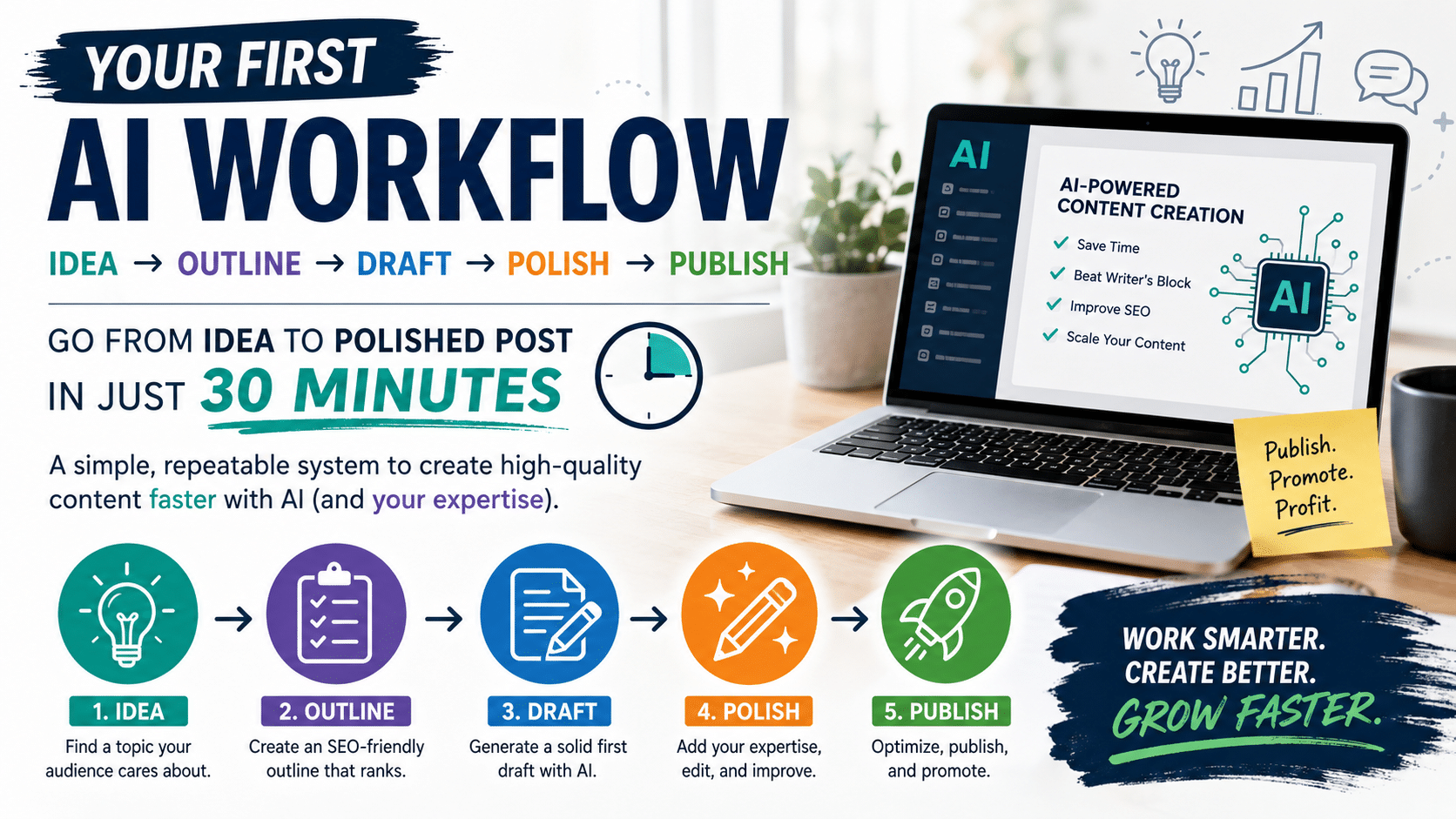
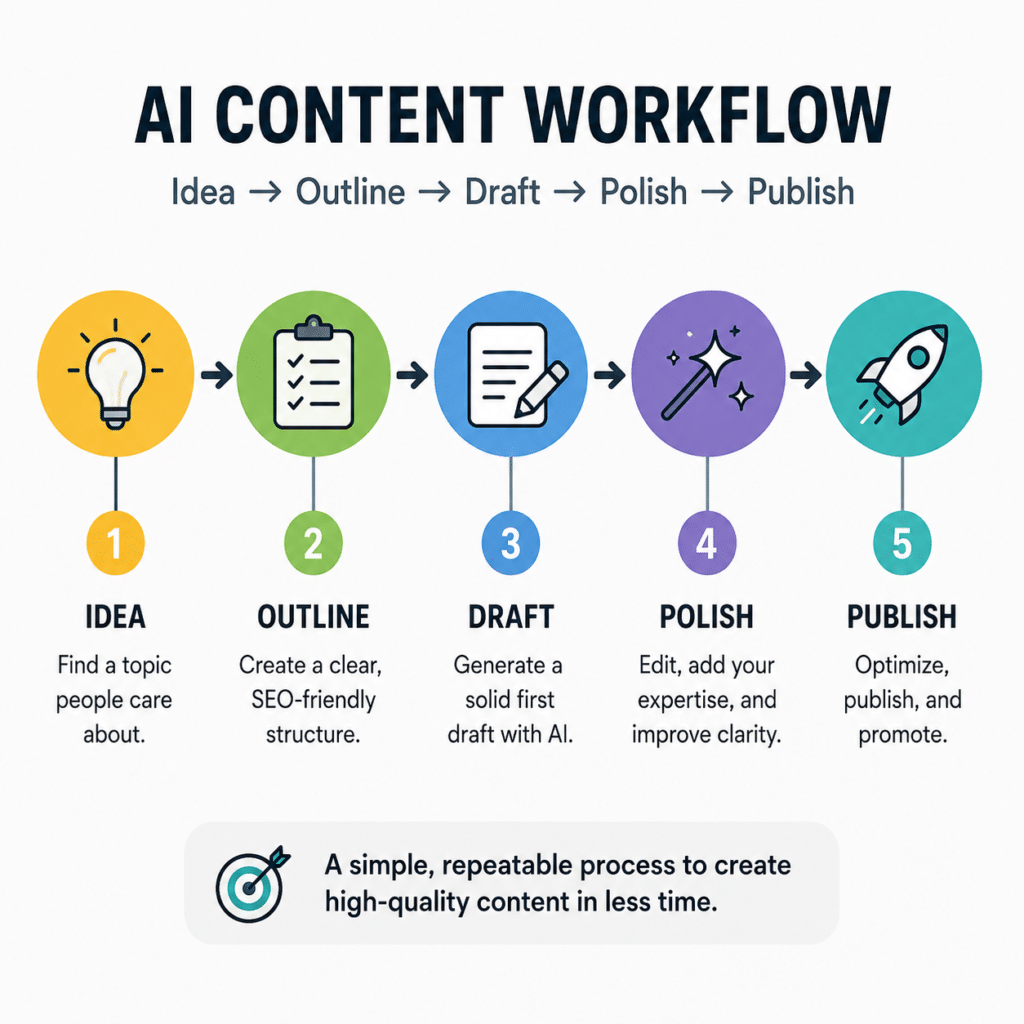
Bottom Line Up Front: The fastest way to create high-quality content with AI isn’t by asking ChatGPT to “write me a blog post.” It’s by following a repeatable workflow. Start with an idea, build an SEO-friendly outline, generate a first draft, then polish it with your own expertise. Once you’ve practiced the process a few times, you can create publish-ready content in about 30 minutes—without sacrificing quality.
If you’ve ever opened ChatGPT, typed a vague prompt, and been disappointed with the results, you’re not alone.
The problem usually isn’t the AI.
It’s the workflow.
Professional marketers don’t rely on one giant prompt and hope for the best. They use AI like an assistant, assigning it one task at a time while keeping control of the strategy, messaging, and final output.
That simple shift is what separates average AI-generated content from articles that actually rank, earn trust, and convert readers into customers.
In this guide, you’ll learn the same four-step AI workflow we use to create content faster while maintaining quality. Whether you’re a business owner, freelancer, blogger, or digital marketer, this process will help you spend less time staring at a blank page and more time publishing content that gets results.
If you’re new to Internet Marketing Muscle, our Publish. Promote. Profit. philosophy is built around creating valuable content consistently, getting it in front of the right audience, and turning that attention into measurable business growth. A structured AI workflow fits perfectly within that process because it helps you publish smarter—not just faster.
What Is an AI Workflow?
An AI workflow is a repeatable sequence of steps that uses artificial intelligence to assist with specific tasks while you remain in charge of the thinking.
Instead of asking AI to do everything, you divide the work into manageable stages.
A typical AI writing workflow looks like this:
Find a topic worth writing about.
Create an SEO-focused outline.
Generate a structured first draft.
Edit and personalize the content.
Optimize it for search engines and AI search.
Publish and promote it.
Each step builds on the previous one.
This approach consistently produces better results than trying to create an entire article with one prompt because you’re giving the AI more context at every stage.
Think of AI as an incredibly fast junior copywriter. It can brainstorm ideas, organize information, and generate drafts in seconds—but it still needs direction from someone who understands the audience and the business goals.
That’s where you come in.
Why Workflows Beat One-Click AI Writing
One-click content generation sounds appealing.
In reality, it often creates articles that are:
Generic
Repetitive
Poorly structured
Missing important information
Difficult to edit
Nearly identical to thousands of other AI-generated posts
A workflow solves those problems because it forces you to make decisions before you start writing.
Instead of asking: “Write me a blog post about AI.”
You ask: “Help me find the best topic.”
Then: “Create an outline.”
Then: “Write Section One.”
Then: “Improve this paragraph.”
Each prompt builds upon the last. The AI becomes more accurate because you’ve given it better instructions.
Think of it like building a house. You wouldn’t pour the foundation, frame the walls, and install the roof all at the same time. Each step builds on the previous one, and content creation works exactly the same way.
Why Every Content Creator Needs an AI Workflow
Creating content used to mean blocking off an entire afternoon to research, outline, write, edit, and publish one article.
Today, AI can reduce that workload dramatically—but only if you have a system.
A good workflow helps you:
Publish consistently
Eliminate writer’s block
Create higher-quality first drafts
Improve SEO without extra effort
Scale your content production
Spend more time on strategy instead of repetitive tasks
Perhaps more importantly, a structured workflow keeps your content focused on solving real problems instead of simply filling a page with words.
That matters because search has changed.
Google no longer rewards content simply because it contains the right keywords. Increasingly, it rewards content that answers questions clearly, demonstrates expertise, and provides a better experience than competing pages.
The same is true for AI-powered search experiences like ChatGPT, Perplexity, and Google’s AI Overviews.
If you’re still learning how search is evolving, you’ll want to read SEO vs. AEO in 2026. It explains why Answer Engine Optimization (AEO) is becoming just as important as traditional SEO and how to structure your content so it’s easier for both search engines and AI assistants to understand.
Understanding this shift is essential because your AI workflow shouldn’t just help you create content faster—it should help you create content that’s more likely to be discovered.
The Four-Step AI Workflow
Every successful piece of AI-assisted content follows the same basic framework.
Step
Goal
Time
1. Idea
Find a topic people actually want
5 minutes
2. Outline
Build a logical structure
5 minutes
3. Draft
Generate quality content
10 minutes
4. Polish
Add expertise and optimize
10 minutes
That’s it.
Your First AI Workflow: Idea → Outline → Draft → Polished Post in 30 Minutes (Easy) 15
No complicated software. No elaborate automation. Just four repeatable steps. Five if you count pressing “publish.”
Let’s break each one down.
Step 1: Find an Idea Worth Writing About
The quality of your article begins long before AI writes the first sentence.
It starts with choosing the right topic.
Many people ask AI something like: Give me ten blog ideas.
The results aren’t usually terrible. They’re just…
…forgettable.
A better prompt gives AI context. For example:
Give me 20 blog ideas for local service businesses that want to increase website traffic using SEO and AI. Organize the ideas by informational, commercial, and transactional search intent.
Notice how much more information you’re giving the AI.
Instead of random ideas, you’ll receive topics aligned with a business objective, making it much easier to build a content strategy instead of a collection of unrelated blog posts.
Validate the Idea Before You Write
AI is an excellent brainstorming partner. It is not a replacement for keyword research.
Before committing to a topic, spend a few minutes validating demand with tools like:
Use tools like Google Search Console to discover the queries your website is already receiving impressions for. These keywords often reveal excellent opportunities to create supporting articles that strengthen your topical authority.
If nobody is searching for the topic, it may not be worth your time—unless it’s part of a broader thought leadership strategy.
One of the biggest mistakes beginners make is assuming every AI-generated idea deserves its own article.
Research first. Write second.
Think in Content Clusters
Instead of publishing random articles every week, think about how each piece supports a larger topic.
For example, this article on AI workflows could naturally connect to future articles about:
Over time, these related articles create topical authority, helping search engines understand that your website is a trusted resource on AI-powered marketing.
You’ll notice that’s exactly how our AI for Marketers resource center is organized. Rather than publishing isolated posts, we build connected content that answers related questions and guides readers naturally from one topic to the next.
That’s one of the simplest—and most overlooked—SEO strategies you can implement today.
Now that you’ve chosen a topic, resist the temptation to ask AI to write the entire article.
Instead, have it build the roadmap first.
A detailed outline serves two purposes:
It keeps your content organized.
It gives AI enough context to produce better, more focused writing.
Think of it this way: you wouldn’t start building a house without a blueprint. Your content deserves the same planning.
Here’s a prompt I use regularly:
Create an SEO-optimized outline for the keyword “AI workflow.” Include an engaging introduction, exact-match H2 headings, supporting H3 sections, FAQs, and a strong conclusion. Structure the article for Google AI Overviews and featured snippets.
Within seconds, you’ll have a framework that’s much easier to edit than a 2,000-word draft generated in one shot.
What Makes a Great Outline?
Before moving on to the writing stage, make sure your outline includes:
A clear answer near the beginning of the article
Exact-match keyword headings
Logical progression from one section to the next
Practical examples
Frequently asked questions
A compelling conclusion with a call to action
This simple step saves far more time than it takes.
Instead of spending an hour reorganizing paragraphs later, you spend five minutes creating a structure that guides the entire article.
If you’re serious about publishing consistently, you’ll also benefit from following a repeatable publishing process. Our guide to Publish explains how to take an article from outline to publication without reinventing your workflow every time you sit down to write.
Let AI Organize—Not Think
One of the biggest misconceptions about AI is that it’s supposed to replace your thinking.
It shouldn’t.
Your expertise determines:
Who you’re writing for
What questions need answering
Which examples matter
What action readers should take
AI simply organizes those ideas into a readable structure.
Think of yourself as the architect. AI is the contractor.
The architect decides what gets built. The contractor helps build it faster.
Step 3: Generate Your First Draft
This is where most people make their biggest mistake.
They ask AI to write everything at once.
The result?
A long article that’s repetitive, generic, and often filled with fluff.
Instead, work one section at a time.
For example, after approving your outline, your prompts might look like this:
Write the introduction using a conversational tone.
Then…
Explain what an AI workflow is for beginners.
Then…
Write the section about generating content ideas.
Each response becomes the starting point for the next.
This approach keeps the AI focused and dramatically improves the quality of the finished article.
Don’t Chase Perfection on the First Draft
Your goal isn’t to publish the first draft.
Your goal is to create something worth improving.
Professional writers rarely produce polished copy on the first attempt.
AI shouldn’t be expected to either.
Instead:
Generate.
Review.
Improve.
Continue.
By the time you’ve finished the article, every section has already been edited once.
That alone will put your content ahead of most AI-generated posts published today.
Give AI Better Prompts
The quality of your prompts determines the quality of your output.
Instead of writing:
Write an article about AI workflows.
Try:
Write this section for small business owners who have never used AI before. Use short paragraphs, practical examples, and a conversational tone. Avoid clichés and explain technical concepts in simple language.
Notice how much more direction you’re providing.
You’re telling AI:
Who the audience is
What tone to use
What to avoid
What outcome you’re looking for
The better your instructions, the less editing you’ll need later.
Add the One Thing AI Doesn’t Have
Here’s something every marketer should remember.
AI has information. You have experience. That’s your advantage.
Anyone can ask ChatGPT to explain what an AI workflow is.
Only you can explain:
How you’ve used it with clients.
What mistakes you’ve made.
Which prompts consistently work.
Which shortcuts save the most time.
What surprised you after using AI every day.
Those insights are impossible to duplicate.
They’re also exactly what Google refers to when it talks about Experience in its E-E-A-T guidelines.
If two articles contain similar information, the one with genuine experience almost always provides more value to readers.
Google specifically encourages content that demonstrates first-hand experience alongside expertise, authoritativeness, and trustworthiness.
Suppose you’re writing for a local roofing company.
Instead of saying: AI helps generate blog ideas.
Show it.
For example:
Prompt:
Give me 15 blog topics for a roofing contractor in Phoenix who wants more local leads.
AI might suggest:
How Long Does a Roof Last in Arizona?
Signs Your Roof Needs Repair After a Monsoon
Tile Roof vs. Shingle Roof: Which Is Better?
Now your readers can immediately see how the workflow applies to their own business.
Examples build trust because they move beyond theory.
Keep Your Voice
One criticism of AI-generated content is that it all sounds the same. That’s usually because people publish the first draft.
Don’t.
Read every paragraph aloud.
Would you actually say those words? If not, rewrite them.
Replace robotic phrases like:
“In today’s digital landscape…”
“Leverage the power of…”
“It’s important to note…”
“Unlock the potential…”
with language you’d naturally use in a conversation.
Readers don’t connect with AI. They connect with people.
Learn From Every Article
One of the biggest advantages of building a workflow is that it improves over time.
After publishing a few articles, you’ll start asking questions like:
Which prompts consistently produce the best outlines?
Which introductions keep readers engaged?
Which calls to action convert the most visitors?
Which article formats generate backlinks?
Those answers become part of your workflow.
Instead of starting from scratch every time, you’re continuously improving your process.
That’s exactly why we’ve continued expanding our AI for Marketers resource library. Every new workflow, prompt, and tutorial builds on what we’ve already learned, making it easier for marketers to skip the trial-and-error phase and start seeing results faster.
Step 4: Polish Your Draft Until It Sounds Human
If there’s one step you should never skip, it’s editing.
AI can produce a solid first draft in minutes, but it doesn’t know your customers, your brand voice, or your personal experiences. That’s what transforms a good article into one that builds trust and authority.
I like to think of AI as a rough carpenter. It can build the framework quickly, but you’re the finish carpenter adding the trim, paint, and details that make the house feel complete.
Before you publish, ask yourself these questions:
Does this sound like something I’d actually say?
Have I answered the reader’s biggest questions?
Is every section useful, or am I repeating myself?
Have I included real examples or personal insights?
Does the article naturally guide readers to the next step?
If the answer to any of those questions is “no,” keep editing. The goal isn’t to make your writing sound more like AI. It’s to make AI sound more like you.
Add Your Experience (This Is Your Competitive Advantage)
One of the biggest myths surrounding AI is that everyone now has access to the same information.
While that’s true to an extent, everyone does not have the same experience.
For example, if you’ve spent years helping businesses improve their SEO, you’ve learned things AI hasn’t:
Which strategies consistently work.
Which “best practices” rarely produce results.
What clients struggle with most.
Which mistakes cost businesses time and money.
Those insights are valuable because they’re earned—not generated.
Whenever possible, include:
Client success stories
Lessons learned
Personal opinions backed by experience
Original screenshots
Custom graphics
Case studies
Before-and-after examples
This kind of original content helps differentiate your article from the growing number of generic AI-generated posts and reinforces your expertise.
Optimize for Google, AI Overviews, and Answer Engines
Publishing great content isn’t just about ranking on Google anymore.
Today’s content also needs to be easy for AI-powered search engines to understand, summarize, and reference.
Fortunately, the same writing habits that improve the reader’s experience also improve your chances of appearing in AI-generated answers.
Google’s own guidance emphasizes creating helpful, people-first content that demonstrates experience, expertise, and trustworthiness rather than writing solely for search engines. Following those principles will improve your content regardless of whether it’s written with or without AI.
Here are a few best practices:
Answer important questions immediately.
Use descriptive H2 and H3 headings.
Break long sections into smaller topics.
Use bullet points before longer explanations.
Include FAQs that mirror real search queries.
Write concise definitions that can stand alone.
Link to related resources throughout your site.
For example:
What Is an AI Workflow?
An AI workflow is a repeatable process that uses artificial intelligence to assist with tasks like brainstorming, outlining, writing, editing, and optimization while a human provides strategy, creativity, and quality control.
That short definition can stand on its own, making it easier for search engines and AI assistants to reference.
Then the rest of the section expands on the idea.
That’s exactly how modern content should be structured.
As Google continues expanding AI Overviews, content that provides direct, well-structured answers is more likely to be surfaced in AI-generated summaries.
Learning what not to do is just as valuable as learning what to do.
Here are some of the most common mistakes I see marketers make when they first start using AI.
1. Asking AI to Write Everything
One prompt.
Two thousand words.
Publish.
This almost always leads to generic content.
Instead, work section by section and guide the conversation.
2. Skipping Keyword Research
AI can generate unlimited ideas.
It can’t tell you which topics your audience is actively searching for.
Always validate ideas with keyword research before investing your time.
3. Ignoring Search Intent
A page targeting “What is an AI workflow?” should educate.
A page targeting “Best AI workflow software” should compare products.
Understand why someone is searching before you start writing.
4. Publishing Without Editing
This is probably the biggest mistake of all.
Even the best AI-generated draft needs a human editor.
Take time to:
Improve transitions.
Remove repetition.
Verify facts.
Add original examples.
Strengthen the conclusion.
Your readers—and search engines—will notice the difference.
Recommended AI Workflow Tools
You don’t need a complicated tech stack to build an effective workflow.
In fact, keeping things simple often produces better results.
Here’s a practical toolkit that works well for most content creators.
ChatGPT
Use it for:
Brainstorming
Outlines
Drafts
Editing
Rewriting
Headline ideas
Google Search Console
Perfect for discovering:
Existing rankings
Low-hanging keyword opportunities
Pages that deserve updates
Search queries already bringing visitors to your site
Semrush or Ahrefs
Ideal for:
Keyword research
Competitor analysis
Backlink opportunities
Content gap analysis
Grammarly
Great for polishing grammar, improving readability, and catching small mistakes before publishing.
WordPress
A well-organized WordPress website makes it easy to publish, optimize, and update your content over time.
Publishing Is Only Half the Battle
Creating an excellent article is a huge accomplishment.
But publishing isn’t the finish line.
It’s the starting line.
Once your article is live:
Share it on LinkedIn.
Include it in your email newsletter.
Mention it in relevant Facebook groups.
Link to it from older articles.
Update it every few months with new examples and statistics.
Great content deserves promotion.
If you publish consistently but rarely promote your work, you’re leaving traffic on the table.
That’s why we’ve built an entire Traffic & Promotion section dedicated to helping marketers get more visibility from the content they’ve already created. A great article should continue generating traffic long after the day you publish it.
Frequently Asked Questions
What is an AI workflow?
An AI workflow is a structured process that uses artificial intelligence to help complete specific tasks—such as brainstorming, outlining, drafting, and editing—while humans provide strategy, creativity, and final quality control.
Can AI write an entire blog post?
Yes, but that doesn’t mean it should.
The best content comes from collaboration. AI accelerates the writing process, while you provide expertise, fact-checking, personality, and original insights that make the article worth reading.
How long should an AI workflow take?
Once you’ve practiced the process a few times, many blog posts can move from idea to polished draft in around 30 minutes. More comprehensive pillar articles may take longer because of additional research, editing, and optimization.
Is AI-generated content bad for SEO?
No.
Google doesn’t penalize content simply because AI helped create it. What matters is whether the content is helpful, accurate, original, and satisfies the reader’s search intent.
Well-edited AI-assisted content can perform extremely well when it demonstrates real expertise and provides value beyond what’s already available online.
What’s the best AI tool for content creation?
There’s no single “best” tool.
Most marketers achieve great results by combining ChatGPT for ideation and drafting with keyword research tools like Semrush or Ahrefs, Google Search Console for performance insights, and WordPress for publishing.
The tool matters less than the workflow.
Final Thoughts
The biggest misconception about AI is that it’s replacing writers.
It isn’t.
It’s replacing inefficient processes.
The marketers who succeed over the next few years won’t necessarily be the ones using the newest AI tools. They’ll be the ones who build repeatable systems that consistently produce helpful, high-quality content.
That’s exactly what an AI workflow gives you.
Instead of relying on inspiration every time you sit down to write, you follow a proven process:
Start with a validated idea.
Build a structured outline.
Draft one section at a time.
Edit until it reflects your expertise and voice.
Optimize, publish, and promote.
Repeat that workflow often enough, and creating content becomes faster, easier, and far less stressful.
Remember, AI isn’t the strategy.
You’re the strategist.
AI is simply the assistant that helps you execute your ideas more efficiently.
If you’re ready to take the next step, explore the other resources here on Internet Marketing Muscle. Whether you’re learning how to optimize for AI search, improve your publishing process, or drive more traffic to your website, each article is designed to help you Publish. Promote. Profit. more effectively.
If you REALLY want to supercharge your AI Workflow, you’ll get:
The affiliate marketing landscape shifts every year. What worked in 2023 may not cut it in 2026. The key to consistent commissions is choosing products that align with buyer intent, offer solid commission structures, and fit into niches with growing demand. This article walks you through how to choose profitable affiliate products in 2026 without relying on guesswork or hype.
Not every high-priced product translates into high commissions. Profitability depends on two factors: the commission model and the buyer intent behind the niche. Products that solve urgent problems or offer recurring value tend to convert better.
Recurring commissions are a powerful way to build long-term income. AI and SaaS affiliate programs, for example, often offer 20-50% monthly or annual recurring commissions. One-time commissions from high-ticket items can also be profitable, but they require constant new sales. For steady growth, prioritize products that pay you every month the customer stays subscribed. Revenue-sharing (cost per sale) remains the most popular model in affiliate marketing, and recurring commissions fit neatly into that model.
Profitable niches are those where people are already searching for solutions with money in hand. Personal Finance & FinTech is a prime example, with high buyer intent and often high commissions. Health & Wellness, Digital Education, and Remote Work tools also have strong purchase signals. Products in these niches rarely require heavy persuasion because the audience already knows they need a fix.
Top Profitable Niches for 2026
Based on industry analysis, three major buckets stand out for 2026: sustainable products, e-learning and remote work tools, and health and wellness. Additionally, AI & Automation Software (SaaS) and Personal Finance are listed among the most profitable niches. Below is a broader list supported by multiple sources.
AI & Automation Software (SaaS)
Personal Finance & FinTech
Digital Education and E-learning
Remote Work Tools
Health & Wellness
Sustainable Living
Home Office Equipment
Pet Care
Online Dating
Home Improvement
Each of these niches can be validated using keyword research and trend analysis. For example, sustainable products are transitioning from a spikey trend into an evergreen category, meaning they now offer steady year-round demand.
Choosing a product without validation is like gambling. Two simple methods will help you confirm whether a product has conversion potential.
Use Commercial Intent Keywords
Google Trends and commercial intent keywords reveal what people are actively searching to buy. If you see phrases like “best AI writing tool for bloggers” or “affordable standing desk for home office,” those signals show purchase intent. Elementor recommends using Google Trends and commercial intent keywords to validate a niche before committing. Sub-niche potential also matters; a broad niche like “health” can be narrowed to “sleep supplements for shift workers” to face less competition.
Want to learn more about Google Trends? Read this.
Check the Commission Model
Review the program’s commission structure before signing up. Cost per action (CPA), pay-per-click (PPC), and revenue-sharing are the main models. Revenue-sharing (cost per sale) is the most popular and often the most reliable. For SaaS products, look for recurring commissions of 20-50% monthly or annual. For Amazon Associates, earnings can exceed $4,000 per month from the US alone, though that depends on site traffic and niche. Always verify exact rates with the official program page.
Deciding between evergreen and trending niches affects your content strategy and income timeline. The table below summarizes the differences based on industry guidance.
Aspect
Evergreen Niches
Trending Niches
Demand pattern
Steady year-round demand (e.g., health, money)
Spikes and dips quickly
Approach required
Patience and depth
Speed and adaptability
Content strategy
Long-form tutorials, comparison guides
Timely reviews, news, social posts
Examples
Personal Finance, Health & Wellness
AI tools, crypto, sustainable gadgets
Risk level
Low to moderate
Moderate to high
If you want predictable monthly income, lean into evergreen niches. If you enjoy fast results and can pivot quickly, trending products can deliver spikes. Sustainable products are one example of a formerly trending category that is now becoming evergreen, offering a hybrid opportunity.
Social Media and Micro-Influencers in 2026
Social media is not just for brand awareness. TikTok, YouTube, and Instagram are key platforms for driving affiliate sales in 2026. Micro-influencers with engaged audiences are increasingly used for authentic affiliate campaigns. Instead of pushing a product with a hard sell, micro-influencers create honest reviews and tutorials that build trust. This approach pairs well with the PPP Framework’s emphasis on presell content and genuine value. Even if you are not an influencer yourself, you can collaborate with micro-influencers or use user-generated content to boost conversions.
AI-driven automation tools are also reshaping how affiliates create and optimize content. From generating product comparisons to A/B testing email sequences, automation can save hours. But the core of converting affiliate sales remains trust and relevance. No tool replaces the need to choose profitable affiliate products that actually solve a problem for your audience.
Revenue-sharing (cost per sale) is the most popular and reliable model. Recurring commissions are especially attractive in AI and SaaS programs, often paying 20-50% monthly. CPA and PPC models exist but are less common for typical affiliate programs. Always check the official program terms for exact rates.
How can I validate a niche without spending money?
Use free tools like Google Trends to see search interest over time. Look for commercial intent keywords using Google’s Keyword Planner or similar free tools. Check forums, YouTube comments, and social media to see real questions people ask. A niche with active conversations and strong search volume is likely worth testing.
Is Amazon Associates still profitable in 2026?
Yes, Amazon Associates can generate significant income. Earnings can exceed $4,000 per month from the US alone, depending on your site’s traffic and niche. However, the flat commission rates require high volume. Many affiliates combine Amazon with higher-commission programs from AI, SaaS, or personal finance products for better overall earnings.
Should I focus on evergreen or trending niches?
Both have merits. Evergreen niches like health and personal finance offer steady, predictable demand but require patience. Trending niches like AI tools can produce fast results but demand speed and adaptability. If you are a beginner, starting with an evergreen niche and adding a trending sub-niche later is a sound strategy.
Do I need to be an influencer to succeed with affiliate marketing?
No. While social media platforms like TikTok, YouTube, and Instagram are important channels, you can succeed with a content site, email list, or SEO alone. Micro-influencers are effective but not required. The PPP Framework (Publish, Promote, Profit) emphasizes publishing helpful content first, then promoting it through multiple channels without needing a personal brand.
Choosing profitable affiliate products in 2026 is about matching high-intent niches with sustainable commission models. Stick with products that solve real problems, validate demand using keyword data, and commit to a content strategy that builds trust. Recurring commissions from SaaS, high-ticket items in finance, and evergreen health offers are all solid bets. Avoid chasing every new trend, and focus on what your audience actually needs. That is how you build income that lasts.
Driving traffic to every post you publish requires a system, not sporadic effort. While many marketers chase the latest trend, the most reliable approach is a repeatable routine built on consistent actions. The U.S. military’s enlisted promotion system offers a clear example of how structured criteria and steady progress produce predictable results. By adapting that mindset to a weekly content promotion plan, you can build a steady flow of visitors to every article in 2026 without relying on hype or luck.
Remember: I am not a military expert but I am using it to illustrate that systems are what drive consistent performance. In that light, I am putting the good stuff in what the military calls BLUF (Bottom Line Up Front).
Building Your Own Weekly Promotion System for 2026
Here is a simple weekly framework inspired by the military’s structured approach. You can adapt it to your schedule and platforms.
Day
Action
Why It Matters
Monday
Repurpose the post into a short video or infographic.
Different formats reach different audience segments.
Tuesday
Share the post on 3 social media platforms with platform-specific copy.
Increases visibility without duplication penalty.
Wednesday
Email your list with a presell paragraph linking to the post.
Direct traffic from your most engaged audience.
Thursday
Reach out to one relevant affiliate partner or collaborator to share the post.
Leverages others’ audiences.
Friday
Engage in comments and repost user-generated reactions.
Builts social proof and encourages further sharing.
Saturday/Sunday
Review analytics and plan next week’s promotion priorities.
Continuous improvement based on data.
What the Military Promotion System Teaches Us About Consistency
Both the Army and the Air Force use well-defined cycles and requirements to advance personnel. Promotions are not random; they follow specific time-in-service (TIS) and time-in-grade (TIG) gates, mandatory training, and board appearances. For example, the Army’s promotion to Staff Sergeant (SSG) requires a Soldier to have at least 70 months TIS and 16 months TIG in the primary zone, and they must complete the Basic Leader Course (BLC) before they can even appear before a promotion board. The Air Force uses the Weighted Airman Promotion System (WAPS), which assigns line numbers each month based on a combination of test scores, performance reports, and time in service.
These military systems are monthly, not weekly. However, the principle behind them, steady accumulation of required criteria and meeting specific milestones, applies directly to content promotion. Instead of waiting for a monthly cycle, you can break those requirements into weekly steps that move each post closer to its target audience.
Army vs. Air Force Promotion Cycles: Why Structure Matters
Understanding the difference between these two systems highlights the value of having a clear framework. The Army uses monthly promotion point cutoff scores. A Soldier in the primary zone for Sergeant (SGT) needs at least 34 months TIS and 10 months TIG to be considered by a board. For Staff Sergeant, the primary zone jumps to 70 months TIS and 16 months TIG. Secondary zone thresholds are lower, for SSG, 46 months TIS and 6 months TIG, but still enforce minimum time requirements. The Air Force publishes cycle numbers and line numbers each month for ranks from Staff Sergeant through Chief Master Sergeant. For June 2026, for example, the line numbers for SSgt (airman) in the U.S. Air Force ranged from 11905 to 13255, and for TSgt from 6479 to 7199. These numbers tell airmen exactly where they stand in the promotion queue.
Both systems remove guesswork. Soldiers and airmen know what they need to do and when. Your content marketing works the same way. If you have a clear set of weekly promotion actions, such as sharing on three social platforms, sending an email to your list, reaching out to one affiliate partner, and repurposing the post into a short video, you remove the guesswork. Each week you advance the post one step further, just like a Soldier moves from CPL to SGT after meeting the TIS/TIG gates.
How to Apply the Military Model to Your Weekly Promotion Routine
The key insight is that promotion happens on a schedule. Army promotion points become effective on the first calendar day of the month following integration approval, which must be granted by the 26th of the prior month. That fixed deadline forces preparation. For your content, set a fixed day each week when you execute your promotion actions. For example, every Tuesday you could share your latest post in five relevant Facebook groups, and every Thursday send a dedicated broadcast email to your list. The repetition builds momentum.
Just as the Army requires completion of the Basic Leader Course before a Soldier can pin on Staff Sergeant, your content may need certain “qualifications” before it can be promoted effectively. That could mean having an SEO-optimized headline, a strong call to action, or a lead magnet attached. You can create a weekly checklist of pre-promotion tasks to ensure every post is ready before you push traffic to it. The criteria are your own version of TIS and TIG gates.
This routine mirrors the monthly promotion cycles of the Army and Air Force. Both services require sustained effort over time. The Army’s SGT primary zone demands 34 months TIS and 10 months TIG, while the SSG primary zone demands 70 months TIS and 16 months TIG. These numbers illustrate that patience and consistency are non-negotiable. Your weekly promotion system should be equally persistent. One share on launch day is rarely enough; regular weekly touches keep your content active and attract new readers.
What About the Air Force Weighted Airman Promotion System?
The Air Force uses WAPS to calculate line numbers each month. For June 2026, the published line numbers for MSgt (25E7) ranged from 5145 to 5524, and for SMSgt (26E8) from 0267 to 0373. These numbers tell airmen exactly how many people stand between them and the next stripe. Similarly, you can track how many views, clicks, or signups each week brings your post. If your weekly promotion actions are consistent, you will see a predictable increase in traffic, much like an airman sees their line number decrease over time as they complete more requirements.
The Space Force also follows a similar monthly cycle, with line numbers published for TSgt (25S6: 0233-0258) and all remaining for Sgt (25S5) and MSgt (25S7) in June 2026. This shows that systematic promotion can apply across different branches, and across different niches. Your content promotion plan should be just as universal.
Pitfalls to Avoid When Building Your Weekly System
One common mistake is trying to promote every post at once. That creates burnout and low-quality sharing. Instead, treat each post like a Soldier preparing for a promotion board. The Army requires SGTs to appear before a board with verified TIS/TIG before they can pin on SSG. In content terms, your post must first meet basic quality metrics, a certain word count, keyword coverage, internal links, before you invest promotion energy into it. Once it qualifies, move it into your weekly rotation.
Another pitfall is ignoring deadlines. Army promotion points only become effective on the first of the month if integration is approved by the 26th. If you miss that window, you wait an additional month. With content, missing your weekly promotion slot means lower initial traffic and weaker social signals. Stick to your scheduled days as you would to a military deadline.
How to Measure Success in Your Weekly Promotion System
Track two key metrics: the number of distinct actions completed per post per week, and the resulting traffic lift over time. The military tracks promotion point cutoffs and line numbers. You can track share count, email open rates, and referral traffic. After four weeks of consistent weekly promotion, compare the performance of posts that received the full treatment against those that did not. The structured approach will likely outperform random sharing.
Remember that the Army’s SPC waiver ceiling is 25 percent, as announced by DMPM (Army G1). That means a limited number of waivers are allowed. In content promotion, avoid the temptation to rely on shortcuts or paid boosts that bypass your system. Stick to organic, repeatable actions that build long-term traffic.
Frequently Asked Questions
Can I use the military’s monthly cycles as a model even if I want a weekly system?
Yes. The military uses monthly cycles because of administrative requirements, but the principle of meeting specific criteria on a regular schedule is directly transferable. Simply compress those criteria into weekly actions. Your content does not need government approval, so you can operate on a faster cadence.
What if I don’t have enough time to promote every post every week?
Focus on one or two high-value posts per week instead of trying to cover everything. Just as only certain Soldiers are in the promotion zone each month, choose a handful of your best articles to support with your full weekly routine. Rotate them each week so older posts get periodic attention.
Does my content need to meet specific “TIS” or “TIG” requirements before promotion?
In this analogy, TIS is the age of the post, and TIG is the time since the last promotion (share). A brand-new post needs at least a week of natural organic exposure before you push it hard. Older posts that have not been shared for a month can be revived with a new round of promotion.
How do I know if my weekly promotion system is working?
Track traffic from each promotional channel weekly. If a post sees consistent increases after three weeks of your routine, the system is working. If not, adjust the timing or the platforms. The Air Force refines its WAPS calculations each month; you should refine your process each month as well.
Is it better to focus on one platform or several?
The military uses multiple branches to create redundancy. Similarly, using two or three platforms reduces risk if one algorithm changes. The Army and Air Force both have multiple promotion paths (primary and secondary zones). You can have a primary promotion channel (email) and secondary channels (social, partnerships) to diversify your traffic sources.
Building a weekly promotion system for your content in 2026 does not require complex tools or expensive ads. It requires the same discipline that the military uses for its enlisted promotions: clear criteria, consistent action, and patience. Start with one post, apply your weekly routine for four weeks, and watch the traffic grow. The system works because it removes guesswork and replaces it with repeatable steps that move each post forward, one week at a time.
Lead magnets are not dead. In fact, they are experiencing a resurgence in 2026. But the old playbook of offering a generic PDF download in exchange for an email address is failing. Audiences are more skeptical, AI-generated content is flooding the market, and trust is harder to earn. To build a list that actually converts, you need a lead magnet strategy built for the current landscape, one that prioritizes relevance, interactivity, and automation.
This article lays out a practical lead magnet strategy for 2026 based on what is working right now. You will learn which formats convert best, how to match your magnet to your content, and why paying with time often leads to paying with money later.
Why Old Lead Magnets Are Failing in 2026
For years, the standard lead magnet was a downloadable PDF, a checklist, a cheat sheet, or a short guide. Those magnets worked when competition was low and audiences were less saturated. Today, generic PDFs are losing effectiveness. Multiple sources point to a trust deficit among audiences and the rise of AI-generated content as the main reasons. When anyone can produce a passable eBook in minutes, a plain PDF no longer signals enough value to justify handing over an email address.
In 2026, a lead magnet must pass a simple test: would someone pay for this? That is the bar set by GrowthCurrency. If your freebie feels like it belongs behind a paywall, it will convert. If it feels like something anyone could create with a ChatGPT prompt, it will be ignored.
The Three Types of Lead Magnets That Work in 2026
GrowthCurrency identifies three categories of lead magnets performing well right now. The first is gated high-value content, think in-depth reports, original research, or full-length guides that require real expertise to produce. The second is repackaged content: taking your best-performing blog posts or videos and turning them into a structured resource readers can consume offline. The third is focused resources: interactive tools, quizzes, templates, and calculators that solve a specific problem in a hands-on way.
These three types share a common trait: they are not easy to replicate. They demand time, thought, or data to create. That is what makes them worth exchanging an email address for.
Contextual Lead Magnets: The 5x Conversion Boost
One of the most actionable findings from the research pack comes from Brennan Dunn, cited by GrowthCurrency. When a lead magnet is contextually matched to the content a person is already reading, conversion rates can jump from around 2% to 10.39%, a roughly fivefold increase. That is not a small improvement. It is the difference between a list that grows slowly and one that compounds quickly.
The logic is straightforward. A visitor lands on your article about email subject lines. If you offer a generic “Free Marketing Tips” PDF, they may not see the connection. But if you offer a “Email Subject Line Swipe File” that directly extends the article’s topic, the magnet feels like a natural next step. The visitor is already in the right mindset, so they are far more likely to opt in.
How to Build Contextual Lead Magnets
Start by mapping your most trafficked or most important content. For each piece, ask: what is the one narrow problem this article solves? Then create a lead magnet that provides a complete solution to that narrow problem, while hinting at a bigger problem your core offer solves. For example, if you publish a post on “How to Write a Blog Post in 30 Minutes,” a contextual magnet might be a “Blog Post Outline Template (30-Minute Edition).” The template solves the immediate need for speed, but the user will later need a full content system, which your core product addresses.
This approach works because the lead magnet is a complete solution to a narrow problem that reveals a bigger problem, as noted by TheFloLetter. It earns trust by delivering immediate value, while creating a logical path to your paid offerings.
Static PDFs are declining. The lead magnets converting best in 2026 are interactive, personalized, or automated. Quizzes are a prime example. A visitor who completes a “What Type of Marketer Are You?” quiz has invested time, not just a click. And TheFloLetter notes that people who pay with time are more likely to pay with money later. The quiz itself qualifies the lead, scores their responses, and can trigger an automated nurture sequence tailored to their results.
AI workflows take this further. Automated lead magnets can now qualify, score, and nurture leads without manual intervention, as described by TheFloLetter. Imagine a lead magnet that is a personalized audit or a custom report generated on the fly. The barrier to entry is higher, but the conversion and retention rates reward the effort.
Focused Resources: Templates, Tools, and Self-Assessments
For consultants and service providers, SarahMoon highlights self-assessments, framework-based guides, and on-demand workshops as high-performing formats. These work because they demonstrate expertise rather than just collecting emails. A self-assessment, for example, gives the prospect a mirror to see their own gaps. It positions you as the guide who can close those gaps. The same principle applies to private podcasts or video trainings, they build authority through demonstration.
In all cases, the format should match your audience’s consumption habits. If your readers prefer video, offer a workshop. If they love templates, give them a swipe file. The medium is part of the value.
Most lead magnets are free. That is standard practice. But SarahMoon points to an emerging trend for consultants with established audiences: paid lead magnets, or “lead products.” Instead of giving away a free report, you charge a small fee (typically $5–$30) for a premium resource that offsets acquisition costs and filters for serious buyers. This approach is not for everyone. It works best when you already have a following that trusts your brand and when the magnet delivers immediate, high-value results.
For most publishers and affiliate marketers starting out, free lead magnets remain the right move. The key is making them feel premium, gated, specific, and hard to replicate, not cheap and generic.
Building Your Lead Magnet Strategy for 2026
To put this into action, start with these steps:
Audit your existing lead magnets. Do they pass the “would someone pay for this?” test? If not, retire them.
Identify your top-performing content pages and create one contextual lead magnet per pillar topic.
Choose an interactive format if possible, a quiz, a self-assessment, or a template, rather than a static PDF.
Set up an AI-automated workflow that scores leads based on their interactions and triggers different nurture sequences.
Test a paid lead magnet if you have an established audience and want to offset ad spend or filter for high-intent buyers.
Remember that a lead magnet is a demonstration of expertise, not just a list-building tool. When you align your magnet with your content and your core offer, you build a list of subscribers who already know, like, and trust you, and that list converts.
Yes, lead magnets remain effective, but only when they are high quality, specific, and relevant to the audience. Generic PDFs are declining due to AI-generated content and trust issues. Formats like contextual guides, quizzes, and automated tools are converting better than ever according to multiple 2025–2026 sources.
What is the best lead magnet format for 2026?
Interactive formats such as self-assessments, quizzes, tools, and templates outperform static PDFs. TheFloLetter notes that people who invest time in a quiz are more likely to become paying customers. For consultants, on-demand workshops and framework-based guides also perform well, as reported by SarahMoon.
How do contextual lead magnets improve conversion rates?
Contextual lead magnets match the topic of the content the visitor is already reading. Brennan Dunn’s data shows this approach can increase conversion rates from about 2% to over 10%, a 5x improvement. The magnet feels like a natural extension of the article, making the opt-in more relevant and trusted.
Should I charge money for my lead magnet?
Paid lead magnets, or lead products, are an emerging trend for consultants with established audiences. They help offset acquisition costs and filter for serious buyers. However, for most beginners and publishers, free lead magnets are still the standard. The key is to make them feel premium enough that someone would pay for them, even if you give them away for free.
How can I automate my lead magnet delivery and follow-up?
AI workflows can automatically qualify, score, and nurture leads after they opt in. For example, a quiz can trigger a personalized email sequence based on the user’s results. TheFloLetter describes how automated lead magnets remove manual work while sending the right message to the right person at the right time, increasing both conversion and retention.
Most people in AI are obsessing over “prompt engineering” like it’s some sacred technical discipline.
Persuasion Engineering vs Prompt Engineering: Why Marketers Will Dominate AI 34
As if typing: “Act as a senior marketing strategist with 17 years of experience…”
…is the modern equivalent of discovering fire.
Meanwhile, marketers are over here doing something far more dangerous: Persuasion engineering.
And the funny part? Most developers don’t even realize the difference. Hell, most people don’t know the difference!
Prompt engineering is about getting the machine to behave.
Persuasion engineering is about getting humans to behave. Read that again. I’ll wait.
That’s the game. Always has been.
A developer wants the AI to output the correct format. A marketer wants the audience to change beliefs, feel urgency, trust faster, buy confidently, and repeat the message to other people.
Those are not remotely the same skill.
One optimizes syntax. The other rewires perception. Huge difference.
Here’s where it gets interesting:
The average engineer thinks intelligence is:
logic
structure
instructions
precision
The average marketer knows intelligence is:
emotional timing
framing
tension
status
psychology
narrative control
A boring GPT says: “Here are 5 tips for improving your sales funnel.”
A persuasion-engineered GPT says: “Your funnel probably isn’t broken. Your messaging is. Most funnels fail because they sound like they were written by someone terrified of having an opinion.”
See the difference?
One delivers information. The other creates movement.
That’s persuasion engineering.
And honestly, this is why most AI-generated marketing content feels dead on arrival.
It’s technically correct. Emotionally sterile. Like a TED Talk given by a microwave.
Because engineers tend to optimize for output quality. Marketers optimize for response.
Different religion entirely.
The engineer asks: “Did the AI follow instructions?”
The marketer asks: “Did the reader feel something strong enough to act?”
That second question is where all the money lives.
The best GPTs in the next few years won’t be the ones with the fanciest prompts. They’ll be the ones with embedded psychological architecture.
Belief shifting.
Objection diffusion.
Identity reinforcement.
Status signaling.
Curiosity loops.
Narrative tension.
Emotional pacing.
Contrarian framing.
That stuff needs to live inside the GPT’s DNA, not stapled on afterward like seasoning.
Because persuasion is not decoration. It’s infrastructure. It is what you do; it is WHO you ARE.
A lot of dev-built GPTs feel like intelligent calculators.
Efficient.
Capable.
Soulless.
Marketer-built GPTs feel like someone who understands human hesitation at 2AM when a prospect is hovering over the buy button wondering if they’re about to look stupid.
That’s the difference. One understands systems. The other understands people.
And if we’re being honest… People are the harder operating system.
This is why marketers who learn AI will beat pure technicians in massive categories.
Not because marketers are smarter. Because persuasion compounds.
A developer can build a tool. A marketer can make people care about the tool.
History has repeatedly shown which one scales faster.
The companies that dominate AI won’t merely have the best models.
They’ll have the best behavioral design.
The best emotional sequencing.
The best trust architecture.
The best narrative framing.
In other words: The winners will be persuasion engineers pretending to be software companies.
Which, frankly, has always been true. Most “tech companies” are really just psychology companies wearing hoodies.
And the marketers who understand this? They’re not building prompts.
They’re building perception engines.
That’s the future. Not better prompting. Better persuasion embedded directly into the machine itself.
If you are just starting out in internet marketing, you might think you need a big budget to buy expensive software. The good news is that in 2026, that is no longer true. Many free or very low-cost marketing tools actually rival or even outperform their expensive counterparts. Whether you need help with SEO, email newsletters, landing pages, analytics, or design, there are solid options available. Below we break down the best internet marketing tools in 2026, so you can focus on building your online business without worrying about shelling out hundreds of dollars per month.
The Best Internet Marketing Tools in 2026
Cheap or free no longer means bare bones
Back when I worked at marketing agencies, “free” often meant “barely usable.” Today, things could not be more different. The research we have done shows that you can cover almost the entire marketing stack with free, freemium, or very low-cost tools. From measurement and analytics to content creation and social media scheduling, the free or lowest tiers are robust enough for beginners and even growing businesses. The key is knowing which tools to pick and how to combine them effectively.
The Core Foundation: Analytics and Search Performance
Google Analytics 4
No marketing effort succeeds without data. Google Analytics 4 (GA4) is the standard for understanding your website traffic and user behavior. It is completely free and gives you insights into where your visitors come from, what they do on your site, and how they convert. Setting up GA4 early in your journey helps you make informed decisions instead of guessing.
Google Search Console
Google Search Console is another essential free tool. It shows you how your site performs in Google search results, which queries bring traffic, and whether there are any technical issues hurting your rankings. Together with GA4, these two tools provide the foundation for any internet marketing strategy.
The Best Internet Marketing Tools in 2026 for SEO (Free and Beginner-Friendly)
Ubersuggest and Ahrefs (free tiers)
Both Ubersuggest and Ahrefs are well-known names in SEO, and each offers a free tier that is useful for beginners. You can run limited keyword research, check your site’s backlink profile, and audit on-page issues. The free versions are not as deep as the paid plans, but they give you enough data to start optimizing your content and finding opportunities. Combine these with Google Search Console for a solid SEO toolkit at zero cost.
Visual content is a big part of internet marketing, whether for social media posts, blog graphics, or lead magnets. Canva offers a generous free plan with thousands of templates, photos, and design elements. You do not need any design experience to create professional-looking images. It is one of the most popular free marketing tools for a reason. NOTE: It’s totally worth it to get the paid version if you create a lot of graphics.
AI Writing Assistants like ChatGPT
Content writing can be time-consuming. ChatGPT (the free version) helps you brainstorm ideas, draft social media captions, write email subject lines, and even outline blog posts. While you should always edit and fact-check AI output, it can speed up your workflow significantly. Many internet marketers use it as a starting point for presell content and email sequences.
If you have a paid cloud service like Google Drive, you often get their AI tools thrown in. And they are good!
Email Marketing and Audience Building
Aweber is the hands-down winner
Email marketing remains one of the highest-ROI channels. Aweber’s lowest-cost plan allows you to build a list, send newsletters, and create basic automations. It lets you start collecting subscribers and sending campaigns right away. Since email marketing is the #1 tool in any online marketer’s toolbox, it’s worth it to shell out a small monthly amount. As your list grows, you can upgrade to more robust plans, but the Lite tier is solid for if you’re just starting out.
Managing multiple social media accounts manually is tedious. Buffer offers a free plan that let you schedule posts, monitor engagement, and track basic analytics. You can connect a handful of profiles and plan your content calendar ahead of time. These tools save hours each week and help you maintain a consistent posting schedule.
Video marketing continues to grow, and free video editing tools have improved dramatically. CapCut is a popular free editor for short videos. Camtasia Online offers a free version with basic editing and screen recording. DaVinci Resolve is a professional-grade tool with a free tier that rivals paid software. Whether you need to create product demos, tutorials, or social clips, these tools have you covered at no cost.
Paid Ad Platforms with Free Access
Meta Ads Manager and Google Ads
If you plan to run paid ads, the platforms themselves offer free tools. Meta Ads Manager and Google Ads both provide free creation and management interfaces. You only pay when you run campaigns. Use these platforms to set up ad accounts, design ads, and test targeting before spending any money. The analytics inside these tools also help you understand what works.
The best inexpensive (or free) internet marketing tools in 2026 can cover almost every area of your online business. Start with Google Analytics 4 and Search Console for measurement. Use Ubersuggest or Ahrefs free tiers for SEO research. Create visuals with Canva and write faster with ChatGPT. Build your email list with Aweber. Schedule social posts with Buffer. Edit videos with CapCut, Camtaisa, or DaVinci. And manage ads through Meta or Google.
Pick one or two tools, learn them well, and add more as you grow.
Frequently Asked Questions
Are free marketing tools really effective for beginners?
Yes. In 2026, many free marketing tools rival their paid counterparts in functionality. Tools like Google Analytics 4, Canva, and Mailchimp provide robust features that let you build a complete marketing foundation without spending money. As your business grows, you can upgrade to paid plans for advanced features.
Which free tool should I start with first?
Start with Google Analytics 4 and Google Search Console to understand your traffic and rankings. Then add a content creation tool like Canva or ChatGPT to produce materials. Email marketing comes next once you have content and visitors to send to your list.
Do I need to pay for SEO tools like Ubersuggest or Ahrefs?
Not at first. Both Ubersuggest and Ahrefs offer free tiers that allow limited keyword research, site audits, and backlink checks. These free versions give beginners enough data to start optimizing. Only consider paid plans once you have more experience and need deeper analysis.
Can I run paid ads using only free tools?
Yes. Meta Ads Manager and Google Ads are free to use for creating and managing campaigns. You only pay when your ads run. The platforms also provide analytics and targeting tools at no extra cost. This lets you test and learn without an upfront subscription.
If you are starting an online business today, you have entered a very different world than the one that existed just a few years ago. The AI boom made the internet repetitive, and audiences have started to ignore generic content. That forces a real shift in the marketing mindset for new internet marketers in 2026. Old habits like blasting out automated posts and chasing clickbait headlines no longer produce results. The people who succeed now are those who build their approach around value, emotional connection, and a genuine understanding of their audience.
This article lays out the core mindset changes you need to make if you want to build a sustainable online business without falling for hype. It is based on real trends and research from 2025 and 2026, not speculation.
Why the Old Marketing Mindset No Longer Works
For a long time, the standard approach to internet marketing meant relying on automation, clickbait headlines, and generic AI generated content. The goal was simple: produce as much as possible, push it in front of as many people as possible, and hope something sticks. That model is now breaking down. Audiences have become savvy. They can spot content that was thrown together by a machine without real thought. They scroll past it. They unsubscribe from email lists that feel robotic. They stop trusting brands that treat them like numbers.
The old mindset treated marketing as a numbers game. The new mindset treats it as a people game. Brands with a modern marketing mindset prioritize value, emotional connection, storytelling, and audience psychology rather than aggressive promotions. They do not try to trick people into clicking. They try to help people solve problems. That shift is not optional anymore. It is the only way to stand out in a crowded and noisy online space.
The Core Traits of a Modern Marketing Mindset
Econsultancy developed a framework called the 10C model that describes what modern marketers need. The traits include being customer-centric, creative, curious, connected, collaborative, commercially focused, confident, capable, committed, and challenging. These traits form a useful guide for anyone trying to build a better mindset for internet marketers in 2026.
Let us break down a few of the most important ones for someone just starting out.
Customer-Centric Thinking
Being customer centric means putting the needs of your audience ahead of your own desire to make a quick sale. Instead of asking what you can sell to people, you ask what problems they face and how you can help. That shift changes everything about how you create content, build email sequences, and choose affiliate products. People can feel when you genuinely care about their situation. That builds trust. And trust is the foundation of any long term online business.
Creativity and Curiosity
Creative copywriting is one of the most effective skills in modern mindset marketing. It is not about flowery language. It is about finding fresh ways to explain familiar problems and showing people a path forward they had not considered. Curiosity drives that. A curious marketer asks why their audience struggles with a specific issue. They research. They test. They do not assume they already know the answers. That combination of creativity and curiosity leads to content that actually resonates.
Being Analytical and Adaptable
Successful marketers in 2026 are analytical, adaptable, creative, and customer centric. Being analytical means you look at the data to understand what works. You track open rates, click through rates, and conversion numbers. But being adaptable means you do not get married to any single strategy. When the data shows a drop in performance, you pivot. You try something new. That flexibility is what separates people who grow from people who stagnate.
Quality Over Quantity: A Non Negotiable Mindset Shift
One of the most important mindset changes for new internet marketers is embracing the idea that quality beats quantity every time. A single strong piece of content can outperform 50 weak posts. That is not a theory. It is a direct observation from the current marketing landscape. When every brand is using AI to produce massive volumes of content, the only way to stand out is to produce something better.
That does not mean you should publish less content overall. It means every piece you publish needs to serve a clear purpose. It needs to answer a real question. It needs to offer a perspective that a reader cannot find in ten other places. If you approach your work with that standard, you will build an audience that actually pays attention to what you say. That audience is worth far more than a thousand visitors who bounce off your site in five seconds.
AI as a Tool, Not a Crutch
AI adoption is a must have for marketers in 2026. According to McKinsey, 88 percent of organizations now use AI in at least one business function. Among high performing companies, 72 percent embed AI into their core processes. So if you are starting out today, you cannot ignore AI. But how you use it determines whether it helps or hurts your business.
There is a difference between AI automation and AI elevation. In 2025, the conversation focused on what tools to use and what tasks to automate. In 2026, the conversation has shifted to leveraging AI at scale to drive customer retention, revenue, and ROI. That is the move from automation to elevation. Instead of using AI to churn out 50 mediocre blog posts in an hour, you use it to research your audience, analyze their behavior, and craft messages that feel personal to each reader.
AI First Marketing
Marketing in 2026 must be AI first, not just digital first. That means building your entire strategy around the capabilities AI provides. AI first marketing can predict customer churn, scale personalization, and drive ROI two to five times better than traditional approaches, according to Gartner. There is also real world evidence. A SaaS client boosted contract values by more than 30 percent by combining account based marketing with AI driven content orchestration. And 70 percent of companies using AI in marketing see measurable revenue increases, with 40 percent reporting double digit growth, based on an Iterable 2025 survey.
The key point is this: AI should make your marketing more human, not less. If you use AI to generate content that sounds like every other piece of content on the internet, you will blend in. If you use AI to understand your audience better and then create content that speaks directly to them, you will stand out.
Several specific trends are influencing how marketers think and act right now. Understanding these trends helps you calibrate your mindset to match what actually works.
Content Marketing and SEO
Content marketing must now address the overload of AI generated content flooding the internet. To get noticed, you need to optimize for AI search and discovery while also writing for real people. SEO trends in 2026 emphasize brand voice as a ranking signal. Google is rewarding sites that have a clear, consistent, and authentic voice. Search intent understanding is crucial. You cannot just stuff keywords into a page and hope for the best. Schema markup is also important because it helps search engines understand your content and present it in rich results.
Paid Marketing
Paid marketing trends focus on ad creative and mastering AI Max. The platforms are getting smarter about targeting, so the creative element of your ads becomes the main differentiator. A strong visual and a compelling headline matter more than fiddling with audience settings.
Social Media
Social media is seeing the growth of community first platforms. At the same time, social media fatigue is driving demand for more authentic content. People are tired of polished, performative posts. They want real conversations and real people. Influencers and content creators are evolving to meet that demand by being more transparent and less salesy.
If you are brand new to internet marketing, you have an advantage. You do not have to unlearn bad habits. You can build the right mindset from the start. Focus on three things.
First, commit to understanding your audience better than anyone else. Spend time in forums, read comments, and listen to what people actually say about their struggles. Second, invest in your creative skills. Learn how to write copy that connects. Learn how to tell stories. Those skills will pay off for your entire career. Third, treat AI as a partner, not a replacement. Use it to speed up research and analysis, but keep the human element in everything you publish.
The mindset for internet marketers in 2026 is not about working harder. It is about working with more intention. Every piece of content you create should make someone feel understood. Every email you send should offer something useful. Every promotion you run should come from a place of genuine desire to help. That approach takes more thought and more effort on the front end, but it builds a business that lasts.
The old internet marketing playbook is dead. The new one is being written by people who choose authenticity over automation and connection over volume. That is the mindset that will carry you through 2026 and beyond.
Frequently Asked Questions
What is the single most important mindset shift for new internet marketers in 2026?
The most important shift is moving from a volume based approach to a value based approach. Instead of trying to produce as much content as possible, focus on creating fewer pieces that genuinely help your audience. That single change affects your content strategy, your email marketing, and your overall business model.
Do I still need to use AI as a new marketer in 2026?
Yes, AI adoption is a must have for marketers in 2026. But you should use it as a tool to understand your audience and scale your efforts, not as a shortcut to produce generic content. The best AI use makes your marketing more personal and more relevant, not more robotic.
How important is creativity compared to technical skills?
Both matter, but creative copywriting is one of the most effective skills in modern mindset marketing. Technical skills like SEO and analytics are necessary, but creativity is what makes your content stand out. A curious, creative marketer who understands their audience will outperform a purely technical marketer every time.
What does quality over quantity mean in practice?
It means that a single strong piece of content can outperform 50 weak posts. In practice, you spend more time researching, writing, and editing each piece. You focus on search intent, brand voice, and genuine value. You do not publish content just to have something new on your site. You publish because the content deserves to exist.
How do I stay adaptable as the market changes?
Stay curious and keep testing. Successful marketers in 2026 are analytical and adaptable. They track what works, but they are willing to pivot when the data tells them something is no longer effective. Read industry research, follow people who share real results, and never assume that last year strategy will work this year.
Starting an online business no longer requires weeks of planning, expensive software, or a technical degree. In 2026, the tools and infrastructure are simpler than ever, and you can go from idea to active selling in under sixty minutes. This guide uses the PPP Framework (Publish, Promote, Profit) to keep every minute productive. You will choose a model, set up your offer, and know exactly what to do next. Ready to set up your online business 2026?
Why an Online Business Belongs on Your 2026 To Do List
Low startup costs are one of the biggest advantages of starting an online business. You do not need to rent physical space, buy inventory upfront, or hire staff. Online businesses also offer unlimited earning potential and the flexibility to work from anywhere. You can reach customers around the world and automate many of the routine tasks that used to eat up your day.
There are real challenges, too. Fierce competition means you need to stand out. Technical hurdles can feel frustrating if you are new. Marketing takes consistent effort, and no business delivers instant success. But the path is straightforward when you follow a repeatable system like Publish, Promote, Profit.
The PPP Framework stands for Publish, Promote, and Profit. It is the core system taught at Internet Marketing Muscle, designed to replace hype with simple, repeatable actions. In the next four sections, you will apply each step to launch your first online business.
Step 1: Publish Choose Your Business Model
The fastest way to start in 2026 is to create a digital product or a service that requires no inventory and zero shipping. According to industry analysis, the most profitable online business models include vertical SaaS, paid newsletters, AI augmented agencies, and digital product stores. All of these enjoy gross margins between 60 and 85 percent, with low fulfillment costs and recurring revenue potential.
For your first sixty minutes, pick the simplest option: a digital product store selling PDF guides, templates, or short video courses. Digital products have gross margins of 90 percent or higher, and top sellers report monthly earnings between $10,000 and $100,000. You do not need to aim that high on day one. The point is to publish something small that solves one problem for a specific audience.
Set up your offer using a free or low cost platform. Create a simple landing page with a headline, a brief description, and a buy button. Upload your digital file. Your product is live in less than twenty minutes.
Step 2: Promote Get Your First Visitors
Your business cannot make money until people see it. Promotion does not require a big ad budget when you are just starting. Share your product link on your personal social media accounts, in relevant online communities, or with friends who match your target audience. The global customer base of the internet means that even a few shares can bring visitors from different countries.
If you already have a blog or an email list, send a quick announcement. Otherwise, spend ten minutes writing a short post that explains what your product does and why it helps. Add a clear call to action that leads to your purchase page.
Step 3: Profit Monetize Quickly
Profit comes when a visitor buys your product. Because you chose a digital product, every sale is nearly pure margin after platform fees. There is no per unit manufacturing cost. You can also add an affiliate link to a related tool or service inside your product. This creates an additional income stream without extra work.
Email marketing is a powerful way to turn one time buyers into repeat customers. Capture email addresses by offering a free bonus related to your product. Send a follow up sequence that suggests other products or resources. The PPP Framework treats profit as the natural result of publishing helpful content and promoting it consistently.
Comparing the Most Profitable Models for 2026
The table below summarizes the top online business models identified in recent research. Use it to decide which direction to explore after your first hour.
Business Model
Gross Margin
Typical Monthly Revenue Range
Fulfillment Cost
Online course creation
90%+
$10,000 – $100,000
Low
Digital products store
90%+
$10,000 – $100,000 (top sellers)
Very low
AI augmented agency
60–85%
$2,000 – $10,000 per client
Low
Micro SaaS
60–85%
$10 – $100 per user per month
Low (recurring)
Branded dropshipping store
Variable
$5,000 – $30,000 profit
Higher (shipping, returns)
These figures are based on industry analysis and individual results vary. Your first hour should focus on one simple model rather than trying to compare every option.
Every new business owner faces the same hurdles. Competition is real, but you can narrow your focus to a very specific audience that bigger companies ignore. Technical challenges like setting up a payment system or a landing page are solved by using platforms designed for non technical users. Marketing effort pays off when you stick to one channel and improve it over time. And remember that success is rarely instant. The PPP Framework works because it is a loop: publish, promote, profit, then repeat with improvements.
Can I really set up an online business in under one hour?
Yes, if you choose a simple business model like selling a digital product. The actual setup of a landing page and payment link takes about twenty minutes. The remaining time goes to writing a short product description and sharing your link with a few people. The goal is to launch, not to perfect.
What is the cheapest online business to start in 2026?
A digital product store or a paid newsletter requires almost no upfront money. Both models have low to zero fulfillment costs, and you can use free or very low cost platforms to host your content. Startup costs are lower than almost any physical business.
Do I need a website to start?
Not necessarily. Many digital product platforms let you create a storefront without building a traditional website. You can also start with a simple landing page on a free tool. A full website becomes useful later as you grow your audience through SEO and email marketing.
How do I get my first customer?
Share your product in places where your target audience already gathers. That might be a Facebook group, a subreddit, a LinkedIn community, or your own social media feed. Offer a clear benefit in your post and include the link. The first sale is often from someone you know or a person who has been waiting for exactly what you created.
Setting up your first online business in under an hour is not a gimmick. It is a realistic starting point if you commit to the Publish, Promote, Profit cycle. Use this sixty minute launch as a foundation. Then spend the next days and weeks refining your offer, building your audience, and repeating the loop that turns a small start into a sustainable income stream.
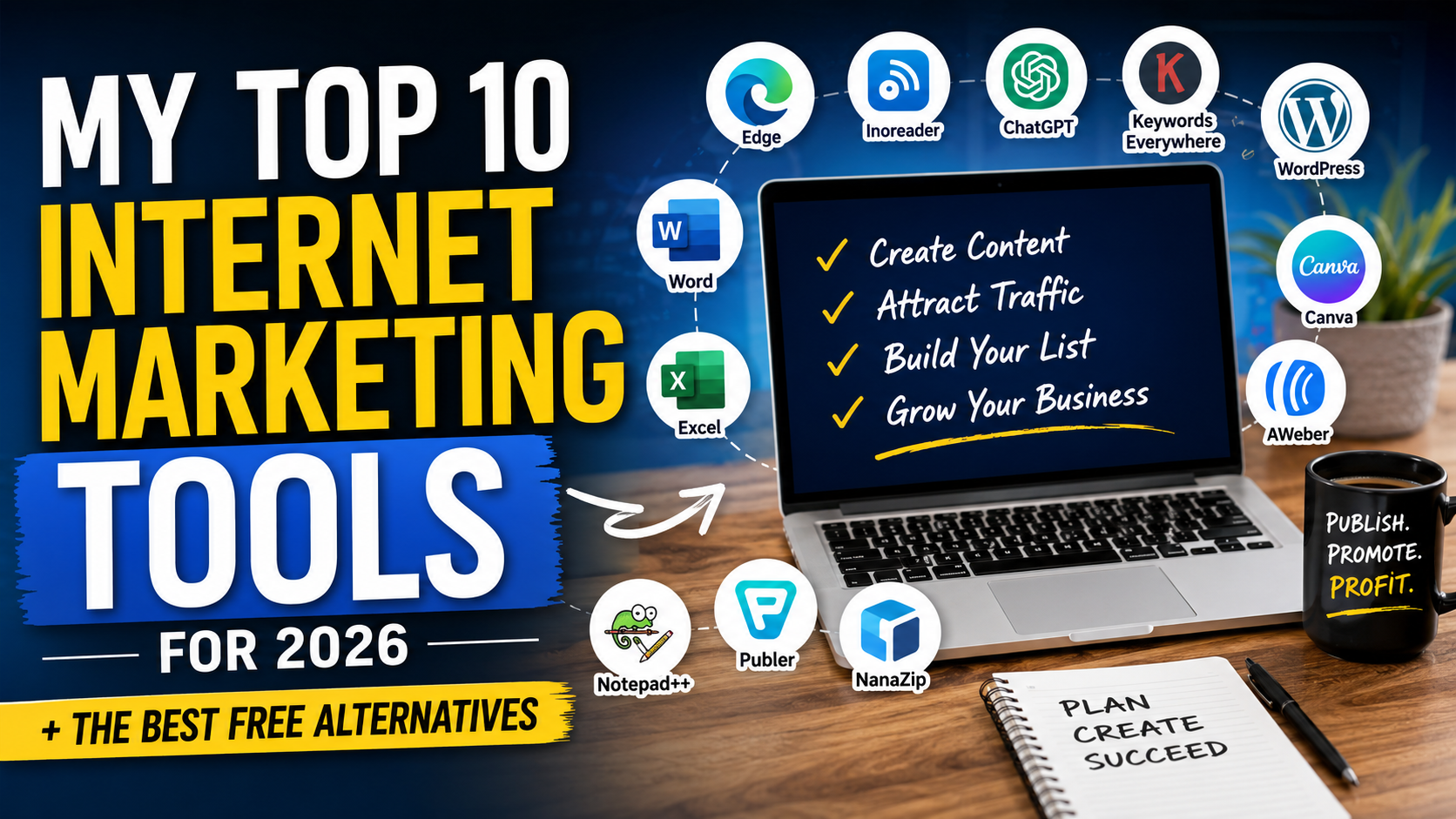
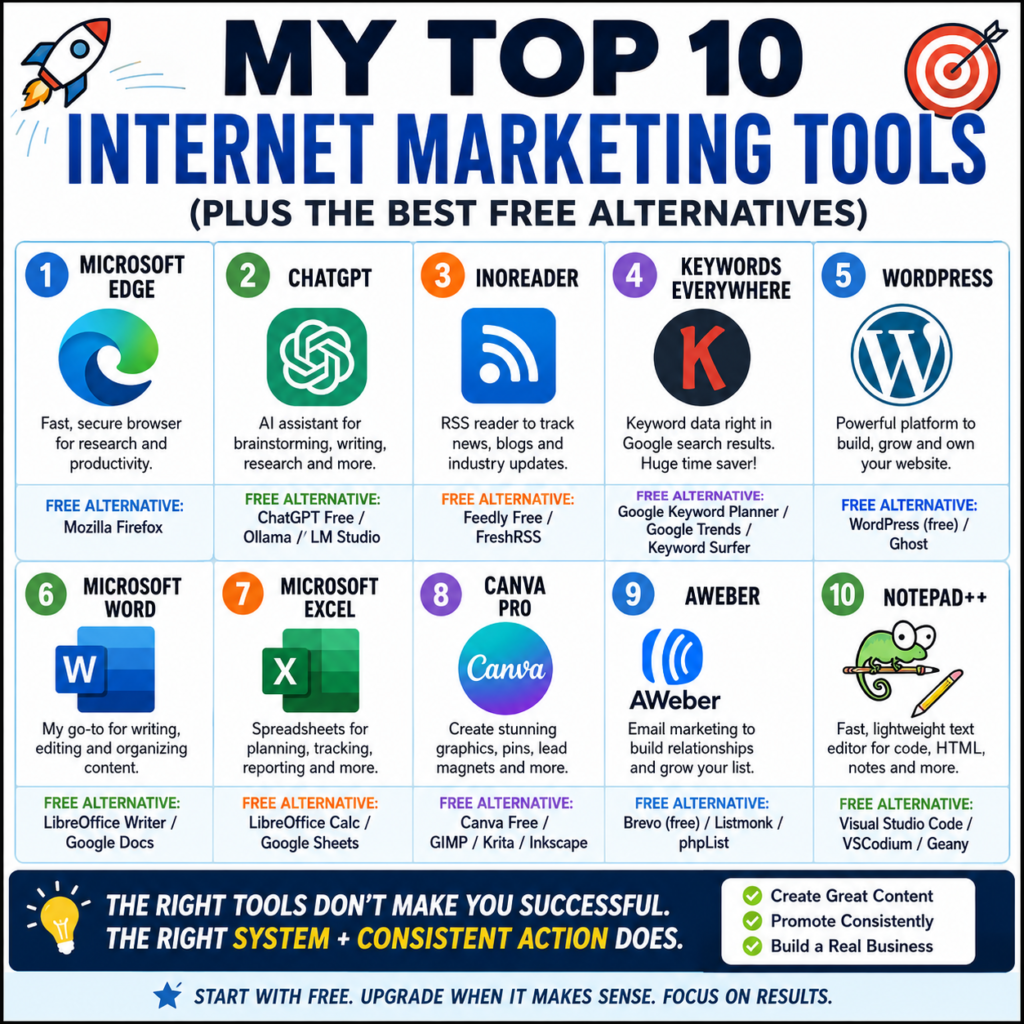
 Explore AI Hand Tools and start building smarter email campaigns today: