
Affiliate marketing blueprint
Affiliate Marketing

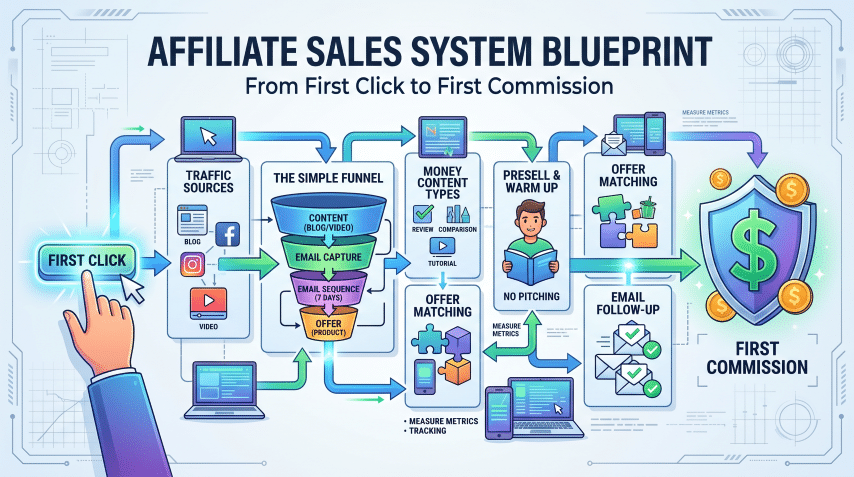
Affiliate Sales System Blueprint: From First Click to First Commission

Most affiliates don’t have a “system.”

They have a pile of tactics… and a weird belief that if they paste enough links into the internet, money will eventually fall out.

That’s not a strategy. That’s digital gambling.

A real affiliate sales system is a repeatable machine:

Traffic → Presell → Offer → Follow-Up → Commission

And yes, the “presell” part is the one most people skip—then they wonder why their “high converting offer” converts like a brick.

If you’re new, start here first: Start Here.
If you want the shortcuts: Free Reports.
Want more like this? Browse the Affiliate Marketing hub. If you want more affiliate marketing content, click here, too.


Key Takeaways

  • Pick one primary traffic source for 90 days (not three… unless you enjoy chaos).
  • Presell with content that answers the real question behind the click.
  • Match the offer to the intent or you lose before you start.
  • Use a simple funnel: Content → Email → Offer.
  • Track what pays you: clicks, email actions, and commissions—not vanity metrics.

What an “Affiliate Sales System” Actually Is (and Why Most People Don’t Have One)

Most affiliate marketers promote whatever looks shiny this week, send traffic wherever they can get it cheapest, and pray.

A real system is a repeatable process:

  • You choose a traffic source you can build on.
  • You publish content that matches buyer intent.
  • You warm the reader up (presell) so the offer doesn’t feel like a jump-scare.
  • You follow up with email so you’re not dependent on “hope” as a metric.

This all ladders into your PPP pillars:

  • Publish = make content that earns attention
  • Promote = get eyeballs consistently
  • Profit = convert like an adult

If you want the “what works now” landscape, read: Affiliate Marketing in 2026: What Works Now (and What Died).


The First Click Problem: Where Your Traffic Should Come From in 2026

Where is your first click coming from?

If your answer is “uh… hopefully Google?” that’s not a plan. That’s a wish.

Here are three traffic sources that actually make sense:

  • Search traffic (SEO): long-form posts targeting “best,” “vs,” and “how to” queries.
  • Email: the highest-leverage traffic you can own (because platforms can’t throttle your list).
  • Niche communities: where real questions get asked (and real buyers hang out).

The mistake: trying to do all three at once.

Pick one, run it for 90 days, then stack the next.

If you need a simple mindset reset on building something you actually own, read: Build a Business, Not a Dependency.


The Presell Step: How to Warm People Up Without Being Gross

Sending cold readers straight to an affiliate offer is like showing up to a first date and handing someone a mortgage application.

Presell bridges the gap.

It’s where you:

  • show you understand the problem
  • show you’ve thought through the options
  • make the offer feel like the natural next step

This is exactly what your presell posts are already doing:

And if your positioning is mush, start here:


The Offer Match: Picking the Right Product for the Right Intent

Most affiliate “failures” are just offer mismatches.

If someone searched “best budget email tool,” and you shove a complex enterprise platform in their face… you didn’t “lose the sale.”

You lost the reader.

Here’s the matching rule:

  • Search intent → product tier
  • Pain point → solution fit
  • Beginner audience → simple offer

Want the easiest way to create offers from content (and stop overthinking it)? Read:


The Simple Funnel Blueprint: Content → Email → Offer

Most affiliates build backwards:

  • find a product
  • then scramble to find people
  • then wonder why nobody buys

Flip it:

  1. Content pulls the right intent
  2. Email captures and warms
  3. Offer converts when the timing is right

If you’re building a blog-based machine, this will help:

And yes, the blog hub is here:


The 3 Money Content Types that Convert Best (with Examples)

Not all content is created equal. Some posts entertain. Some posts convert.

Here are three “money content” types worth your time:

  • Product reviews (high intent)
  • Best-for guides (“best X for Y” = buyer intent with context)
  • Comparisons (“A vs B” = decision-stage traffic)

Money content doesn’t need to be clever. It needs to be clear.


The Email Follow-Up that Gets the Commission (7-Day Mini Sequence)

Most affiliates send one email… and then vanish like a magician who forgot the trick.

Here’s a simple 7-day sequence that actually closes:

  • Day 1: the offer + your honest take (why you chose it)
  • Day 2–3: use case + proof (how it solves the problem)
  • Day 4: handle the #1 objection
  • Day 5–6: send extra detail to engaged readers only
  • Day 7: final call (no drama, no begging)

Want more subscribers to even send this to? Start at:


Tracking Without Overcomplicating It: What to Measure First

Track what pays you.

Not bounce rate. Not “time on page.” Not how pretty your dashboard looks.

Track:

  • clicks to affiliate links
  • email clicks
  • commissions by source

Start simple. Get consistent. Add complexity only after the money shows up.


The Biggest Mistakes That Keep You Stuck at $0

Here are the big three:

Mistake PatternWhat You’re DoingWhat Kills You
Wrong traffic focusswitching channels constantlynothing compounds
No preselldropping raw affiliate linkstrust never forms
Weak contentthin posts with no angleno authority, no conversions

If you’re overwhelmed, you don’t need motivation—you need a plan. This is a good one:


Your Next 7 Days: From Blueprint to First Commission

If you want your first commission, stop “learning” and start shipping.

Here’s your week:

  • Day 1–2: pick one niche angle + one offer
  • Day 3: write one money post (review/comparison/best-for)
  • Day 4: publish + add your presell section + add your CTA
  • Day 5: send it to your list (or start building one)
  • Day 6–7: write 2 follow-up emails and track clicks + results

Then follow the system:

And if you want the fast-start tools, grab them here:


Frequently Asked Questions

How long does it realistically take to earn your first affiliate commission?

If you’re consistent, 3–6 months is a realistic window for most beginners. It can happen faster with a tight niche and high-intent content—but don’t plan your business like a lottery ticket.

Can you run an affiliate system with zero budget?

Yes. It’s slower, but it works. Focus on SEO content + email list building. Once commissions show up, reinvest into tools and promotion.

Yes. Always. Transparency builds trust—and trust is what gets repeat buyers. If you want to be extra safe, you can also link your Disclaimer and Privacy Policy in your footer like you already do.

The FTC is very clear about “clear and conspicuous” disclosures. Here's the official guidance.

Usually it’s traffic quality, compliance, or context. Clean up the page, follow the network rules, and reapply. Most rejections are fixable.

How do you scale one working system to multiple offers?

You don’t build multiple systems—you clone a working one. Same funnel, same email structure, same content templates. New offer gets slotted in once the machine is proven.


Conclusion

You’ve got the blueprint. Now do the only part that matters: run it.

Pick one traffic source. Publish one money post. Presell like a human. Follow up with email. Track what pays you.

If you want more help, start here:

Now go earn your first commission.

Read More
affiliate marketing in 2026
Affiliate Marketing

Affiliate Marketing in 2026: What Works Now (and What Died)

Affiliate marketing in 2026 isn’t “dead.” It’s just done pretending.

The old playbook—cookie crumbs, last-click fantasies, and generic “best of” lists written by people who’ve never used the product—still exists… it just converts like a fax machine.

Here’s what works now, what died, and the simple system to build affiliate income without sounding like a carnival barker.


Key Takeaways

  • Cookies and last-click “credit” are fading fast—so you need clean tracking you can control (UTMs, link IDs, email list, on-site behavior).
  • Generic affiliate sites aren’t dead; generic content is. Micro-niches + use-case content wins.
  • Trust beats polish. People buy from proof (experience, screenshots, demos), not “optimized hype.”
  • The winners run a loop: PublishPromoteProfit—not “post and pray.”
  • AI can speed up drafts, research, and repurposing, but it still needs a human who’s willing to say what’s true.

Affiliate Marketing in 2026: The New Rules of the Game

Let’s get real: affiliate marketing is still one of the best business models for beginners and intermediates because you can start without inventory, fulfillment, or customer support.

But 2026 rewards a different skill set:

  • Clarity over volume (tight niche, specific problems, specific use cases)
  • Proof over persuasion (show, don’t sell)
  • Systems over inspiration (a repeatable weekly loop)
  • Owned assets over rented attention (email list beats algorithm mood swings)

If your affiliate plan depends on “hoping the platform credits you,” you don’t have a plan. You have a prayer.


What Died (and Why It Deserved It)

Some tactics didn’t “stop working.” They stopped working for people who were never building trust in the first place.

Affiliate tracking still exists, but it’s not 2009. Browsers, platforms, and privacy rules have been tightening for years. If your entire strategy is “get the click and hope I get credit,” you’re building on sand.

Last-click worship

Last click was always a dumb measuring stick. It ignores the content that created the decision and rewards whoever happened to be the final stop. In 2026, you need to think like a marketer: assist value matters, and your best hedge is building channels you can measure directly.

Generic “Best of” listicles with zero experience

The internet is drowning in “best of” posts written by people who are basically re-typing Amazon listings. Those aren’t authority posts—they’re content-shaped spam. Google knows. Readers know. You know.

Hard-sell, polished promo copy

Over-produced persuasion is getting weaker. If your content sounds like a brochure, it gets treated like a brochure: skimmed, ignored, and forgotten.


What Still Works If You Do It Clean

Here’s the good news: the fundamentals still work if you’re not trying to cheat the game.

Micro-niches win

Don’t “do fitness.” Do at-home strength training for busy dads with cranky knees.
Don’t “do marketing.” Do affiliate marketing for beginner bloggers who hate social media.

Micro-niche doesn’t mean tiny income. It means focused trust.

Proof-based content wins

Screenshots. Demos. Real pros/cons. “Here’s what surprised me.” “Here’s what I’d do differently.”

You don’t need to be a guru. You need to be believable.

Email still wins

Email is still the best hedge against platform nonsense. If you’re not building a list, you’re renting your entire business.

Relationships beat “spray and pray”

Even if you never negotiate a custom deal, you can still win by promoting fewer offers better. Depth > breadth.


What Works Better Now: The 2026 Playbook

Affiliate marketing in 2026 is less “SEO trickery” and more “content + conversion + trust.”

Here’s what’s working better than the old model:

Use-case content instead of generic rankings

Instead of “Best email marketing tools,” publish:

Use cases create relevance. Relevance creates clicks. Clicks create money.

Short-form + community as distribution, not as the business

You don’t need to become an influencer. But you do need distribution loops:

  • short clips → longer explanation
  • longer explanation → email sign-up
  • email → offers + evergreen posts
  • evergreen posts → more clips

That’s a system. Not a hustle.

AI as a multiplier, not a replacement

Use AI to:

  • generate first drafts
  • create outlines
  • repurpose content
  • draft promo angles
  • summarize pros/cons

But you still need to be the adult in the room:

  • verify claims
  • add real experience
  • write the final opinion

AI can write words. It can’t build trust.


The Simple 3-Step System: Publish → Promote → Profit (Affiliate Edition)

Here’s the part most affiliates never do: they never choose a system.

Publish

Create content that earns trust and answers real questions:

  • reviews (with real pros/cons)
  • comparisons (with use-case guidance)
  • “best for X” lists (with exclusions and reasoning)
  • how-tos that naturally lead to tools/products

Promote

Don’t rely on “publish and Google will send traffic.” Promote using a repeatable loop:

  • YouTube (or short clips) → blog post
  • blog post → email opt-in
  • email → back to content + offers
  • Skool/Facebook → discussions that feed new content ideas

Profit

Profit comes from:

  • matching the right offer to the right intent
  • using presell frameworks (so the link isn’t awkward)
  • building a simple email sequence that warms people up

If you want the shortcut for the “Profit” step, grab this:
Affiliate Promo Builder Engine: https://reports.internet-marketing-muscle.com/affiliate-promo-builder-engine

(Yeah, I’m biased. It works.)


Content That Converts: Reviews, Comparisons, and “Best Of” Posts

Here’s the simplest way to think about it:

Reviews convert when they include:

  • who it’s for / not for
  • real wins and real annoyances
  • what you’d do differently
  • proof (screenshots, steps, results—anything tangible)

Comparisons convert when they include:

  • a “winner by use case” section
  • what matters (and what doesn’t)
  • pricing notes + update date (build trust)

Best-of posts convert when they’re not lazy:

  • categorize by situation (beginner, budget, power user, etc.)
  • include exclusions (“Why X didn’t make the list”)
  • make the decision easier, not longer

If your “best of” post reads like a shopping catalog, don’t be shocked when it earns catalog-level trust.


Traffic That Doesn’t Collapse: Loops, Not Luck

Algorithms are moody. SEO takes time. Social reach gets throttled. That’s not a crisis—it’s normal.

The fix is not panic. The fix is loops:

  • One core post (blog or YouTube)
  • Repurpose into 3–5 clips/posts
  • Drive to email (owned asset)
  • Email drives back to your evergreen content
  • Evergreen content monetizes consistently

The goal is stability, not virality.


Email Still Wins: The Asset Most Affiliates Ignore

If you want to beat 90% of affiliates, do the boring thing: build the list.

Email lets you:

  • follow up when people aren’t ready to buy today
  • recommend products without begging an algorithm
  • segment by interest (so you stop blasting everyone)
  • run promos that actually convert because trust exists

If you need help building a lead magnet that converts, grab: Lead Magnet Engine: https://reports.internet-marketing-muscle.com/lead-magnet-engine

One of the smartest ways to make affiliate marketing more resilient is to build an email list you own, which is exactly what the Email Marketing Hub walks through.


Trust Signals That Matter in 2026 (E-E-A-T Without the Buzzwords)

Here’s what trust looks like in 2026:

  • Specificity: “for who” and “for what situation”
  • Transparency: disclosures, real pros/cons, no miracle promises
  • Experience: you’ve used it, tested it, or you clearly say you haven’t
  • Updates: your content isn’t frozen in time
  • Consistency: your content doesn’t contradict itself across pages

E-E-A-T isn’t a trick. It’s just what real humans expect.


Your Next Steps: What to Do This Week (Not “Someday”)

Do this in the next 7 days:

  1. Pick one micro-niche (one audience + one main problem).
  2. Pick one offer that genuinely fits that problem.
  3. Write one “use-case” post:
    • “Best {tool} for {specific audience/situation}”
    • or a comparison that ends with “who should choose what”
  4. Create one simple opt-in (lead magnet) that helps that niche.
  5. Start a basic email sequence:
    • value
    • value
    • value + soft recommendation

Then read the pillar that ties your monetization together:


Conclusion

Affiliate marketing in 2026 isn’t about more links. It’s about better intent, better trust, and a system that doesn’t collapse when a platform sneezes.

Build the loop. Show proof. Collect the email. Promote clean offers.

And if you want a plug-and-play way to create promos that don’t feel gross, grab the Affiliate Promo Builder Engine:
https://reports.internet-marketing-muscle.com/affiliate-promo-builder-engine

Read More
Build a business on land you own. Don't be a sharecropper!
Affiliate Marketing

Build a Business, Not a Dependency.

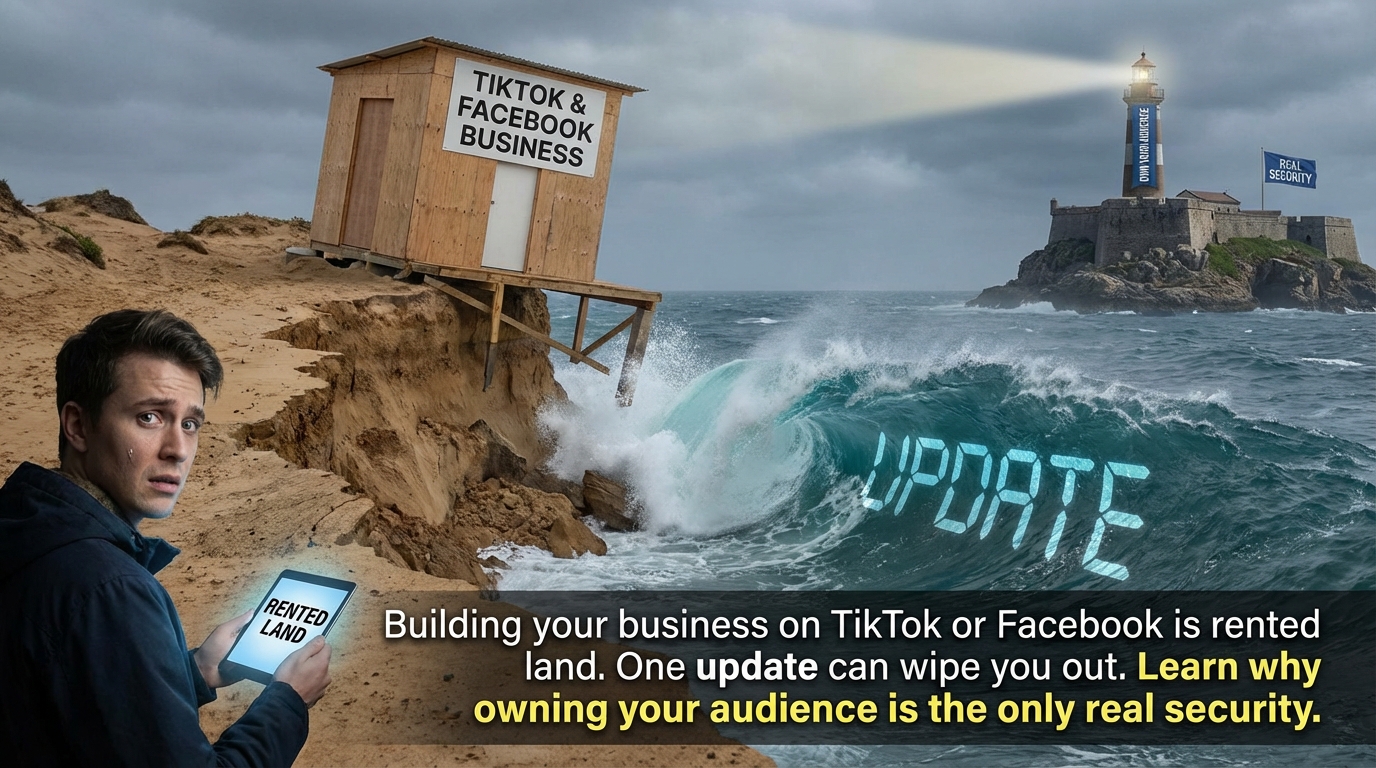
Building your entire business on TikTok or Facebook is like running a restaurant inside someone else’s living room. They can walk downstairs one morning, decide they’re “not feeling Italian food anymore,” and boom—your whole livelihood gets evicted before lunch.

And the craziest part?

Entrepreneurs keep acting shocked when it happens.

Like, “Wait, my reach dropped overnight? My account got flagged for no reason? My audience disappeared even though I did everything right?”

Yes. Because you built your house on land you don’t own.

Platforms don’t care about your “brand.” They don’t care about your grind, your consistency, or your inspirational posts about “showing up even when you don’t feel like it.” They care about:

  • keeping people scrolling
  • ads
  • shareholder happiness
  • and if it's Facebook, who the fuck knows what their algo is? They can and will ban you for no reason whatsoever. Ask me how I know.

Your little content empire? Collateral damage.

And look—you can absolutely use TikTok, Facebook, Instagram, whatever. Just don’t pretend they’re your business. If you don’t own:

  • the audience
  • the data
  • the distribution
  • the relationship

…you’re basically doing digital sharecropping. You work the field, they keep the land, and if the algorithm gods decide you’re not entertaining enough today, they cut your sunlight and salt the soil.

You and I both know creators who were pulling 5M views per month… until one day they woke up to numbers so low they thought their phone broke. Nothing changed except the landlord raised the rent.

Here’s the truth people don’t want to hear:

Social platforms are attention funnels—not business foundations.

If you’re smart, you drive the traffic somewhere you actually control:

  • your email list
  • your site
  • your product ecosystem
  • your community (iffy, though)

Because one email subscriber is worth more than 10,000 “followers” whose visibility depends on a bored engineer adjusting a slider in the back end.

If you’re serious about building assets instead of dependencies, the Email Marketing Hub should be part of your core reading. And this Affiliate Sales System Blueprint is must-read, too.

So yeah—post on TikTok. Use Facebook. Ride the waves.

Just don’t confuse surfing with owning the ocean. The moment you build your business on rented land, you’re one policy update away from becoming a “whatever happened to them?” cautionary tale. And that’s the part people won’t say out loud—but I will: If your entire strategy collapses because a social platform hiccups, you didn’t build a business. You built a dependency. And dependencies don’t scale. They just break dramatically.

As the old saying goes (about bankruptcy): At first, it's slow. Then it's sudden. Same with sharecropping.

Read More