
featured 7661590 2
Traffic & Promotion

The Weekly Promotion System: How to Drive Traffic to Every Post in 2026

Driving traffic to every post you publish requires a system, not sporadic effort. While many marketers chase the latest trend, the most reliable approach is a repeatable routine built on consistent actions. The U.S. military’s enlisted promotion system offers a clear example of how structured criteria and steady progress produce predictable results. By adapting that mindset to a weekly content promotion plan, you can build a steady flow of visitors to every article in 2026 without relying on hype or luck.

Remember: I am not a military expert but I am using it to illustrate that systems are what drive consistent performance. In that light, I am putting the good stuff in what the military calls BLUF (Bottom Line Up Front).

Building Your Own Weekly Promotion System for 2026

Here is a simple weekly framework inspired by the military’s structured approach. You can adapt it to your schedule and platforms.

DayActionWhy It Matters
MondayRepurpose the post into a short video or infographic.Different formats reach different audience segments.
TuesdayShare the post on 3 social media platforms with platform-specific copy.Increases visibility without duplication penalty.
WednesdayEmail your list with a presell paragraph linking to the post.Direct traffic from your most engaged audience.
ThursdayReach out to one relevant affiliate partner or collaborator to share the post.Leverages others’ audiences.
FridayEngage in comments and repost user-generated reactions.Builts social proof and encourages further sharing.
Saturday/SundayReview analytics and plan next week’s promotion priorities.Continuous improvement based on data.

What the Military Promotion System Teaches Us About Consistency

Both the Army and the Air Force use well-defined cycles and requirements to advance personnel. Promotions are not random; they follow specific time-in-service (TIS) and time-in-grade (TIG) gates, mandatory training, and board appearances. For example, the Army’s promotion to Staff Sergeant (SSG) requires a Soldier to have at least 70 months TIS and 16 months TIG in the primary zone, and they must complete the Basic Leader Course (BLC) before they can even appear before a promotion board. The Air Force uses the Weighted Airman Promotion System (WAPS), which assigns line numbers each month based on a combination of test scores, performance reports, and time in service.

These military systems are monthly, not weekly. However, the principle behind them, steady accumulation of required criteria and meeting specific milestones, applies directly to content promotion. Instead of waiting for a monthly cycle, you can break those requirements into weekly steps that move each post closer to its target audience.

Army vs. Air Force Promotion Cycles: Why Structure Matters

Understanding the difference between these two systems highlights the value of having a clear framework. The Army uses monthly promotion point cutoff scores. A Soldier in the primary zone for Sergeant (SGT) needs at least 34 months TIS and 10 months TIG to be considered by a board. For Staff Sergeant, the primary zone jumps to 70 months TIS and 16 months TIG. Secondary zone thresholds are lower, for SSG, 46 months TIS and 6 months TIG, but still enforce minimum time requirements. The Air Force publishes cycle numbers and line numbers each month for ranks from Staff Sergeant through Chief Master Sergeant. For June 2026, for example, the line numbers for SSgt (airman) in the U.S. Air Force ranged from 11905 to 13255, and for TSgt from 6479 to 7199. These numbers tell airmen exactly where they stand in the promotion queue.

Both systems remove guesswork. Soldiers and airmen know what they need to do and when. Your content marketing works the same way. If you have a clear set of weekly promotion actions, such as sharing on three social platforms, sending an email to your list, reaching out to one affiliate partner, and repurposing the post into a short video, you remove the guesswork. Each week you advance the post one step further, just like a Soldier moves from CPL to SGT after meeting the TIS/TIG gates.

traffic growth plan
Photo by K on Pexels

How to Apply the Military Model to Your Weekly Promotion Routine

The key insight is that promotion happens on a schedule. Army promotion points become effective on the first calendar day of the month following integration approval, which must be granted by the 26th of the prior month. That fixed deadline forces preparation. For your content, set a fixed day each week when you execute your promotion actions. For example, every Tuesday you could share your latest post in five relevant Facebook groups, and every Thursday send a dedicated broadcast email to your list. The repetition builds momentum.

Just as the Army requires completion of the Basic Leader Course before a Soldier can pin on Staff Sergeant, your content may need certain “qualifications” before it can be promoted effectively. That could mean having an SEO-optimized headline, a strong call to action, or a lead magnet attached. You can create a weekly checklist of pre-promotion tasks to ensure every post is ready before you push traffic to it. The criteria are your own version of TIS and TIG gates.

This routine mirrors the monthly promotion cycles of the Army and Air Force. Both services require sustained effort over time. The Army’s SGT primary zone demands 34 months TIS and 10 months TIG, while the SSG primary zone demands 70 months TIS and 16 months TIG. These numbers illustrate that patience and consistency are non-negotiable. Your weekly promotion system should be equally persistent. One share on launch day is rarely enough; regular weekly touches keep your content active and attract new readers.

systematic promotion
Photo by www.kaboompics.com on Pexels

What About the Air Force Weighted Airman Promotion System?

The Air Force uses WAPS to calculate line numbers each month. For June 2026, the published line numbers for MSgt (25E7) ranged from 5145 to 5524, and for SMSgt (26E8) from 0267 to 0373. These numbers tell airmen exactly how many people stand between them and the next stripe. Similarly, you can track how many views, clicks, or signups each week brings your post. If your weekly promotion actions are consistent, you will see a predictable increase in traffic, much like an airman sees their line number decrease over time as they complete more requirements.

The Space Force also follows a similar monthly cycle, with line numbers published for TSgt (25S6: 0233-0258) and all remaining for Sgt (25S5) and MSgt (25S7) in June 2026. This shows that systematic promotion can apply across different branches, and across different niches. Your content promotion plan should be just as universal.

Pitfalls to Avoid When Building Your Weekly System

One common mistake is trying to promote every post at once. That creates burnout and low-quality sharing. Instead, treat each post like a Soldier preparing for a promotion board. The Army requires SGTs to appear before a board with verified TIS/TIG before they can pin on SSG. In content terms, your post must first meet basic quality metrics, a certain word count, keyword coverage, internal links, before you invest promotion energy into it. Once it qualifies, move it into your weekly rotation.

Another pitfall is ignoring deadlines. Army promotion points only become effective on the first of the month if integration is approved by the 26th. If you miss that window, you wait an additional month. With content, missing your weekly promotion slot means lower initial traffic and weaker social signals. Stick to your scheduled days as you would to a military deadline.

weekly promotion system
Photo by Markus Winkler on Pexels

How to Measure Success in Your Weekly Promotion System

Track two key metrics: the number of distinct actions completed per post per week, and the resulting traffic lift over time. The military tracks promotion point cutoffs and line numbers. You can track share count, email open rates, and referral traffic. After four weeks of consistent weekly promotion, compare the performance of posts that received the full treatment against those that did not. The structured approach will likely outperform random sharing.

Remember that the Army’s SPC waiver ceiling is 25 percent, as announced by DMPM (Army G1). That means a limited number of waivers are allowed. In content promotion, avoid the temptation to rely on shortcuts or paid boosts that bypass your system. Stick to organic, repeatable actions that build long-term traffic.

Frequently Asked Questions

Can I use the military’s monthly cycles as a model even if I want a weekly system?

Yes. The military uses monthly cycles because of administrative requirements, but the principle of meeting specific criteria on a regular schedule is directly transferable. Simply compress those criteria into weekly actions. Your content does not need government approval, so you can operate on a faster cadence.

What if I don’t have enough time to promote every post every week?

Focus on one or two high-value posts per week instead of trying to cover everything. Just as only certain Soldiers are in the promotion zone each month, choose a handful of your best articles to support with your full weekly routine. Rotate them each week so older posts get periodic attention.

Does my content need to meet specific “TIS” or “TIG” requirements before promotion?

In this analogy, TIS is the age of the post, and TIG is the time since the last promotion (share). A brand-new post needs at least a week of natural organic exposure before you push it hard. Older posts that have not been shared for a month can be revived with a new round of promotion.

How do I know if my weekly promotion system is working?

Track traffic from each promotional channel weekly. If a post sees consistent increases after three weeks of your routine, the system is working. If not, adjust the timing or the platforms. The Air Force refines its WAPS calculations each month; you should refine your process each month as well.

Is it better to focus on one platform or several?

The military uses multiple branches to create redundancy. Similarly, using two or three platforms reduces risk if one algorithm changes. The Army and Air Force both have multiple promotion paths (primary and secondary zones). You can have a primary promotion channel (email) and secondary channels (social, partnerships) to diversify your traffic sources.

Building a weekly promotion system for your content in 2026 does not require complex tools or expensive ads. It requires the same discipline that the military uses for its enlisted promotions: clear criteria, consistent action, and patience. Start with one post, apply your weekly routine for four weeks, and watch the traffic grow. The system works because it removes guesswork and replaces it with repeatable steps that move each post forward, one week at a time.
Read More
weekly promotion loop
Traffic & Promotion

Turn Your Blog into a Traffic Engine: The Weekly Promotion Loop

Most bloggers treat publishing like a finish line. They hit Publish, share the post once, then act confused when it gets six clicks and a pity-like from their aunt.

That’s why most blogs plateau.

A blog becomes a traffic engine when every post runs through a simple, repeatable process that creates multiple “touches” across the places your audience already hangs out—without you having to become a full-time content hamster.

This is the weekly promotion loop I want you running.

One post. One week. Repeat.

If you’re brand new to this whole game, start here: Start Here.
If you want the shortcuts and templates: Free Reports.


Key Takeaways

  • Publishing is the start. Promotion is the multiplier.
  • A weekly loop beats random posting: launch → repurpose → email → community → internal links.
  • Repurposing isn’t “make more content.” It’s “make the same content do more jobs.”
  • Internal links are promotion. Updating older posts is how you compound traffic quietly.
  • Consistency wins: one system, executed weekly, for 90 days.

Why Most Blog Posts Die Quietly After Publishing

Here’s the typical routine:

  1. You publish a post you worked hard on.
  2. You share it once.
  3. You get a trickle of clicks.
  4. You move on.
  5. The post gets buried.

That’s not because your post was “bad.” It’s because your post got one chance to get discovered.

A traffic engine doesn’t rely on one chance. It relies on repetition (with variation) across the week.

This sits inside your PPP system:


The Weekly Promotion Loop

The loop is simple:

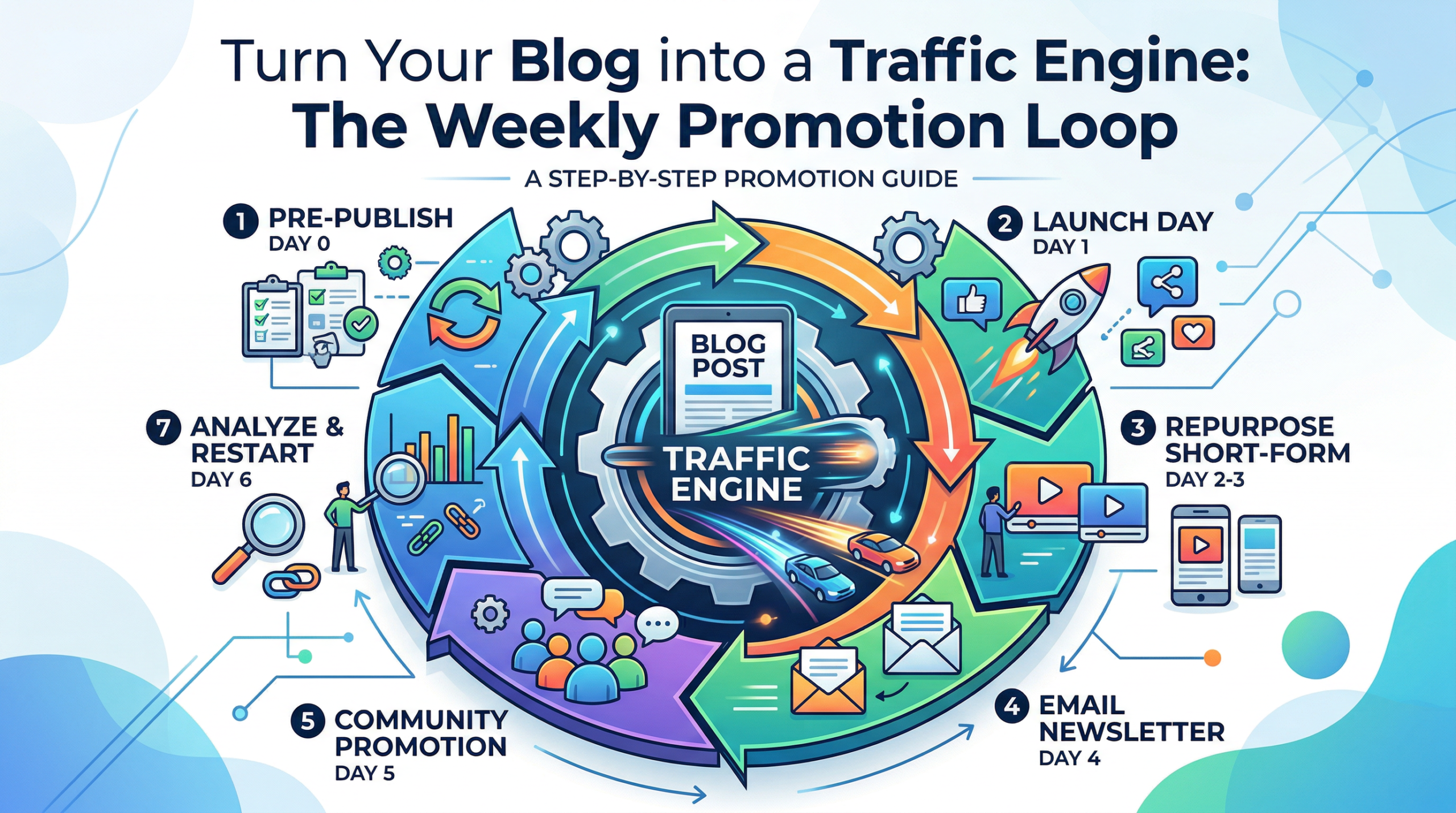
Day 0 prep → Day 1 launch → Day 2–3 repurpose → Day 4 email → Day 5 community → Day 6 internal links + refresh

You’re not spamming the same link for six days. You’re creating six different reasons for someone to discover it.

Here’s the schedule:

DayWhat you doThe point
Day 0Prep hooks + linksMake the post easy to promote
Day 1Launch distributionGet initial momentum
Day 2–3Repurpose into short formReach new people without new research
Day 4Send an emailDrive clicks from an owned channel
Day 5Start a community discussionPull targeted readers in naturally
Day 6Add internal links + update old postsCompound traffic for months

Run this loop every week for 90 days and your “traffic problem” usually turns into a “which post do I expand first?” problem.


Day 0: Before You Publish, Set the Post Up to Be Promotable

Most people try to figure out promotion after the fact.

That’s like cooking a meal and then asking, “Wait… do I own plates?”

Do these three things before you hit publish:

Write 3 hooks (not headlines)

Your headline is for search. Hooks are for humans.

Write three:

  • Curiosity hook: “Most bloggers do X… and that’s why Y never happens.”
  • Contrarian hook: “Stop doing X. Do this instead.”
  • Outcome hook: “Do this weekly and your posts stop dying.”

Open 3–5 older posts related to the new one and note:

  • where a link would naturally fit
  • what anchor text you’ll use

You’ll update these on Day 6.

Decide the one CTA

One post should push one next step:

  • subscribe
  • grab a free report
  • read the next post in the sequence
  • monetization path (when appropriate)

No link salad.

(If you want a simple habit to stay consistent with all of this, see: The 2-Minute Morning Rule That Quietly Moves Your Business Forward.)


Day 1: Launch Day Distribution Without Being Annoying

Launch day is not “post everywhere.”

Launch day is “post where it actually makes sense.”

Pick 2–3:

  • your email list (if you have one)
  • one social platform you can show up on consistently
  • one community where your audience already talks

What to say:

  • lead with the outcome
  • mention what’s in it for them
  • tell them exactly what to do next

Example:

If your posts die after Day 1, this weekly loop fixes it. Steal it and run it this week.

That’s useful. Not annoying.

If you need a place to send people when they want “the next step,” use your hub: Blog.


Day 2–3: Repurpose the Post Into Short-Form Without Starting Over

Repurposing is just format shifting.

Pull from the post you already wrote:

  • 3–5 key takeaways → 3–5 short posts
  • one checklist → a carousel or graphic
  • one “mistake” section → a short rant post (people love those)
  • one example → a quick “how-to” clip script

This is how one blog post becomes:

  • multiple touchpoints
  • multiple entry doors
  • multiple chances to be discovered

If you’re building your blog with AI in the mix (without turning it into AI slop), you’ll like: Build Your AI-Powered Blog in 2025.


Day 4: Turn the Post Into an Email That Drives Clicks

Please don’t send: “New blog post is live!” That email dies in the inbox like a leaf.

Instead:

  • open with the problem
  • tease the “one thing”
  • link once
  • stop talking

Use this structure:

Subject: Stop letting posts die after Day 1
Body:
2–4 sentences, one link, optional P.S.

Want more subscribers so email actually matters? That’s what Subscribe is for—and why your Free Reports hub should exist.


Day 5: Community Promotion That Doesn’t Feel Like a Pitch

Community promotion is not “here’s my link.” Community promotion is: “here’s something useful… and if you want the full breakdown, I wrote it up.”

Do this:

  1. post the core insight in plain English
  2. ask a question
  3. add the link only if it fits naturally

Example:

What do you do after you publish? I run a 6-day loop (repurpose + email + internal links) so posts don’t die. Want the schedule?

That’s how you get clicks without becoming that guy.


Day 6: The SEO Booster Most Bloggers Ignore

This is the compounding step. Open 3–5 older posts and do two things:

Add internal links to the new post

Find a sentence where the topic overlaps and add a link naturally.

Refresh the old post slightly

Add:

  • a new example
  • an update note
  • a small FAQ
  • a paragraph that references the newer post

This signals:

  • relevance
  • freshness
  • topical connection

Internal linking is promotion because it keeps traffic circulating inside your site instead of bouncing off into the void.


The Biggest Promotion Mistakes

Mistake: Promote once and disappear

Fix: run the loop.

Mistake: Use the same message everywhere

Fix: change the angle by platform:

  • curiosity for social
  • clarity for email
  • discussion starter for community

Fix: Day 6 becomes non-negotiable.

Mistake: Treat every post the same

Fix: promote based on intent:

  • evergreen = spread out touches over weeks
  • time-sensitive = heavier Day 1–3 push

Your Next 7 Days: Turn One Post Into a Traffic Engine

Pick one post you published recently and do this:

  • Day 0: write 3 hooks + pick internal link targets
  • Day 1: publish + share in 2–3 places
  • Day 2–3: create 3–5 repurpose pieces
  • Day 4: write one tight email with one link
  • Day 5: start one community discussion
  • Day 6: add 3–5 internal links from older posts + refresh one older post slightly

Then follow the system:
PublishPromoteProfit

And if you want your monetization to be as systematic as your promotion, read:
Affiliate Sales System Blueprint: From First Click to First Commission


Frequently Asked Questions

How long should I run the weekly promotion loop before judging results?

Give it 90 days. Not because I’m romantic about quarters, but because consistency compounds and you need enough reps to see patterns.

What if a post still doesn’t get traction?

Fix the top 3 things:

  • title (does it match intent?)
  • intro (does it answer fast?)
  • internal links (is it connected to anything?)

Then run the loop again on the next post. Don’t spiral.

Can I automate the weekly promotion loop?

You can automate scheduling. You shouldn’t automate community engagement. Automation distributes—you still have to show up like a person.

Should evergreen and time-sensitive posts use the same loop?

Same loop, different intensity. Evergreen gets a slower burn. Time-sensitive gets a heavier Day 1–3 push.

What repurposing format should I start with?

Start with the one you’ll actually do consistently. Consistency beats “optimal” every time.


Conclusion

Stop treating posts like one-hit wonders.

Run a weekly promotion loop and your blog becomes an engine:

  • one post becomes multiple entry points
  • internal links keep traffic circulating
  • your effort compounds instead of disappearing

If you want the “plug-and-play” resources that make this easier, start here:

Read More
2 minute mornings
Traffic & Promotion

The 2-Minute Morning Rule that Quietly Moves Your Business Forward

It's a 2-Minute Morning Rule that you can read in less than 1 minute.

Most marketers wake up and immediately hand their brain to notifications.

Email. Slack. DMs. Someone else’s urgency hijacks the day before you’ve made a single move for your business.

That’s the mistake. Here’s the fix—and it’s embarrassingly simple.

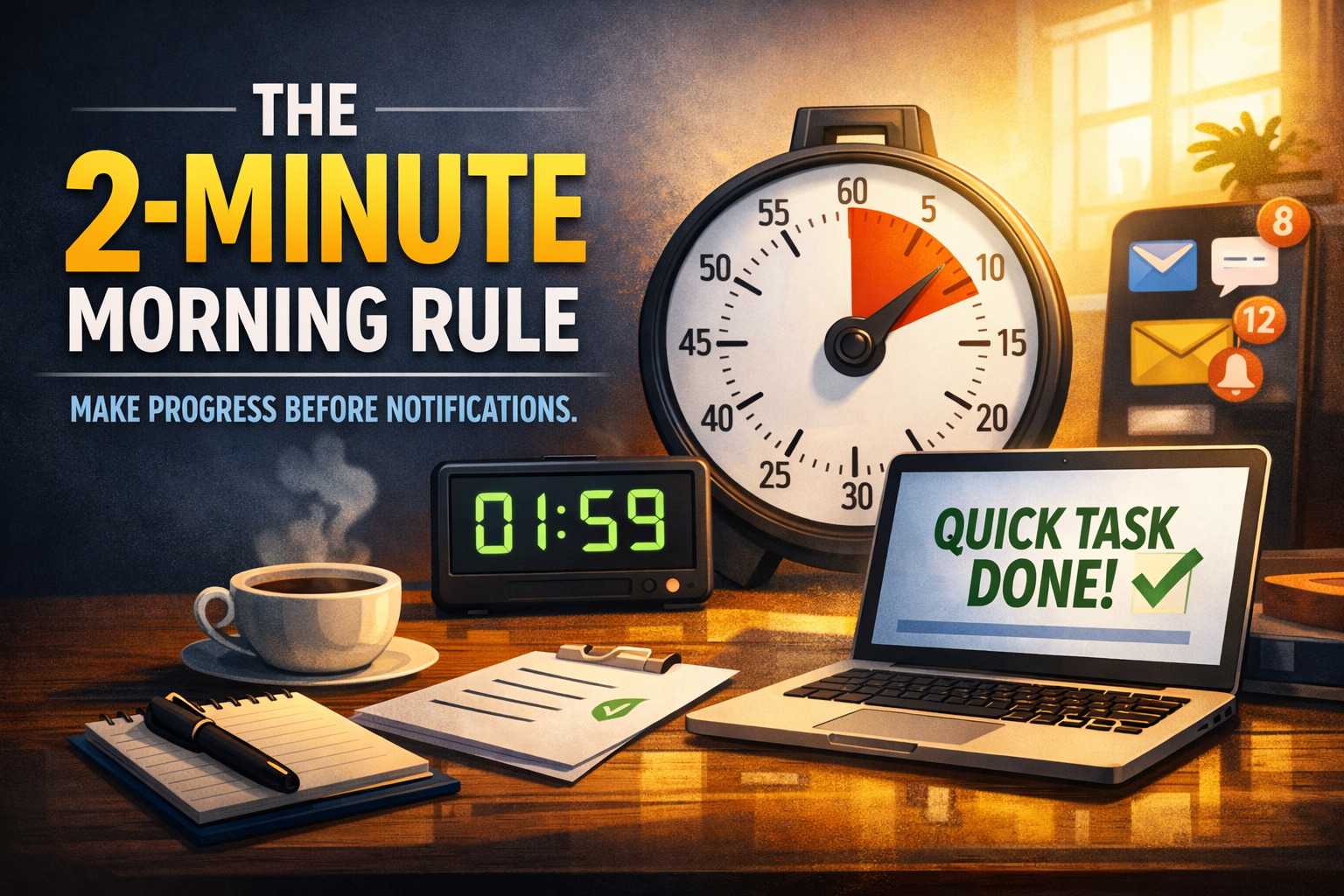
The 2-Minute Morning Rule

Before you check anything, spend two minutes doing one small, deliberate action that moves your business forward.

  • Not planning.
  • Not organizing.
  • Not “getting ready.”

Actual progress. “Moving the needle” progress.

  • Send one outreach message.
  • Write one paragraph.
  • Review one metric that actually matters.
  • Fix one tiny thing you’ve been avoiding.

Two minutes. Timer on. No exceptions.

Why This Works (When Bigger Moves Fail)

This punches way above its weight because it sidesteps the real enemy: friction. Most people think progress requires big, heroic effort. It doesn’t. It requires starting before your brain talks you out of it.

  • Small actions compound.
  • Momentum compounds.
  • Identity compounds.

Do this enough times and you stop being “someone who means to work on their business” and become someone who does—daily. That shift matters more than any new tactic.

How to Implement It Today (Not Someday)

Set a 120 second timer tomorrow morning.

When it starts, do one business-forward action:

  • One sentence of copy
  • One follow-up email
  • One decision you’ve been postponing

When the timer ends, stop. Yes, really. You’re not trying to win the day. You’re trying to prove to your brain that progress is easy to start.

Once that’s wired in, everything else gets easier.

Pro Tip Most People Skip

Make this a daily non-negotiable practice. A habit, if you will.

Consistency beats intensity. Always.

Small optimizations done repeatedly will outperform giant “one day I’ll fix this” projects every time. Those projects don’t fail because they’re hard—they fail because they never start.

Two minutes fixes that.

And no, it’s not sexy. It’s just effective. Which is kind of the point. And remember, when you start seeing real progress, you may be able to thank the 2-Minute Morning Rule for it!

Read More