
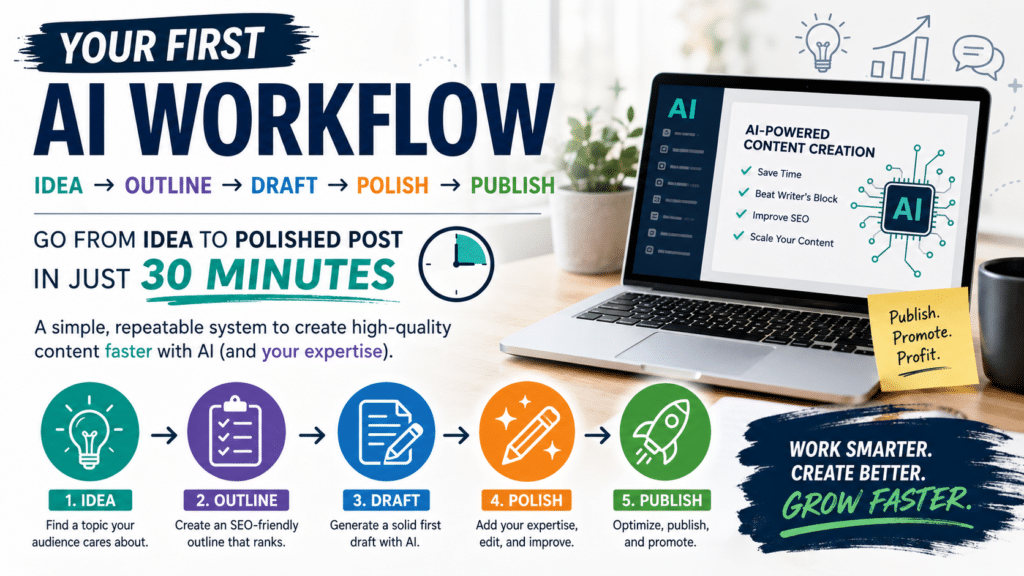
Bottom Line Up Front: The fastest way to create high-quality content with AI isn’t by asking ChatGPT to “write me a blog post.” It’s by following a repeatable workflow. Start with an idea, build an SEO-friendly outline, generate a first draft, then polish it with your own expertise. Once you’ve practiced the process a few times, you can create publish-ready content in about 30 minutes—without sacrificing quality.
If you’ve ever opened ChatGPT, typed a vague prompt, and been disappointed with the results, you’re not alone.
The problem usually isn’t the AI.
It’s the workflow.
Professional marketers don’t rely on one giant prompt and hope for the best. They use AI like an assistant, assigning it one task at a time while keeping control of the strategy, messaging, and final output.
That simple shift is what separates average AI-generated content from articles that actually rank, earn trust, and convert readers into customers.
In this guide, you’ll learn the same four-step AI workflow we use to create content faster while maintaining quality. Whether you’re a business owner, freelancer, blogger, or digital marketer, this process will help you spend less time staring at a blank page and more time publishing content that gets results.
If you’re new to Internet Marketing Muscle, our Publish. Promote. Profit. philosophy is built around creating valuable content consistently, getting it in front of the right audience, and turning that attention into measurable business growth. A structured AI workflow fits perfectly within that process because it helps you publish smarter—not just faster.
What Is an AI Workflow?
An AI workflow is a repeatable sequence of steps that uses artificial intelligence to assist with specific tasks while you remain in charge of the thinking.
Instead of asking AI to do everything, you divide the work into manageable stages.
A typical AI writing workflow looks like this:
- Find a topic worth writing about.
- Create an SEO-focused outline.
- Generate a structured first draft.
- Edit and personalize the content.
- Optimize it for search engines and AI search.
- Publish and promote it.
Each step builds on the previous one.
This approach consistently produces better results than trying to create an entire article with one prompt because you’re giving the AI more context at every stage.
Think of AI as an incredibly fast junior copywriter. It can brainstorm ideas, organize information, and generate drafts in seconds—but it still needs direction from someone who understands the audience and the business goals.
That’s where you come in.
Why Workflows Beat One-Click AI Writing
One-click content generation sounds appealing.
In reality, it often creates articles that are:
- Generic
- Repetitive
- Poorly structured
- Missing important information
- Difficult to edit
- Nearly identical to thousands of other AI-generated posts
A workflow solves those problems because it forces you to make decisions before you start writing.
Instead of asking: “Write me a blog post about AI.”
You ask: “Help me find the best topic.”
Then: “Create an outline.”
Then: “Write Section One.”
Then: “Improve this paragraph.”
Each prompt builds upon the last. The AI becomes more accurate because you’ve given it better instructions.
Think of it like building a house. You wouldn’t pour the foundation, frame the walls, and install the roof all at the same time. Each step builds on the previous one, and content creation works exactly the same way.
Why Every Content Creator Needs an AI Workflow
Creating content used to mean blocking off an entire afternoon to research, outline, write, edit, and publish one article.
Today, AI can reduce that workload dramatically—but only if you have a system.
A good workflow helps you:
- Publish consistently
- Eliminate writer’s block
- Create higher-quality first drafts
- Improve SEO without extra effort
- Scale your content production
- Spend more time on strategy instead of repetitive tasks
Perhaps more importantly, a structured workflow keeps your content focused on solving real problems instead of simply filling a page with words.
That matters because search has changed.
Google no longer rewards content simply because it contains the right keywords. Increasingly, it rewards content that answers questions clearly, demonstrates expertise, and provides a better experience than competing pages.
The same is true for AI-powered search experiences like ChatGPT, Perplexity, and Google’s AI Overviews.
If you’re still learning how search is evolving, you’ll want to read SEO vs. AEO in 2026. It explains why Answer Engine Optimization (AEO) is becoming just as important as traditional SEO and how to structure your content so it’s easier for both search engines and AI assistants to understand.
Understanding this shift is essential because your AI workflow shouldn’t just help you create content faster—it should help you create content that’s more likely to be discovered.
The Four-Step AI Workflow
Every successful piece of AI-assisted content follows the same basic framework.
| Step | Goal | Time |
|---|---|---|
| 1. Idea | Find a topic people actually want | 5 minutes |
| 2. Outline | Build a logical structure | 5 minutes |
| 3. Draft | Generate quality content | 10 minutes |
| 4. Polish | Add expertise and optimize | 10 minutes |
That’s it.
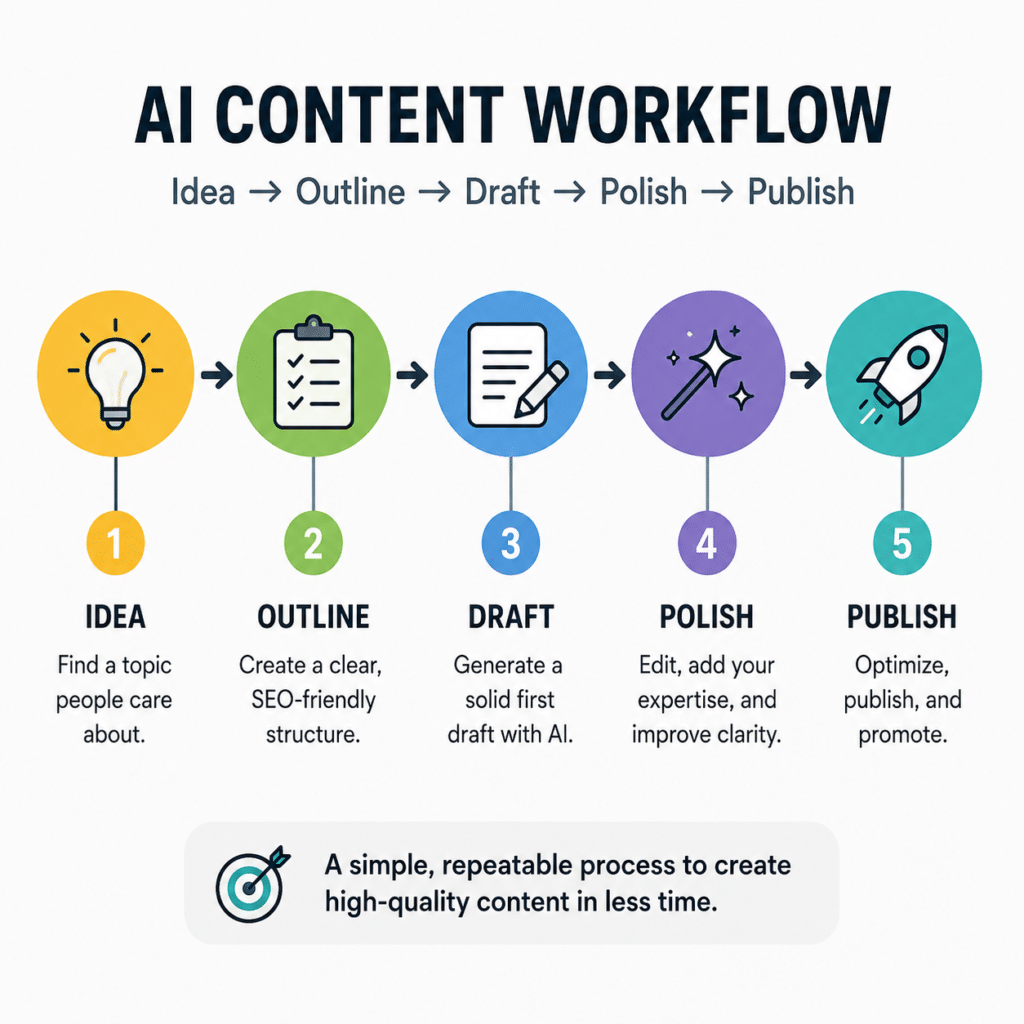
No complicated software. No elaborate automation. Just four repeatable steps. Five if you count pressing “publish.”
Let’s break each one down.
Step 1: Find an Idea Worth Writing About
The quality of your article begins long before AI writes the first sentence.
It starts with choosing the right topic.
Many people ask AI something like: Give me ten blog ideas.
The results aren’t usually terrible. They’re just…
…forgettable.
A better prompt gives AI context. For example:
Give me 20 blog ideas for local service businesses that want to increase website traffic using SEO and AI. Organize the ideas by informational, commercial, and transactional search intent.
Notice how much more information you’re giving the AI.
Instead of random ideas, you’ll receive topics aligned with a business objective, making it much easier to build a content strategy instead of a collection of unrelated blog posts.
Validate the Idea Before You Write
AI is an excellent brainstorming partner. It is not a replacement for keyword research.
Before committing to a topic, spend a few minutes validating demand with tools like:
- Google Autocomplete
- People Also Ask
- Google Search Console
- Semrush
- Ahrefs
- AnswerThePublic
Use tools like Google Search Console to discover the queries your website is already receiving impressions for. These keywords often reveal excellent opportunities to create supporting articles that strengthen your topical authority.
If nobody is searching for the topic, it may not be worth your time—unless it’s part of a broader thought leadership strategy.
One of the biggest mistakes beginners make is assuming every AI-generated idea deserves its own article.
Research first. Write second.
Think in Content Clusters
Instead of publishing random articles every week, think about how each piece supports a larger topic.
For example, this article on AI workflows could naturally connect to future articles about:
- AI prompts for marketers
- AI SEO checklists
- Humanizing AI content
- AI content strategy
- AI productivity tools
- Prompt engineering
Over time, these related articles create topical authority, helping search engines understand that your website is a trusted resource on AI-powered marketing.
You’ll notice that’s exactly how our AI for Marketers resource center is organized. Rather than publishing isolated posts, we build connected content that answers related questions and guides readers naturally from one topic to the next.
That’s one of the simplest—and most overlooked—SEO strategies you can implement today.
Step 2: Build an SEO-Friendly Outline
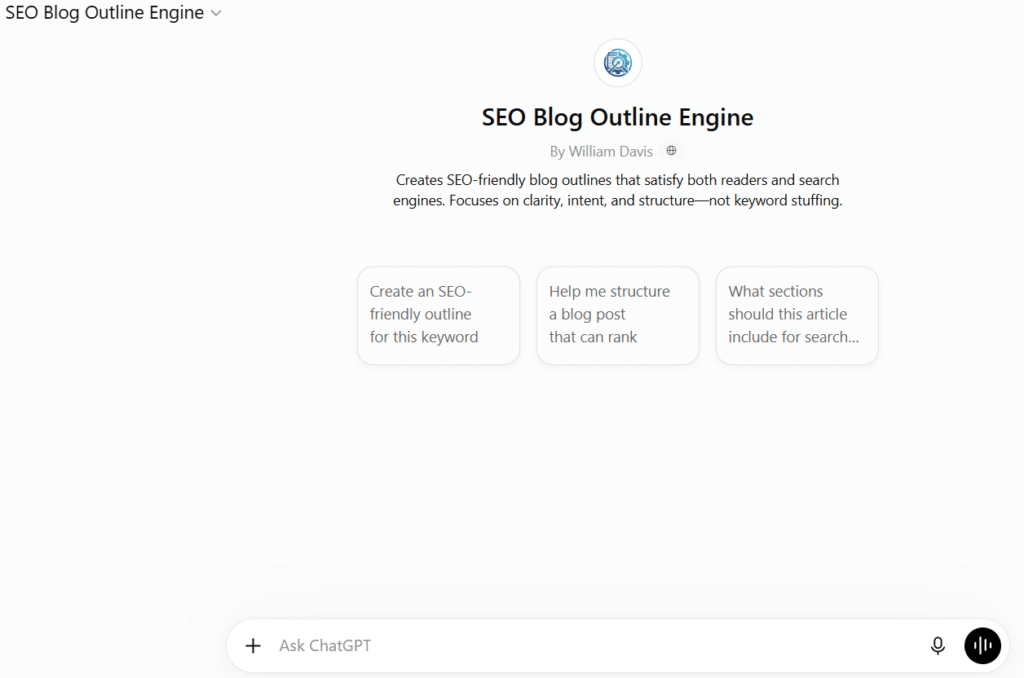
Now that you’ve chosen a topic, resist the temptation to ask AI to write the entire article.
Instead, have it build the roadmap first.
A detailed outline serves two purposes:
- It keeps your content organized.
- It gives AI enough context to produce better, more focused writing.
Think of it this way: you wouldn’t start building a house without a blueprint. Your content deserves the same planning.
Here’s a prompt I use regularly:
Create an SEO-optimized outline for the keyword “AI workflow.” Include an engaging introduction, exact-match H2 headings, supporting H3 sections, FAQs, and a strong conclusion. Structure the article for Google AI Overviews and featured snippets.
Within seconds, you’ll have a framework that’s much easier to edit than a 2,000-word draft generated in one shot.
What Makes a Great Outline?
Before moving on to the writing stage, make sure your outline includes:
- A clear answer near the beginning of the article
- Exact-match keyword headings
- Logical progression from one section to the next
- Practical examples
- Frequently asked questions
- A compelling conclusion with a call to action
This simple step saves far more time than it takes.
Instead of spending an hour reorganizing paragraphs later, you spend five minutes creating a structure that guides the entire article.
If you’re serious about publishing consistently, you’ll also benefit from following a repeatable publishing process. Our guide to Publish explains how to take an article from outline to publication without reinventing your workflow every time you sit down to write.
Let AI Organize—Not Think
One of the biggest misconceptions about AI is that it’s supposed to replace your thinking.
It shouldn’t.
Your expertise determines:
- Who you’re writing for
- What questions need answering
- Which examples matter
- What action readers should take
AI simply organizes those ideas into a readable structure.
Think of yourself as the architect. AI is the contractor.
The architect decides what gets built. The contractor helps build it faster.
Step 3: Generate Your First Draft
This is where most people make their biggest mistake.
They ask AI to write everything at once.
The result?
A long article that’s repetitive, generic, and often filled with fluff.
Instead, work one section at a time.
For example, after approving your outline, your prompts might look like this:
Write the introduction using a conversational tone.
Then…
Explain what an AI workflow is for beginners.
Then…
Write the section about generating content ideas.
Each response becomes the starting point for the next.
This approach keeps the AI focused and dramatically improves the quality of the finished article.
Don’t Chase Perfection on the First Draft
Your goal isn’t to publish the first draft.
Your goal is to create something worth improving.
Professional writers rarely produce polished copy on the first attempt.
AI shouldn’t be expected to either.
Instead:
- Generate.
- Review.
- Improve.
- Continue.
By the time you’ve finished the article, every section has already been edited once.
That alone will put your content ahead of most AI-generated posts published today.
Give AI Better Prompts
The quality of your prompts determines the quality of your output.
Instead of writing:
Write an article about AI workflows.
Try:
Write this section for small business owners who have never used AI before. Use short paragraphs, practical examples, and a conversational tone. Avoid clichés and explain technical concepts in simple language.
Notice how much more direction you’re providing.
You’re telling AI:
- Who the audience is
- What tone to use
- What to avoid
- What outcome you’re looking for
The better your instructions, the less editing you’ll need later.
Add the One Thing AI Doesn’t Have
Here’s something every marketer should remember.
AI has information. You have experience. That’s your advantage.
Anyone can ask ChatGPT to explain what an AI workflow is.
Only you can explain:
- How you’ve used it with clients.
- What mistakes you’ve made.
- Which prompts consistently work.
- Which shortcuts save the most time.
- What surprised you after using AI every day.
Those insights are impossible to duplicate.
They’re also exactly what Google refers to when it talks about Experience in its E-E-A-T guidelines.
If two articles contain similar information, the one with genuine experience almost always provides more value to readers.
Google specifically encourages content that demonstrates first-hand experience alongside expertise, authoritativeness, and trustworthiness.
https://developers.google.com/search/docs/fundamentals/creating-helpful-content
Add Examples Whenever Possible
Suppose you’re writing for a local roofing company.
Instead of saying: AI helps generate blog ideas.
Show it.
For example:
Prompt:
Give me 15 blog topics for a roofing contractor in Phoenix who wants more local leads.
AI might suggest:
- How Long Does a Roof Last in Arizona?
- Signs Your Roof Needs Repair After a Monsoon
- Tile Roof vs. Shingle Roof: Which Is Better?
Now your readers can immediately see how the workflow applies to their own business.
Examples build trust because they move beyond theory.
Keep Your Voice
One criticism of AI-generated content is that it all sounds the same. That’s usually because people publish the first draft.
Don’t.
Read every paragraph aloud.
Would you actually say those words? If not, rewrite them.
Replace robotic phrases like:
- “In today’s digital landscape…”
- “Leverage the power of…”
- “It’s important to note…”
- “Unlock the potential…”
with language you’d naturally use in a conversation.
Readers don’t connect with AI. They connect with people.
Learn From Every Article
One of the biggest advantages of building a workflow is that it improves over time.
After publishing a few articles, you’ll start asking questions like:
- Which prompts consistently produce the best outlines?
- Which introductions keep readers engaged?
- Which calls to action convert the most visitors?
- Which article formats generate backlinks?
Those answers become part of your workflow.
Instead of starting from scratch every time, you’re continuously improving your process.
That’s exactly why we’ve continued expanding our AI for Marketers resource library. Every new workflow, prompt, and tutorial builds on what we’ve already learned, making it easier for marketers to skip the trial-and-error phase and start seeing results faster.
Step 4: Polish Your Draft Until It Sounds Human
If there’s one step you should never skip, it’s editing.
AI can produce a solid first draft in minutes, but it doesn’t know your customers, your brand voice, or your personal experiences. That’s what transforms a good article into one that builds trust and authority.
I like to think of AI as a rough carpenter. It can build the framework quickly, but you’re the finish carpenter adding the trim, paint, and details that make the house feel complete.
Before you publish, ask yourself these questions:
- Does this sound like something I’d actually say?
- Have I answered the reader’s biggest questions?
- Is every section useful, or am I repeating myself?
- Have I included real examples or personal insights?
- Does the article naturally guide readers to the next step?
If the answer to any of those questions is “no,” keep editing. The goal isn’t to make your writing sound more like AI. It’s to make AI sound more like you.
Add Your Experience (This Is Your Competitive Advantage)
One of the biggest myths surrounding AI is that everyone now has access to the same information.
While that’s true to an extent, everyone does not have the same experience.
For example, if you’ve spent years helping businesses improve their SEO, you’ve learned things AI hasn’t:
- Which strategies consistently work.
- Which “best practices” rarely produce results.
- What clients struggle with most.
- Which mistakes cost businesses time and money.
Those insights are valuable because they’re earned—not generated.
Whenever possible, include:
- Client success stories
- Lessons learned
- Personal opinions backed by experience
- Original screenshots
- Custom graphics
- Case studies
- Before-and-after examples
This kind of original content helps differentiate your article from the growing number of generic AI-generated posts and reinforces your expertise.
Optimize for Google, AI Overviews, and Answer Engines
Publishing great content isn’t just about ranking on Google anymore.
Today’s content also needs to be easy for AI-powered search engines to understand, summarize, and reference.
Fortunately, the same writing habits that improve the reader’s experience also improve your chances of appearing in AI-generated answers.
Google’s own guidance emphasizes creating helpful, people-first content that demonstrates experience, expertise, and trustworthiness rather than writing solely for search engines. Following those principles will improve your content regardless of whether it’s written with or without AI.
Here are a few best practices:
- Answer important questions immediately.
- Use descriptive H2 and H3 headings.
- Break long sections into smaller topics.
- Use bullet points before longer explanations.
- Include FAQs that mirror real search queries.
- Write concise definitions that can stand alone.
- Link to related resources throughout your site.
For example:
What Is an AI Workflow?
An AI workflow is a repeatable process that uses artificial intelligence to assist with tasks like brainstorming, outlining, writing, editing, and optimization while a human provides strategy, creativity, and quality control.
That short definition can stand on its own, making it easier for search engines and AI assistants to reference.
Then the rest of the section expands on the idea.
That’s exactly how modern content should be structured.
As Google continues expanding AI Overviews, content that provides direct, well-structured answers is more likely to be surfaced in AI-generated summaries.
https://developers.google.com/search/docs/appearance/ai-features
Common AI Workflow Mistakes
Learning what not to do is just as valuable as learning what to do.
Here are some of the most common mistakes I see marketers make when they first start using AI.
1. Asking AI to Write Everything
One prompt.
Two thousand words.
Publish.
This almost always leads to generic content.
Instead, work section by section and guide the conversation.
2. Skipping Keyword Research
AI can generate unlimited ideas.
It can’t tell you which topics your audience is actively searching for.
Always validate ideas with keyword research before investing your time.
3. Ignoring Search Intent
A page targeting “What is an AI workflow?” should educate.
A page targeting “Best AI workflow software” should compare products.
Understand why someone is searching before you start writing.
4. Publishing Without Editing
This is probably the biggest mistake of all.
Even the best AI-generated draft needs a human editor.
Take time to:
- Improve transitions.
- Remove repetition.
- Verify facts.
- Add original examples.
- Strengthen the conclusion.
Your readers—and search engines—will notice the difference.
Recommended AI Workflow Tools
You don’t need a complicated tech stack to build an effective workflow.
In fact, keeping things simple often produces better results.
Here’s a practical toolkit that works well for most content creators.
ChatGPT
Use it for:
- Brainstorming
- Outlines
- Drafts
- Editing
- Rewriting
- Headline ideas
Google Search Console
Perfect for discovering:
- Existing rankings
- Low-hanging keyword opportunities
- Pages that deserve updates
- Search queries already bringing visitors to your site
Semrush or Ahrefs
Ideal for:
- Keyword research
- Competitor analysis
- Backlink opportunities
- Content gap analysis
Grammarly
Great for polishing grammar, improving readability, and catching small mistakes before publishing.
WordPress
A well-organized WordPress website makes it easy to publish, optimize, and update your content over time.
Publishing Is Only Half the Battle
Creating an excellent article is a huge accomplishment.
But publishing isn’t the finish line.
It’s the starting line.
Once your article is live:
- Share it on LinkedIn.
- Include it in your email newsletter.
- Mention it in relevant Facebook groups.
- Link to it from older articles.
- Update it every few months with new examples and statistics.
Great content deserves promotion.
If you publish consistently but rarely promote your work, you’re leaving traffic on the table.
That’s why we’ve built an entire Traffic & Promotion section dedicated to helping marketers get more visibility from the content they’ve already created. A great article should continue generating traffic long after the day you publish it.
Frequently Asked Questions
What is an AI workflow?
An AI workflow is a structured process that uses artificial intelligence to help complete specific tasks—such as brainstorming, outlining, drafting, and editing—while humans provide strategy, creativity, and final quality control.
Can AI write an entire blog post?
Yes, but that doesn’t mean it should.
The best content comes from collaboration. AI accelerates the writing process, while you provide expertise, fact-checking, personality, and original insights that make the article worth reading.
How long should an AI workflow take?
Once you’ve practiced the process a few times, many blog posts can move from idea to polished draft in around 30 minutes. More comprehensive pillar articles may take longer because of additional research, editing, and optimization.
Is AI-generated content bad for SEO?
No.
Google doesn’t penalize content simply because AI helped create it. What matters is whether the content is helpful, accurate, original, and satisfies the reader’s search intent.
Well-edited AI-assisted content can perform extremely well when it demonstrates real expertise and provides value beyond what’s already available online.
What’s the best AI tool for content creation?
There’s no single “best” tool.
Most marketers achieve great results by combining ChatGPT for ideation and drafting with keyword research tools like Semrush or Ahrefs, Google Search Console for performance insights, and WordPress for publishing.
The tool matters less than the workflow.
Final Thoughts
The biggest misconception about AI is that it’s replacing writers.
It isn’t.
It’s replacing inefficient processes.
The marketers who succeed over the next few years won’t necessarily be the ones using the newest AI tools. They’ll be the ones who build repeatable systems that consistently produce helpful, high-quality content.
That’s exactly what an AI workflow gives you.
Instead of relying on inspiration every time you sit down to write, you follow a proven process:
- Start with a validated idea.
- Build a structured outline.
- Draft one section at a time.
- Edit until it reflects your expertise and voice.
- Optimize, publish, and promote.
Repeat that workflow often enough, and creating content becomes faster, easier, and far less stressful.
Remember, AI isn’t the strategy.
You’re the strategist.
AI is simply the assistant that helps you execute your ideas more efficiently.
If you’re ready to take the next step, explore the other resources here on Internet Marketing Muscle. Whether you’re learning how to optimize for AI search, improve your publishing process, or drive more traffic to your website, each article is designed to help you Publish. Promote. Profit. more effectively.
If you REALLY want to supercharge your AI Workflow, you’ll get:
AI Power Tools