
The Bottom Line
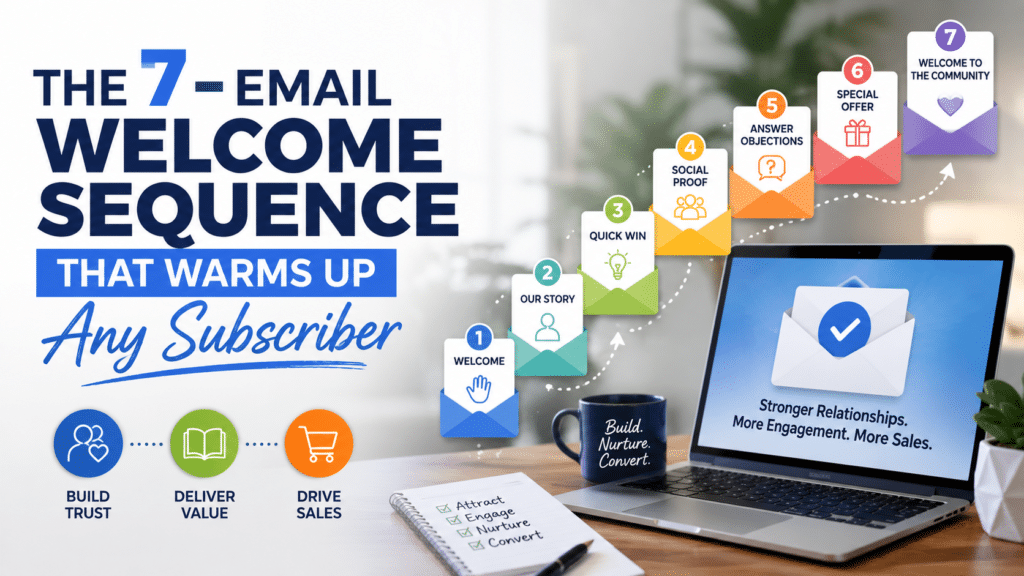
The first seven emails you send after someone joins your email list will have a greater impact on your long-term revenue than almost any other email campaign. A well-designed welcome sequence introduces your brand, builds trust, delivers value, answers objections, and naturally guides subscribers toward becoming paying customers.
Instead of sending a single “thanks for subscribing” email, businesses that use a structured 7-email welcome sequence consistently see higher open rates, better engagement, stronger customer relationships, and more conversions. Whether you’re a coach, consultant, affiliate marketer, ecommerce store, agency, or SaaS business, this framework can become one of your highest-performing marketing assets.
What Is a Welcome Email Sequence?
A welcome email sequence is an automated series of emails sent immediately after someone subscribes to your email list. Rather than leaving new subscribers wondering what comes next, the sequence intentionally moves them through a journey—from curious prospect to informed buyer.
A successful welcome sequence should:
- Deliver the promised lead magnet or incentive immediately
- Introduce your brand and build credibility
- Educate subscribers with practical advice
- Demonstrate expertise through real-world examples
- Overcome common buying objections
- Present a relevant offer
- Transition subscribers into your regular email newsletter
If you’re just beginning your email marketing journey, start with the Email Marketing Hub. It provides a comprehensive collection of resources covering list building, automation, copywriting, segmentation, and email strategy.
Why Welcome Email Sequences Matter
Many marketers spend hundreds or thousands of dollars acquiring leads, only to neglect the period when subscribers are most engaged.
The first 48 hours after someone subscribes represent your best opportunity to:
- Make a memorable first impression
- Establish authority
- Demonstrate value
- Encourage replies and engagement
- Generate your first sale
Research consistently shows that welcome emails outperform standard marketing emails because subscribers are expecting to hear from you. They recognize your brand, remember why they signed up, and are actively looking for the value you promised.
When you capitalize on that attention, your entire email marketing system performs better.
The Psychology Behind a High-Converting Welcome Sequence
Successful welcome sequences don’t rely on clever copy alone. They leverage several well-established psychological principles that influence decision-making.
Many of these principles—including reciprocity, authority, and social proof—are based on the behavioral science popularized by Dr. Robert Cialdini.
Reciprocity
When you give valuable information without asking for anything in return, subscribers naturally become more receptive to future recommendations.
This is why educational content should come before sales emails.
Consistency
Once subscribers take small actions—such as downloading a guide, replying to an email, or reading a blog post—they become more likely to continue engaging with your brand.
Each email should encourage one simple action.
Authority
People trust experts.
Sharing case studies, practical advice, customer success stories, and your own experience positions you as a trusted authority rather than another marketer trying to make a sale.
Social Proof
Testimonials, reviews, and success stories reduce uncertainty.
When subscribers see others achieving positive results, they become more confident that your solution can help them as well.
Familiarity
The more consistently someone encounters your brand in a positive context, the more comfortable they become purchasing from you.
A welcome sequence accelerates that familiarity.
Before You Build Your Sequence
Before writing your first email, answer these questions:
- Who is subscribing?
- Why did they join your list?
- What problem are they trying to solve?
- What transformation are they looking for?
- What product or service should naturally come next?
Everything in your welcome sequence should move subscribers toward that desired outcome.
If you don’t yet have a compelling lead magnet, read Lead Magnet Strategy for 2026: Freebies That Actually Convert.
An effective welcome sequence starts with an irresistible reason for someone to subscribe.
The Complete 7-Email Welcome Sequence
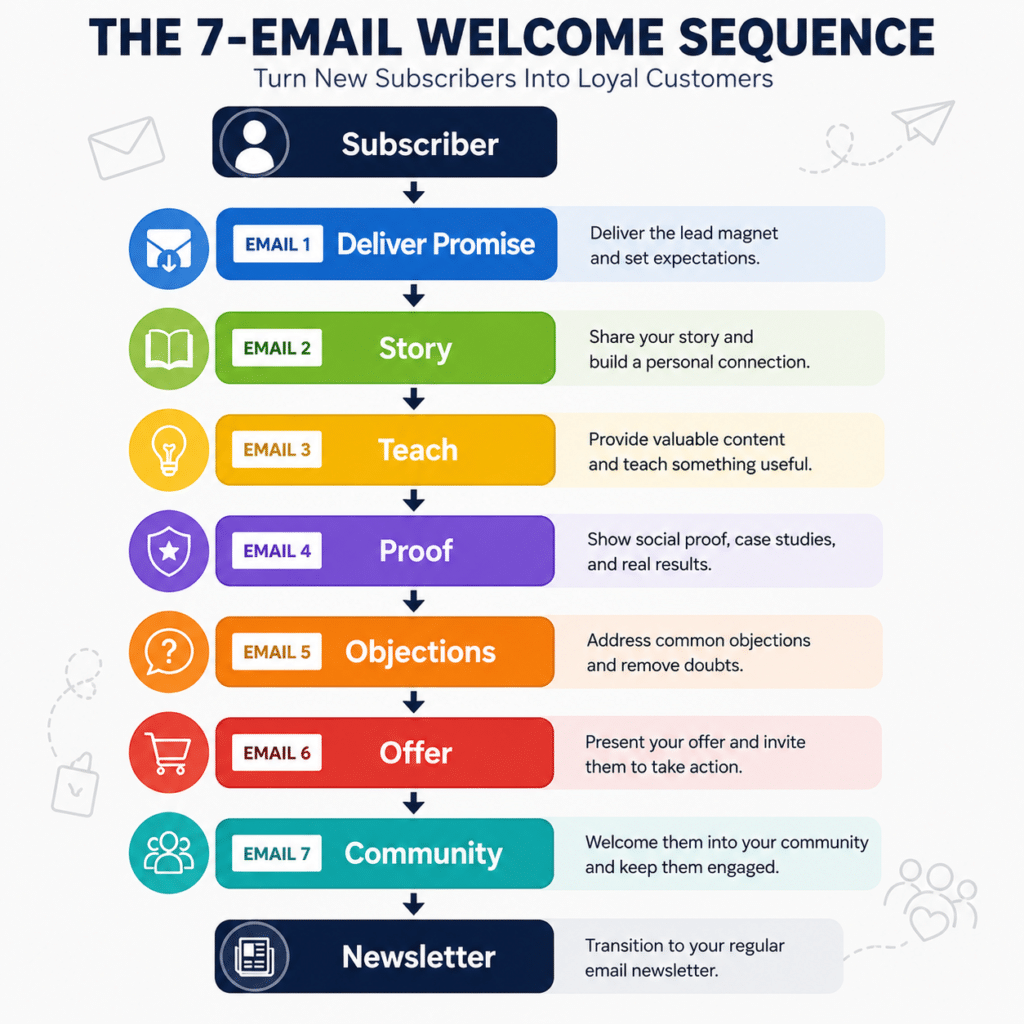
Email #1: Deliver the Promise Immediately
Goal
Build trust by delivering exactly what was promised.
Include
- Welcome message
- Download link
- Expectations
- Whitelist request
- Simple CTA
Example Subject Lines
- Welcome! Here’s Your Free Guide
- You’re In! Let’s Get Started
- Your Download Is Ready
- Thanks for Joining!
Sample Structure
Start by thanking subscribers for joining.
Immediately provide access to the promised resource.
Explain what they’ll receive over the next two weeks.
Encourage them to save your email address or move your message into their primary inbox.
Encouraging subscribers to add you to their contacts can improve inbox placement and aligns with Google’s email sender best practices.
Finally, invite them to reply with their biggest challenge.
This last step dramatically improves engagement while providing valuable market research.
Email #2: Tell Your Story
People connect with stories.
They don’t connect with sales pitches.
Instead of talking about your products, explain:
- Why you started your business
- The struggles you experienced
- The breakthrough you discovered
- How you help others today
Your story should make subscribers think:
“This person understands exactly what I’m going through.”
Don’t try to impress readers.
Aim to become relatable.
Email #3: Teach Something Useful
By now you’ve earned enough trust to start teaching.
This email should solve one specific problem.
Examples include:
- Three mistakes beginners make
- Five simple tips
- One overlooked strategy
- A quick tutorial
- A useful checklist
Subscribers should finish reading with a practical takeaway they can implement immediately.
Small wins create momentum.
Large walls of information create overwhelm.
Focus on one lesson.
Email #4: Show Proof
Anyone can claim they’re an expert.
Few can prove it.
This email is where testimonials, case studies, screenshots, reviews, and success stories become invaluable.
Include:
- Customer wins
- Before-and-after examples
- Revenue increases
- Time savings
- Performance improvements
For example:
“After implementing our welcome sequence, one client increased first-time customer conversions by 37% in less than 60 days.”
Stories outperform statistics because readers imagine themselves achieving similar results.
Email #5: Handle Common Objections Before They Become Roadblocks
By the fifth email, your subscribers know who you are, understand what you teach, and have received genuine value. Yet many still won’t take the next step—not because they aren’t interested, but because unanswered questions create hesitation.
This email is designed to eliminate friction.
Instead of pushing harder with sales copy, address the concerns that naturally arise before someone invests in your product or service.
Common Objections to Address
- “Will this work for someone like me?”
- “I don’t have enough time.”
- “I’m just getting started.”
- “I’ve tried similar solutions before.”
- “I can’t afford to make another mistake.”
- “How long before I see results?”
- “Is this too complicated?”
When you proactively answer these questions, subscribers feel understood. They no longer have to wonder if your solution is right for them—you’ve already shown them.
Subject Line Ideas
- Still on the Fence?
- Let’s Answer Your Biggest Questions
- Before You Decide…
- Wondering If This Will Work?
Email Structure
Start with empathy.
Acknowledge that it’s normal to have questions before making a decision.
Address your three to five biggest objections.
Use simple, conversational language.
Support your answers with proof.
Reference testimonials, case studies, or your own experience.
Close with reassurance.
Invite readers to reply if they have additional questions.
Example
One of the questions I hear most often is, “What if I’m just getting started?”
The truth is, beginners often see the biggest improvements because they’re building good habits from day one. You don’t need a massive audience—you need the right system.
Notice how this approach educates rather than pressures.
Email #6: Make the First Offer
Now it’s time to invite subscribers to become customers.
Notice the wording:
Invite—not pressure.
A welcome sequence isn’t about squeezing every dollar out of a new subscriber. It’s about offering the logical next step after you’ve demonstrated your expertise.
What Makes a Great First Offer?
The best introductory offer solves the next obvious problem.
For example:
- A course
- A coaching program
- A software trial
- A membership
- A consulting package
- A digital download
- A paid workshop
Avoid overwhelming readers with multiple choices.
One offer.
One call-to-action.
One outcome.
Subject Line Ideas
- Ready for the Next Step?
- Here’s How We Can Work Together
- Let’s Take This Further
- Your Next Move Starts Here
Framework
Problem
Restate the challenge your audience faces.
Solution
Introduce your product or service.
Benefits
Explain what they’ll gain.
Social Proof
Include testimonials or measurable results.
Call to Action
Make it easy to take the next step.
Optional Bonus
Adding a limited-time bonus can increase conversions without resorting to aggressive scarcity.
Examples include:
- Bonus templates
- Extra training
- Private Q&A session
- Additional downloads
- Extended support
The emphasis should remain on value rather than urgency.
Email #7: Welcome Them Into Your Community
Not everyone buys immediately.
That’s perfectly normal.
The purpose of your final welcome email is to keep subscribers engaged regardless of whether they’ve purchased.
Think of this email as the bridge between your onboarding sequence and your ongoing newsletter.
Include
- A thank you
- Your mission
- Community resources
- Your most popular content
- Ways to stay connected
Invite subscribers to:
- Follow you on social media
- Join your community
- Listen to your podcast
- Watch your videos
- Read your best articles
- Reply whenever they have questions
Your goal is simple:
Remain top of mind.
Subject Line Ideas
- Welcome to the Community
- Let’s Stay Connected
- You’re Officially Part of the Family
- Here’s What’s Next
Suggested Timing for the 7-Email Welcome Sequence
Timing matters almost as much as content.
Here’s a schedule that works well across most industries.
| Day | Goal | |
|---|---|---|
| Day 0 | Welcome | Deliver the promised resource |
| Day 1 | Your Story | Build trust |
| Day 3 | Educational Lesson | Demonstrate expertise |
| Day 5 | Social Proof | Build credibility |
| Day 7 | Overcome Objections | Remove buying barriers |
| Day 10 | First Offer | Generate conversions |
| Day 14 | Community Invitation | Encourage long-term engagement |
Avoid sending every email on consecutive days. Giving subscribers time to consume and apply your content makes the sequence feel more natural.
Welcome Email Templates You Can Customize
Email 1 Template
Subject: Welcome! Here’s Your Free Guide
Hi {{First Name}},
Thanks for joining!
As promised, here’s your download:
[Download Link]
Over the next two weeks I’ll send you practical strategies that will help you:
- Improve your results
- Avoid common mistakes
- Reach your goals faster
I’d love to know:
Simply reply and tell me your biggest challenge.
Talk soon,
Your Name
Email 2 Template
Tell your story.
Explain why you started.
Describe the turning point.
Share what changed.
Invite readers to continue the journey with you.
Email 3 Template
Teach one lesson.
Keep it practical.
End with one action item readers can implement immediately.
Email 4 Template
Share a customer success story.
Include measurable results whenever possible.
Show the transformation—not just the outcome.
Email 5 Template
Answer the questions you hear most often.
Be honest.
If your solution isn’t right for everyone, say so.
Authenticity builds trust.
Email 6 Template
Present your offer.
Explain who it’s for.
Describe the benefits.
Provide one clear button or link.
Email 7 Template
Thank subscribers.
Share your best resources.
Encourage continued engagement.
Transition them into your regular newsletter.
Accessibility Tip: Use meaningful link text, sufficient color contrast, descriptive alt text for images, and a logical heading structure so your emails remain accessible to all readers. The accessibility resources from WebAIM are an excellent reference.
How to Automate Your Welcome Sequence
The beauty of a welcome sequence is that you build it once and let automation do the work.
While automation saves time, make sure your emails comply with the FTC’s CAN-SPAM Act by including accurate sender information, a physical mailing address, and a clear unsubscribe option.
Most modern email marketing platforms make this straightforward.
Popular options include:
- Kit (formerly ConvertKit)
- Mailchimp
- ActiveCampaign
- AWeber
- GetResponse
- MailerLite
- Brevo
The automation workflow is simple:
- A visitor subscribes to your list.
- They receive Email #1 immediately.
- The remaining emails are sent according to your schedule.
- If they purchase, move them to a customer sequence.
- If they don’t purchase, transition them into your regular newsletter.
As your business grows, you can create separate welcome sequences for different lead magnets, audience segments, or product lines, ensuring every subscriber receives the most relevant content.
If you’re building your entire marketing ecosystem from the ground up, the Start Here guide is an excellent roadmap.
It walks through the foundational pieces that support long-term online business growth, including email marketing, funnels, and traffic generation.
Advanced Strategies to Increase Welcome Sequence Conversions
A basic welcome sequence can generate impressive results, but an optimized sequence can become one of your highest-converting marketing assets. Once your seven foundational emails are performing consistently, it’s time to refine and improve them.
The goal isn’t simply to send more emails—it’s to send the right message to the right subscriber at the right time.
Segment Your Audience Early
Not every subscriber joins your email list for the same reason.
Some are complete beginners looking for foundational education, while others are experienced professionals searching for advanced strategies. Sending identical emails to every subscriber limits your results.
Consider segmenting subscribers based on:
- Which lead magnet they downloaded
- Their business type
- Their experience level
- Products they’ve viewed
- Previous purchases
- Survey responses
- Geographic location
- Industry or niche
For example, someone who downloads a guide on lead generation may receive a different educational path than someone interested in affiliate marketing.
Personalization increases relevance, and relevance increases conversions.
Use Behavioral Triggers
Modern email platforms allow automation based on subscriber behavior rather than just time delays.
Behavioral triggers include:
- Opening an email
- Clicking a specific link
- Visiting a pricing page
- Downloading another resource
- Completing a purchase
- Watching a webinar
- Ignoring several emails
Imagine a subscriber clicks every educational email but ignores your sales offer.
Instead of continuing with generic content, you could automatically send additional case studies, testimonials, or FAQs before presenting the offer again.
Behavior-based automation creates a far more personalized customer experience.
Write Subject Lines That Earn Opens
Your emails can’t convert if they aren’t opened.
Just as important as getting an open is making your emails easy to read. Nielsen Norman Group’s usability research consistently shows that people scan digital content before deciding whether to engage with it.
The best subject lines are:
- Clear
- Curiosity-driven
- Benefit-focused
- Personal
- Short enough for mobile devices
Examples
Welcome Email
- Welcome! Here’s Your Guide
- You’re In!
- Let’s Get Started
Story Email
- Why I Almost Quit
- The Lesson That Changed Everything
- My Biggest Mistake
Educational Email
- Stop Making This Common Mistake
- Three Things You Should Do Today
- One Simple Improvement
Social Proof
- See What’s Possible
- A Customer Success Story
- Real Results
Offer Email
- Ready for the Next Step?
- Let’s Work Together
- Here’s How We Can Help
Avoid deceptive clickbait. The promise made in your subject line should always be fulfilled inside the email.
Personalization Beyond First Names
Adding a subscriber’s first name is helpful, but meaningful personalization goes much deeper.
Instead of:
Hi John,
Consider:
Since you downloaded our lead generation guide, I wanted to share another strategy that works especially well for service businesses.
That small change immediately makes the email feel more relevant.
Subscribers respond when they feel understood—not when they feel like one of thousands receiving the same message.
Common Welcome Sequence Mistakes
One of the biggest mistakes I see is businesses treating their welcome sequence like a brochure instead of a conversation. The first email shouldn’t sell—it should reassure subscribers they made the right decision. I’ve also found that asking a simple reply question in Email #1 often increases long-term engagement because mailbox providers recognize two-way conversations as positive signals.
Many businesses create a welcome sequence once and never revisit it. Unfortunately, that often leads to declining engagement over time. Avoid these common mistakes.
Selling Too Soon
One of the biggest mistakes is making your first email a sales pitch.
People subscribed because they wanted value.
Earn trust before asking for a purchase.
Too Much Information
Some marketers attempt to teach everything in one email.
Instead:
- One lesson
- One takeaway
- One call-to-action
Readers should finish every email knowing exactly what to do next.
No Personality
Corporate jargon doesn’t build relationships.
Write like a real person.
Imagine you’re helping one subscriber—not broadcasting to thousands.
Weak Calls-to-Action
Don’t assume readers know what to do next.
Every email should include a single, obvious action.
Examples include:
- Download the guide
- Read the article
- Watch the video
- Reply to this email
- Book a consultation
- Start your free trial
Clarity consistently outperforms cleverness.
Ignoring Replies
One overlooked benefit of welcome emails is the opportunity to start real conversations.
Encourage replies.
Then respond.
Those early conversations often become your most valuable customer insights.
A/B Testing Your Welcome Sequence
Never assume your first version is your best version.
Continuous testing can dramatically improve long-term results.
Test one variable at a time.
Subject Lines
Compare curiosity-based versus benefit-driven headlines.
Send Times
Morning versus afternoon.
Weekdays versus weekends.
Immediate versus delayed delivery.
Calls-to-Action
Button versus text link.
Short versus long copy.
Different colors.
Different wording.
Email Length
Some audiences prefer concise emails.
Others appreciate detailed educational content.
Let your data decide.
Key Metrics to Track
Every welcome sequence should be measured.
Pay attention to:
Open Rate
Indicates whether subject lines are compelling.
Click-Through Rate
Measures how many readers take action.
Reply Rate
One of the strongest indicators of trust.
Conversion Rate
How many subscribers become customers.
Revenue Per Subscriber
Often the most important metric of all.
Unsubscribe Rate
A sudden increase usually indicates poor targeting or excessive promotion.
Review these metrics quarterly and update your sequence as needed. Continual optimization is one of the cornerstones of sustainable email marketing.
Where a Welcome Sequence Fits in Your Marketing Funnel
A welcome sequence is only one part of a successful digital marketing system.
The broader journey often looks like this:
- A visitor discovers your website through search, social media, or referrals.
- They download a valuable lead magnet.
- They enter your welcome sequence.
- They consume educational content.
- They become a customer.
- They receive onboarding emails.
- They become repeat buyers and advocates.
If you’re developing this broader ecosystem, explore the Promote section on Internet Marketing Muscle for strategies on driving qualified traffic from SEO, content marketing, and other digital channels.
You’ll also find foundational digital marketing resources in the Internet Marketing Foundations category.
Together, these resources complement a strong email marketing strategy by helping you attract the right audience before they ever enter your welcome sequence.
Want to master every aspect of email marketing?
Explore our Email Marketing Hub for in-depth guides on list building, lead magnets, email automation, segmentation, copywriting, deliverability, and conversion optimization.
Frequently Asked Questions
How many emails should a welcome sequence include?
Seven emails provide enough touchpoints to build trust, educate subscribers, establish authority, and introduce an offer without overwhelming new readers. Businesses with longer sales cycles may expand the sequence to 10–12 emails, but seven is an excellent starting point.
How long should a welcome sequence last?
Most businesses spread their welcome sequence across 10 to 14 days. This cadence keeps your brand top of mind while giving subscribers enough time to consume your content and take action.
Should every email contain a sales pitch?
No. Most emails in your sequence should focus on delivering value, building credibility, and strengthening the relationship. A well-balanced sequence earns trust first and introduces relevant offers only after demonstrating expertise.
Can I reuse this sequence for different lead magnets?
Absolutely. The structure remains the same, but the examples, educational content, and offers should be tailored to the subscriber’s interests. This creates a more personalized experience and typically improves engagement and conversion rates.
How often should I update my welcome sequence?
Review performance at least every 90 days. Refresh outdated examples, replace underperforming subject lines, update statistics, improve calls-to-action, and add new customer success stories. Regular updates help maintain relevance and align with SEO and AI content best practices.
Conclusion
Your welcome sequence is far more than a series of automated emails—it’s the first real relationship your business builds with every new subscriber. Done well, it establishes trust, demonstrates expertise, and creates a natural path from curiosity to conversion.
By delivering immediate value, telling your story, educating consistently, showcasing real customer results, addressing objections, and making a thoughtful offer, you create an experience that subscribers appreciate rather than ignore.
Treat your welcome sequence as a living asset. Test it, refine it, and update it regularly based on subscriber behavior and performance data. Small improvements in open rates, click-through rates, and conversions can compound into significant revenue growth over time.
If you’re serious about building an email list that becomes one of your most valuable business assets, make your welcome sequence a priority. Start with the framework in this guide, customize it for your audience, and continue optimizing as your business grows.
Build Your Welcome Sequence in Minutes with AI
Why start from a blank page when AI can do the heavy lifting? Our AI Hand Tools give you access to professionally crafted prompts and workflows that help you write high-converting welcome emails, subject lines, lead magnets, sales copy, and more—without the guesswork.
 Explore AI Hand Tools and start building smarter email campaigns today:
https://internet-marketing-muscle.com/ai-hand-tools/