First 90 Days Online
Internet Marketing Foundations

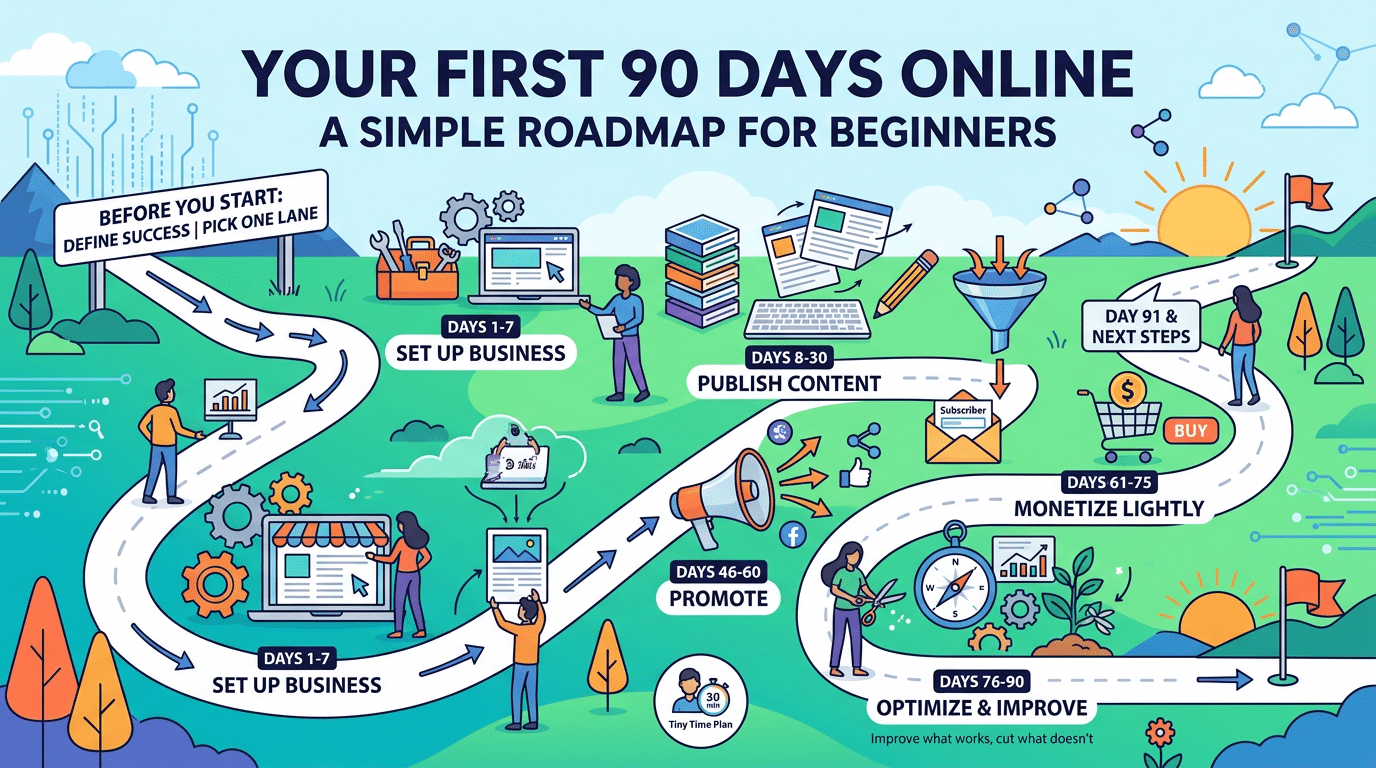
Your First 90 Days Online: A Simple Roadmap for Beginners

If you’re new to making money online, here’s the truth: you don’t need a “perfect brand,” a $997 course, or 14 tools you’ll forget to log into.

You need a simple plan for your first 90 days online that builds real assets:

  • a home base you control (website or channel)
  • content that answers real questions
  • an email list you own
  • one monetization method you can test without being weird about it

That’s it.

Quick Answer (read this if you’re in a hurry)

In your first 90 days, focus on setup → publish → list building → promotion → light monetization → optimization. Publish 8–12 helpful pieces, build 100+ subscribers, and test one monetization method. Consistency beats “genius” every time.

I suggest you read my Start Here guide, as well.


Key Takeaways for Your First 90 Days Online

  • Your win in 90 days is assets + momentum, not perfection.
  • Pick one lane for 90 days (no business-model roulette).
  • Publish 8–12 pieces that solve specific problems.
  • Build your email list early (100+ subscribers is the first real milestone).
  • Add one monetization method and let data tell you what to do next.

Before You Start: What “Success” Looks Like in 90 Days

If you don’t define “success,” your brain will define it as: “I watched 47 videos and still haven’t posted anything.”

Here’s what success actually looks like by Day 90:

  • A functional website or channel (not fancy—functional)
  • 8–12 published pieces that solve real problems
  • 100+ email subscribers
  • One monetization method live (affiliate, service, or a simple product)
  • Basic tracking so you’re not guessing

That’s enough to prove you can do the three things that matter: create → distribute → convert.

No vanity goals. No “I need 10,000 followers first.” You’re building a system that can be repeated, improved, and scaled.


The Only Rule: Pick One Lane for 90 Days (No Model-Hopping)

Most beginners don’t fail because they’re lazy. They fail because they’re trying to do everything:

  • affiliate marketing
  • a YouTube channel
  • a course
  • a newsletter
  • and a coaching offer

All at once.

Pick one primary lane for 90 days. You can add more later—after you can prove you can drive traffic and get clicks. Here’s a reality-check table:

ModelTime to First DollarsBest ForBiggest Trap
Content + Affiliate60–90 daysbuilders who like writing/videoquitting too early
Freelance/Services14–30 daysfast cash + skill-basedgetting stuck selling time
Digital Products60–120 daysleverage + expertisebuilding before audience
YouTube/Podcast60–120 dayspersonality + trustinconsistency

Pick one lane. Commit. Ignore the shiny objects. Your future self will thank you.

You may find this post helpful: Affiliate Marketing in 2026: What Works Now (and What Died)


Days 1–7: Set Up the Minimum Viable Online Business

This week is about infrastructure, not perfection. Minimum viable business = three things:

  1. Home base (website or channel)
  2. Email capture (opt-in form + basic welcome email)
  3. A plan to publish content (topics + schedule)

Your Days 1–7 checklist

  • Choose your platform (WordPress / YouTube / newsletter — pick ONE primary)
  • Set up a simple homepage + about + contact (keep it basic)
  • Set up email capture (one form + one thank-you page)
  • Write a short “Start Here” style post/page (even if it’s rough)
  • Pick your first 10 content ideas (problem-based, not “my journey” posts)
  • Publish your first piece by Day 7 (yes, even if it’s ugly)

Checkpoint: If you haven’t published anything by Day 7, you’re still “preparing,” not building.

Looking for “Tools I Use?” Get them here.


Days 8–30: Publish Your Foundation Content (and Stop Overthinking It)

This is where most people choke—because publishing makes it real. Your job for Days 8–30 is simple:

Publish 2–3 pieces per week until you hit 8–12 total. Each piece should do one thing: solve one problem for one type of person.

What to publish (easy mode)

  • 3 beginner “how to” posts
  • 3 “mistakes to avoid” posts
  • 2 “best tools / best resources” posts (only if you can be honest)
  • 2 “start here / roadmap” style posts (like this one)

Simple publishing rules

  • short paragraphs (readable)
  • clear headings
  • one main point per section
  • include a next step (comment / subscribe / download)

Checkpoint: By Day 30 you should have content worth linking to. Not a perfect library. A real one.

Take a look at my Publish page. It has some good ideas. You can learn about SEO (and AEO, or “answer engine optimization“) here.


Days 31–45: Build Your Email List Before You “Need” It

If you wait to build your list “until you have something to sell,” you’ll discover the fun problem of having… nobody to sell to. Email is the asset you own. Social is rented land.

What you build in this phase

  • 1 simple lead magnet (checklist, swipe file, template, short guide)
  • 2–3 opt-in placements (end of posts + sidebar + start-here page)
  • A basic welcome sequence (3 emails is plenty)

Here’s a clean rollout:

WeekFocusDeliverable
Week 5Lead magnet1 downloadable freebie
Week 6Opt-ins3–5 placements across your site/content
Week 7Welcome emails3-email welcome sequence
Week 8PromotionMention lead magnet in every new post/video

Checkpoint: Aim for your first 25 subscribers by Day 45. If you hit 100, you’re rolling.

I have some free reports here that you can use in your email marketing. I don't care if you copy & paste. Just make the final copy in your voice.

I have more about Email Marketing here.


Days 46–60: Add Simple Promotion That Actually Moves the Needle

This is where traffic starts showing up if you do promotion like an adult. You don’t need 12 platforms. You need 2.

Pick:

  • one “home” platform (your main site/channel)
  • one “distribution” platform (where your people already hang out)

Examples:

  • Blog + Pinterest
  • YouTube + Shorts
  • Blog + Facebook groups
  • Newsletter + X/Threads/LinkedIn

The simple promotion loop

Every time you publish:

  1. Share it on your distribution platform
  2. Turn it into 2–3 smaller posts/snippets
  3. Reply to comments / DMs
  4. Send it to your email list (even if it’s tiny)

Checkpoint: By Day 60, you should be able to point to some consistent traffic source—even if it’s small.

You may find my Promote page helpful.


Days 61–75: Light Monetization (Without Becoming a Sales Robot)

Monetization in the first 90 days should feel like this:

“Here’s what I use and why. If you want it, cool. If not, also cool.”

Start with one method:

  • Affiliate links (easiest)
  • Service offer (fastest cash)
  • Simple product (template/checklist/mini-guide)

A smart way to monetize without being cringe

  • Add affiliate links only where they naturally belong (tools/resources pages, tutorials)
  • Add one “recommended resources” section to your best posts
  • Send one email that says: “Here’s what I use for X” (helpful, not pushy)
Monetization MethodBest ForWhat to Track
Affiliatebeginnersclicks + conversions
Servicesquick revenueinquiries + calls booked
Simple productleveragesales page views + sales

Checkpoint: By Day 75, you should have something monetized—even lightly. This is a pretty good post about pre-selling. If you don't know what that means, you really should read it 🙂 I also have some affiliate marketing posts here.


Days 76–90: Improve What’s Working and Cut What Isn’t

Now you stop guessing and start optimizing. Pull the simplest numbers:

  • top 3 posts/videos by views
  • top 3 by clicks (if you’re tracking)
  • emails with highest opens/clicks
  • any page bringing opt-ins

Your optimization plan

  • Create 2 more pieces similar to what’s already working
  • Improve your top content (better headline, better intro, clearer CTAs)
  • Add internal links between related posts
  • Kill anything that’s going nowhere (or stop spending time on it)

This is where businesses become real: not when you “feel ready,” but when you improve based on results.

This “Profit” page is good. Read it.


If You Only Have 30 Minutes a Day: The “Tiny Time” Plan

Thirty minutes a day beats five hours once a week. Every time. Here’s the exact tiny-time formula:

  • Minutes 1–10: Create (write 150–250 words, outline a section, record a short clip)
  • Minutes 11–20: Publish or schedule (post it, or prep it for tomorrow)
  • Minutes 21–30: Promote + engage (share it, reply to 3 people, comment in 1 community)

Do that daily for 90 days and you’ll look up and realize you built a real asset.

Don't forget about using AI. It's a useful tool. But treat it as such. It is NOT a panacea.


FAQ + Next Steps: What to Do on Day 91

Day 91 isn’t a finish line. It’s when you finally have enough data to make smart moves.

What should I do on Day 91?

  • Double down on your best-performing topic
  • Publish 2× more content in that direction
  • Expand your lead magnet and opt-in placements
  • Build a simple “money page” (resources, offer, or product)

Should I quit my job to do this?

No. Not yet. Prove you can publish, get traffic, and convert first.

How much money do I need to start?

You can start with almost nothing, but expect some basic costs eventually (domain/hosting/email). Start lean, upgrade later.

What if I picked the wrong niche?

If you’re getting zero engagement after consistent publishing, you might need a pivot. But don’t pivot because you’re bored—pivot because the market is silent.

Can I switch business models mid-way?

Only if you have data that shows your model is a bad fit. Otherwise, stick the 90 days. Model-hopping is the fastest way to stay broke.

Tools I Use

Here are six tools I use in my business. I think they could help you, too.


Conclusion

In 90 days, you won’t feel “ready.” Nobody does. But you can be in a position most people never reach:

  • published content
  • a list you own
  • a promotion routine
  • a monetization method you can test and improve

That’s not motivation. That’s a business foundation. Next step: Start with your Day 1–7 checklist and publish your first piece this week.

I encourage you to read “Build a Business, Not a Dependency“. Too often, we start a business only to become an employee. Don't do that. Be the OWNER. There is a difference.
Read More
PPP vs. CTPM
Internet Marketing Foundations

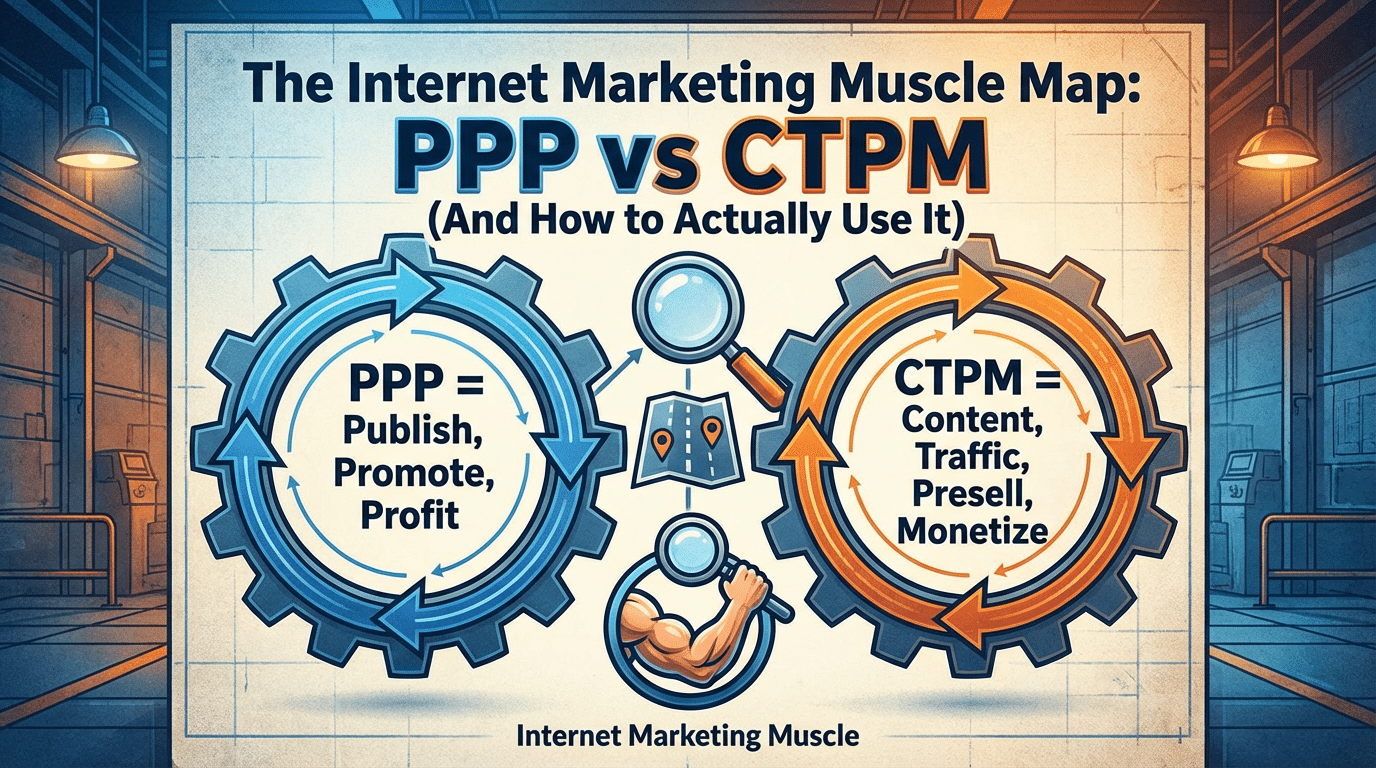
The Internet Marketing Muscle Map: PPP vs CTPM (And How to Actually Use It)


If you’ve been doing “a little SEO,” posting on social when you remember, tweaking your homepage, buying another tool, watching another affiliate video, and then wondering why nothing compounds…

Congrats. You’ve mastered random acts of marketing.

It feels productive because you’re always doing something. But your results look like a heart monitor for a houseplant.

You don’t need more tactics. You need a map — a simple framework that tells you what to do next, what to ignore, and why your “busy” isn’t turning into money.

Two maps do that better than anything else on this site:

  • CTPM (Content → Traffic → Pre-Sell → Monetize)
  • PPP (Publish → Promote → Profit)

Pick one, run it end-to-end, and you’ll start spotting bottlenecks like they’re glowing in the dark.

Start here if you’re brand new: https://internet-marketing-muscle.com/start-here/
And yes, you should be building your list: https://internet-marketing-muscle.com/subscribe/

The Problem: Random Acts of Marketing

Uncoordinated tactics don’t create a path from attention → trust → clicks → cash.

They create noise.

And noise is the easiest thing to generate online. There’s a whole internet full of people generating noise like it’s their job. (Sometimes it literally is.)

Here’s what random acts of marketing look like:

  • You publish a post with no purpose.
  • You promote “a little” everywhere with no consistent loop.
  • You mention an offer once and hope it magically converts.
  • You change tools because you’re bored, not because you have a system.
  • You measure the wrong thing (or nothing), so you can’t diagnose what’s broken.

You don’t fix this by “trying harder.” You fix it by running one framework on purpose.

That’s what PPP vs CTPM are: rulebooks that force you to build a chain instead of a junk drawer.

Two Frameworks, One Game

PPP and CTPM aren’t rival religions. They’re two ways of describing the same game:

  • You create something valuable.
  • You get the right people to see it.
  • You earn trust before you ask for the click.
  • You monetize in a way that matches the promise.

The difference is how they help you think.

  • CTPM is a full funnel narrative. It keeps you honest about trust and sequencing.
  • PPP is a tight operating loop. It helps you execute fast and iterate like a grown-up.

Understanding the differences between PPP vs CTPM can significantly enhance your marketing strategy.

CTPM is best when you need compounding growth and long-term trust.
PPP is best when you need focus, speed, and measurable iteration.

And yes — you can use both. But only if you know which one you’re running right now.

CTPM Explained (Content → Traffic → Pre-Sell → Monetize)

CTPM is the “build the engine” framework.

Understanding the differences and applications of PPP vs CTPM will elevate your marketing strategy.

Content

Content is not “thought leadership.” Content is answers.

It’s publishing things people actually want:

  • How-to posts
  • comparisons
  • checklists
  • “what to do next” guides
  • system explanations

If you’re publishing content nobody searches for, nobody shares, and nobody cares about… that’s not noble. That’s just invisible.

(If you want the modern search reality, read this: https://internet-marketing-muscle.com/seo-aeo/seo-vs-aeo-in-2026-how-to-rank-in-google-and-get-cited-by-ai/)

Traffic

Traffic is not “post everywhere.”

Traffic is deliberate distribution:

  • SEO
  • email
  • social repurposing
  • partnerships
  • communities

And traffic isn’t just volume. It’s the right people arriving with the right expectation.

Pre-Sell

Pre-sell is where most internet marketers faceplant, because they go straight to “buy now.”

Pre-sell means you:

  • clarify the problem
  • show the path
  • handle objections
  • earn micro-commitments (subscribe, download, reply, click)

Pre-sell is the difference between “affiliate links everywhere” and actual conversions.

This one nails the concept fast: https://internet-marketing-muscle.com/copywriting-sales/the-60-second-trick-that-turns-any-post-into-a-pre-sell-machine/

Monetize

Monetize is last — because monetization works best when it’s the natural next step.

That could be:

  • affiliate offers
  • your own products
  • memberships
  • consulting
  • tools you use and recommend

If you monetize too early, you sound like every other MMO blog that “reviews” products they’ve never touched.

If you want the modern affiliate reality check: https://internet-marketing-muscle.com/affiliate-marketing/affiliate-marketing-in-2026-what-works-now-and-what-died/

PPP Explained (Publish → Promote → Profit)

PPP is the “run the loop” framework.

It’s what you use when you’re tired of theory and you want a weekly operating system.

Publish

Publish one focused asset.

Not five half-drafts. Not “content vibes.” One thing with one job:

  • rank for a query
  • pre-sell an offer
  • drive a lead magnet opt-in
  • convert a buyer

This is why your pillars matter:
https://internet-marketing-muscle.com/publish/

Promote

Promote is where most creators quietly die.

They publish… then they stare at the post like it owes them money.

Promotion is a repeatable loop:

  • email your list
  • repurpose for social
  • link internally from relevant posts
  • add it to your hub pages
  • re-share later with a new angle

This is the stage most people skip, then blame the algorithm.
https://internet-marketing-muscle.com/promote/

Profit

Profit means you intentionally convert.

That means:

  • clear CTAs
  • relevant offers
  • smart internal links
  • follow-up (usually email)
  • tracking what actually drives action

And if you don’t have an offer yet? Your first offer can be affiliate. Just do it clean.
https://internet-marketing-muscle.com/profit/
Your products hub lives here: https://internet-marketing-muscle.com/sales/

The Overlay: How PPP Maps to CTPM

Here’s the “overlay” view — the cleanest way to understand how they relate:

  • PublishContent
    The asset you control.
  • PromoteTraffic
    The distribution you can repeat and scale.
  • ProfitPre-Sell + Monetize
    Persuasion + conversion, backed by follow-up.

This is why I like teaching both:

  • CTPM forces you to respect the full journey.
  • PPP forces you to stop “planning” and start shipping loops.

If you ever feel stuck, ask one question:

Which stage am I pretending I’m in?

Because most people are trying to “optimize Profit” when they haven’t even built a real Publish or Promote system yet.

Example #1: The Total Beginner

If you’re brand new, your biggest enemy is not failure.

It’s whiplash.

One minute you’re learning SEO. Next minute you’re setting up email automation. Then you’re 14 tabs deep into tool comparisons and somehow you still haven’t published a single piece of content.

Here’s the beginner move:

Run PPP for 30 days.

  • Publish: 3 useful posts that answer real questions in your niche
  • Promote: share each post twice (once when it goes live, once a week later)
  • Profit: pick one affiliate offer or lead magnet to connect to your content

Don’t try to build “a brand.” Build proof of motion.

Start here: https://internet-marketing-muscle.com/start-here/
Grab a free report so you have something to offer immediately: https://internet-marketing-muscle.com/free-reports/

And if you’re wondering what tools to use without going broke: https://internet-marketing-muscle.com/six-tools/

Example #2: Traffic Is Up, Money Is Not

This is the most common phase for bloggers and affiliate marketers.

Traffic goes up. Revenue doesn’t.

That usually means one of three things:

  1. Wrong traffic
    You’re attracting people who love reading but will never buy.
    Fix: tighten your topic selection and message-match your intro.
  2. No pre-sell
    Your content is informative but doesn’t move readers toward a decision.
    Fix: add intent blocks, objections, and “what to do next” CTAs.
  3. Weak offer connection
    You mention an offer like it’s an afterthought.
    Fix: make the offer the natural next step (and explain why).

If you want two great “bridge” concepts for monetization:

Then come back and ask: “Where is the leak — click, opt-in, or purchase?”

Example #3: The AI Tool Hoarder

AI can help you publish faster.

It can also turn you into a full-time settings manager.

If you have five writers, three dashboards, two email platforms, and none of them connect to a single offer…

You don’t have a marketing system. You have a subscription collection.

Here’s how to fix it using the map:

  • Publish: pick one primary workflow (outline → draft → polish → publish)
  • Promote: pick one repeatable distribution loop (email + 2 socials + internal links)
  • Profit: pick one monetization path (affiliate, product, lead magnet) and track it weekly

This is why your tools need to serve the system — not become the system.

If AI is your lane, start with:
https://internet-marketing-muscle.com/ai-for-marketers/build-your-ai-powered-blog-in-2025/

And don’t skip the “modern search” part:
https://internet-marketing-muscle.com/seo-aeo/seo-vs-aeo-in-2026-how-to-rank-in-google-and-get-cited-by-ai/

The Bottleneck Diagnosis (Find What’s Actually Missing)

Here’s the rule:

You’re not “bad at marketing.” You just have a bottleneck.

So diagnose it like a builder, not a vibes-based optimizer.

Pick one primary path, like:
Post → Opt-in → Follow-up → Offer

Then find the first steep drop.

If the bottleneck is PUBLISH

Symptoms:

  • inconsistent posting
  • lots of drafts, few published assets
  • unclear niche or unclear content purpose
  • content that doesn’t answer real questions

Fixes:

  • commit to one publishing cadence (even 1/week)
  • use a content system (traffic / pre-sell / list / sale)
  • build a real internal linking plan (stop orphan posts)
  • focus on “answer content,” not thought pieces

Start here:
https://internet-marketing-muscle.com/publish/

If the bottleneck is PROMOTE

Symptoms:

  • “I post but nobody sees it”
  • traffic spikes then disappears
  • you rely on one platform
  • you don’t re-share, repurpose, or email consistently

Fixes:

  • build a weekly promotion loop
  • repurpose every post into multiple assets
  • use internal links to create compounding traffic
  • build your list so you have direct distribution

Start here:
https://internet-marketing-muscle.com/promote/
And yes, build your list:
https://internet-marketing-muscle.com/subscribe/

If the bottleneck is PROFIT

Symptoms:

  • traffic but low clicks
  • clicks but no opt-ins
  • opt-ins but no sales
  • unclear CTA, weak offer connection, no follow-up

Fixes:

  • strengthen pre-sell (objections + “what to do next”)
  • move CTAs closer to intent blocks
  • match offers to the exact promise of the content
  • follow up by email like you actually want this to work

Start here:
https://internet-marketing-muscle.com/profit/
Offers hub:
https://internet-marketing-muscle.com/sales/
Free lead magnets (to build your list while you build your offers):
https://internet-marketing-muscle.com/free-reports/

FAQs:

How do I know whether to use PPP or CTPM?

Use CTPM when your main problem is attention and trust (you need people to find you, stick around, and believe you). Use PPP when your main problem is execution and iteration (you need a weekly loop you can run, measure, and tighten). If you’re not sure, start with PPP for 30 days so you stop drifting.

Can I use PPP and CTPM at the same time?

Yes — but only if they’re doing different jobs.
CTPM is your “full journey” lens (content → traffic → pre-sell → monetize). PPP is your “weekly operating loop” (publish → promote → profit). The mistake is mixing them without defining the objective, which creates mismatched content, weak CTAs, and confused promotion.

What if I’m getting traffic but no clicks or sales?

That’s almost never “bad luck.” It’s usually message-match, pre-sell, or offer fit.
Fix in this order:

  1. tighten the promise (headline + intro),
  2. add pre-sell blocks (objections + next-step CTAs),
  3. make the offer the natural next step,
  4. follow up by email.

What’s the fastest way to find my bottleneck?

Pick one path and trace it: Post → Opt-in → Follow-up → Offer.
Then find the first steep drop:

  • impressions → clicks (Publish/Promote issue)
  • clicks → opt-ins (Pre-sell/offer clarity issue)
  • opt-ins → sales (Profit/follow-up issue)
    Fix the first drop before you “optimize” anything else.

I’m overwhelmed — what should I do first this week?

Do one simple PPP cycle:

  • Publish: one useful post (or improve your best existing one)
  • Promote: email it + share it twice + add 3 internal links
  • Profit: add one clear CTA to Subscribe/Free Reports (or a relevant offer)
    Then repeat next week. Consistency beats hero mode.

Your Next Step: Pick Your Stage and Move

Here’s how you get unstuck fast:

Pick the stage you’re in — and do the matching work.

If you need PUBLISH

Read: https://internet-marketing-muscle.com/publish/
Then write one useful post this week. One. Not five drafts.

If you need PROMOTE

Read: https://internet-marketing-muscle.com/promote/
Then run a simple weekly loop: email + repurpose + internal links.

If you need PROFIT

Read: https://internet-marketing-muscle.com/profit/
Then add one clear CTA to your best post and follow up with your list.

If you’re not sure which stage you’re in, start here:
https://internet-marketing-muscle.com/start-here/

Grab a free report so you have a clean next step for readers:
https://internet-marketing-muscle.com/free-reports/

And if you haven’t subscribed yet… stop pretending you’re above email lists:
https://internet-marketing-muscle.com/subscribe/

Finally, read more about internet marketing foundations here.

Read More