Table of Contents
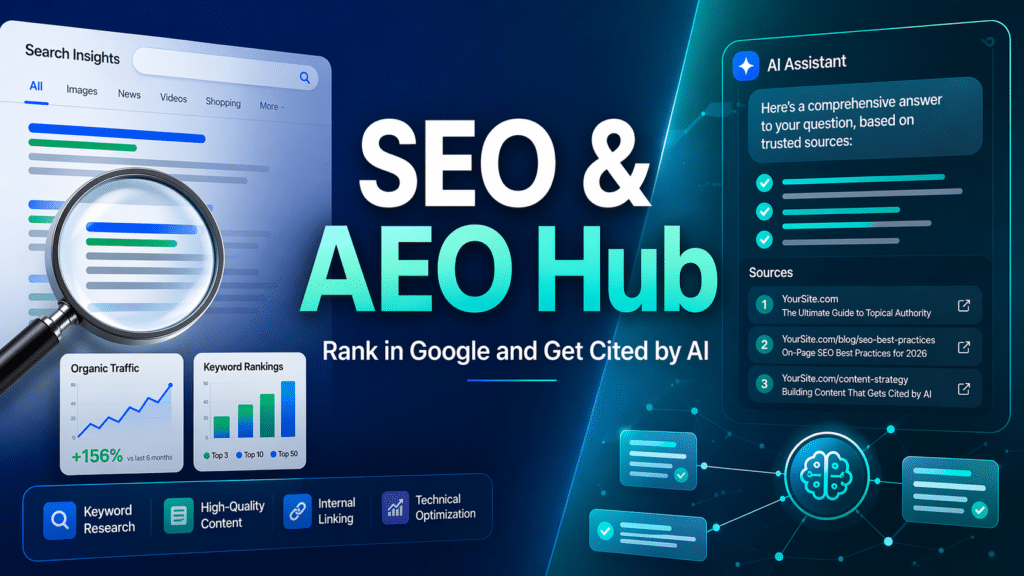
In 2026, you’re not competing on Google alone. You’re competing to become the answer—and the source AI systems feel safe pulling from. That means you need two skills working together:
- SEO: rank in search (so humans can find you)
- AEO: structure answers so AI can extract and cite you (so you earn authority even when clicks get weird)
If you’re brand new to the site, start here: Start Here.
If you want the shortcuts and systems: Free Reports.
Key Takeaways
- SEO gets you ranked. AEO gets you quoted. You want both.
- Win by matching intent and structuring content so answers are obvious.
- Topic clusters + internal links are how your site stops feeling random.
- “Trust signals” aren’t fluff—they’re what keeps you from being ignored.
- Most ranking jumps come from improving what you already published, not from pumping out more posts.
What This Hub Is (and How to Use It)
This hub is not a dictionary entry for SEO. It’s a roadmap. Use it like this:
- Read the plain-English difference between SEO and AEO
- Run the quick wins checklist on ONE page this week
- Build topic clusters so your site becomes a library (not a junk drawer)
- Follow PPP so traffic turns into subscribers and commissions
If you want the “big picture” pillars this connects to:
SEO vs AEO: The Plain-English Difference
SEO (Search Engine Optimization) is how you rank in Google results. You win by matching intent, using clear structure, and building authority over time.
AEO (Answer Engine Optimization) is how your content gets extracted into AI answers. You win by making answers easy to pull, easy to verify, and easy to attribute.
Here’s the difference without the marketing perfume:
| Factor | SEO | AEO |
|---|---|---|
| Primary goal | Rank for searches | Get cited/quoted in answers |
| What “wins” | Relevance + structure + authority | Clear answers + trustworthy formatting |
| Best content style | Comprehensive, intent-matched | Answer-first, scannable, verifiable |
| Timeframe | Weeks to months | Ongoing (varies by platform + visibility) |
If you want to build a business that isn’t dependent on one traffic source, this matters: Build a Business, Not a Dependency.
The 2026 Reality: Rankings Aren’t the Whole Game
Google still matters. A lot. But now your visibility can come from:
- search results
- “AI answers”
- summaries and citations people share
So your job is no longer “rank first.” Your job is: be the clearest, most useful source in your niche.
That’s what makes both humans and machines trust you.
Start Here: The Fastest Path to Better SEO (and Better AEO)
If you’re starting from scratch, don’t chase 14 tactics at once. Do this:
Step 1: Pick one topic you can own
Not “marketing.” Not “fitness.” Something tight enough to build authority.
If you need a structured plan, start here: Your First 90 Days Online
Step 2: Publish one cornerstone post
Then publish supporting posts that answer the sub-questions.
Step 3: Promote the post for a full week
Because “publish and pray” is not a strategy. Use this: Turn Your Blog Into a Traffic Engine: The Weekly Promotion Loop
Step 4: Add internal links so it compounds
Internal links are how your content stays alive longer than 24 hours.
The “Answer-Ready” Structure That Gets Cited
If you want your content to show up in answers, you have to stop writing like you’re trying to win a creative writing contest. Use this structure on important posts:
- Answer fast (don’t bury the point)
- Define key terms (don’t make people guess)
- Use scannable sections (bullets, steps, tables)
- Add a small FAQ (the exact questions people ask)
- Finish with next steps (where should they go now?)
If your post is 2,000 words of “set the stage” and 12 words of actual answer, AI will politely ignore you. So will humans.
Topic Clusters: How This Site Builds Topical Authority
A topic cluster is simple:
- One main post covers the big topic
- Supporting posts cover the sub-questions
- Everything links together so your site feels organized
The point isn’t “more content.” The point is connected content. That’s how you build a site that Google understands and readers can actually navigate.
This is the same thinking behind your PPP system:
Internal Linking Rules That Make Google Understand Your Site
Internal linking is not decoration. It’s architecture.
Use these rules:
- Every post links to a pillar (Publish, Promote, or Profit)
- Every post links to its “next step” (one related post that continues the thought)
- Every post links to one conversion path (Free Reports, Subscribe, or a relevant offer)
- Use descriptive anchors (not “click here”)
- Update older posts to link forward to newer posts (compounding traffic)
If you want a simple habit that helps you stay consistent with all of this, read: The 2-Minute Morning Rule That Quietly Moves Your Business Forward
On-Page SEO Quick Wins
You don’t need 97 SEO tricks. You need the basics done well. Run this checklist on your next post (or one old post this week):
- Title matches intent (what they actually want)
- Intro answers fast (no 300-word throat clearing)
- Clear H2s (each section has a job)
- One table or checklist (adds “information gain”)
- 3–5 internal links (pillar + related + conversion)
- A short FAQ (5 questions max)
AEO Boosters: FAQs, Definitions, and Clean Summaries
If you want your content to be extractable:
- Add a short definition early
- Add a “quick summary” block
- Add FAQ questions that match real searches
- Keep answers tight and direct (40–70 words)
AEO is not “write for robots.” AEO is: make your content easy to understand and hard to misinterpret.
What to Track (Without Becoming a Spreadsheet Goblin)
Don’t obsess daily. Watch trends weekly. Track:
- organic traffic (which pages are growing)
- clicks from email (what actually drives visits)
- which posts lead to opt-ins
- which topics generate multiple pageviews per session (internal linking working)
If you want more subscribers (and more predictable traffic), your “next step” is always: Subscribe
…and keep your best magnets here: Free Reports
Common Mistakes That Keep Posts Stuck on Page 3
Here are the repeat offenders:
- Writing for “everyone” (so no one cares)
- Weak intent match (the post answers a different question than the title implies)
- Orphaned posts (no internal links pointing in or out)
- Vague headings (Google can’t parse “Everything You Need to Know”)
- No updates (content gets stale, rankings drift)
Your next ranking jump usually comes from rewiring old posts, not publishing 40 new ones.
Next Steps: What to Do This Week
Pick one post and do this:
- Rewrite the intro to answer faster
- Add one table or checklist
- Add 3–5 internal links (pillar + related + conversion)
- Add a short FAQ
- Promote it for a week using the loop: Turn Your Blog Into a Traffic Engine: The Weekly Promotion Loop
If you want more context on monetization once traffic starts showing up, read:
- Affiliate Marketing in 2026: What Works Now (and What Died)
- Affiliate Sales System Blueprint: From First Click to First Commission
Frequently Asked Questions
Should I optimize for Google or AI first?
Google first. It’s still the most consistent traffic engine. But if you structure content clearly (definitions, steps, FAQs), you’re also helping AEO automatically. Think foundation first, then polish.
How often should I update old posts?
Quarterly is a good rhythm for your important pages. Update what’s ranking, what’s converting, or what’s close to ranking. Don’t “refresh everything.” Refresh what pays you back.
Can I rank without topic clusters?
Yes, sometimes. But clusters speed up authority, improve internal navigation, and give Google clearer context. A site with clusters feels like expertise. A site without clusters feels like randomness.
How do I know if my content is getting cited in AI answers?
Don’t chase perfect tracking. Watch for patterns: pages that suddenly get more branded searches, direct traffic spikes, or weird new queries in Search Console. The goal is more visibility and trust—not building an “AI citation dashboard” that becomes your new procrastination hobby.
What’s the fastest “quick win” on a struggling post?
Rewrite the first 150–250 words to answer the question faster, then add internal links and a short FAQ. Most posts don’t fail because they’re too short—they fail because they’re unclear.
Conclusion
You don’t need to “pick SEO or AI.”
You need a site that’s clear, organized, and useful enough to be trusted everywhere.
Build topic clusters. Add internal links. Promote posts for a full week. Track what matters. Repeat.
If you want help choosing what to write next, start with: Blog or Start Here.